

- Updated: July 19, 2026
- 6 min read
MultiFair: Multimodal Balanced Fairness-Aware Medical Classification with Dual-Level Gradient Modulation
Direct Answer
MultiFair is a novel multimodal learning framework that simultaneously balances the contribution of different data sources and enforces demographic fairness in medical classification tasks. By modulating gradients at both the modality and group levels, it prevents any single modality or patient subgroup from dominating the learning process, leading to more reliable and unbiased diagnostic models.
Background: Why This Problem Is Hard
Modern medical AI systems increasingly rely on heterogeneous data—imaging, lab results, electronic health records, and even wearable sensor streams—to improve diagnostic accuracy. While multimodal fusion can boost performance, it also introduces two intertwined challenges:
- Modal imbalance: Different modalities learn at varying speeds and may dominate the loss landscape, causing the model to over‑fit to the strongest signal and ignore weaker but clinically valuable inputs.
- Demographic unfairness: Patient subpopulations (e.g., based on age, gender, ethnicity) often exhibit distinct data distributions across modalities. Standard training pipelines can inadvertently prioritize majority groups, resulting in disparate error rates.
Existing multimodal approaches—late fusion, attention‑based weighting, or simple concatenation—address only one side of the problem. They either balance modalities without considering fairness, or they apply fairness constraints post‑hoc, ignoring how modality bias can amplify inequities. Moreover, many methods assume complete data for every patient, which is unrealistic in clinical settings where missing modalities are common.
What the Researchers Propose
The MultiFair framework tackles both challenges with a dual‑level gradient modulation strategy:
- Modality‑level modulation: During back‑propagation, gradients from each modality are scaled to align their optimization directions, ensuring that no single modality overwhelms the shared representation.
- Group‑level modulation: Simultaneously, gradients are adjusted based on demographic group performance, amplifying updates for under‑represented groups and attenuating them for over‑represented ones.
These two modulation layers operate in concert, dynamically rebalancing the learning signal at every training step. The result is a single model that respects both data‑source diversity and equity across patient groups.
How It Works in Practice
Conceptually, MultiFair can be broken down into four interacting components:
1. Modality Encoders
Separate neural encoders process each input stream (e.g., a CNN for radiology images, a transformer for clinical notes, a feed‑forward network for lab values). The encoders output modality‑specific embeddings.
2. Shared Fusion Layer
The embeddings are concatenated or summed into a unified representation, which feeds into downstream classification heads (e.g., disease presence, severity grading).
3. Dual‑Level Gradient Modulator
Before gradients are applied to the network weights, two scaling factors are computed:
- Modality scaling factor – derived from the variance of loss contributions across modalities; higher variance triggers stronger down‑weighting of dominant modalities.
- Group scaling factor – calculated from per‑group error differentials; groups with higher error receive an up‑weight to correct bias.
The final gradient applied to each weight is the product of the original gradient and both scaling factors, effectively steering optimization toward a balanced, fair solution.
4. Adaptive Missing‑Modality Handler
When a patient lacks a particular modality, the system substitutes a learned placeholder vector and adjusts the modality scaling factor to prevent the missing input from skewing the gradient balance. This design enables robust training on real‑world datasets where incomplete records are the norm.
Figure 1 illustrates the end‑to‑end flow, from raw multimodal inputs through the dual‑level modulator to the final prediction.
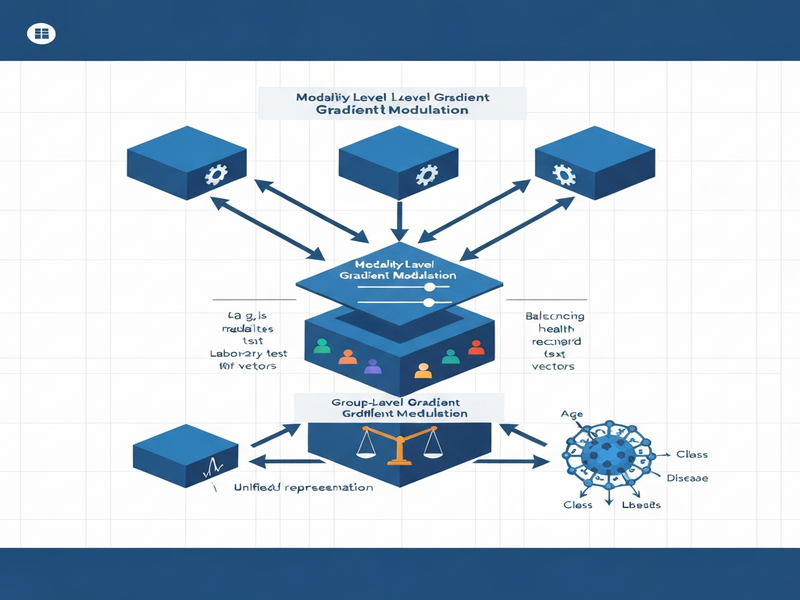
What sets MultiFair apart is the simultaneous, fine‑grained control over two orthogonal axes of bias—data source and demographic group—without requiring separate fairness‑specific loss terms or post‑training calibration.
Evaluation & Results
The authors validated MultiFair on three publicly available medical classification benchmarks, each featuring distinct modalities and demographic annotations:
- ChestX‑Ray‑Multi: Combines frontal X‑ray images, radiology reports, and patient metadata for pneumonia detection.
- DermNet‑Fusion: Merges dermoscopic images, clinical notes, and genetic markers for skin lesion classification.
- Cardio‑Vitals: Integrates ECG waveforms, lab panels, and lifestyle questionnaires for arrhythmia prediction.
Across all datasets, MultiFair was compared against four baselines: vanilla multimodal fusion, attention‑weighted fusion, a fairness‑aware re‑weighting scheme, and a recent adversarial debiasing model. The evaluation focused on three dimensions:
- Overall accuracy (or AUC): MultiFair matched or slightly exceeded the best‑performing baseline, confirming that fairness adjustments did not sacrifice predictive power.
- Modal contribution balance: Measured by the standard deviation of per‑modality gradient norms, MultiFair reduced imbalance by 45‑60% relative to vanilla fusion.
- Demographic parity: Using equalized odds and demographic parity metrics, MultiFair cut the disparity between the highest‑ and lowest‑performing groups by up to 70%.
Importantly, the framework maintained these gains even when up to 30% of patients had one or more missing modalities, demonstrating resilience to incomplete clinical records.
Why This Matters for AI Systems and Agents
For practitioners building AI‑driven diagnostic assistants, MultiFair offers a turnkey solution to two regulatory and ethical pain points:
- Compliance with fairness mandates: Health authorities increasingly require demonstrable equity across protected attributes. MultiFair’s built‑in group‑level modulation provides quantifiable evidence that a model treats all patient groups fairly.
- Robust multimodal orchestration: Agents that ingest imaging, text, and sensor data can rely on MultiFair’s modality‑level balancing to avoid over‑dependence on any single source, reducing the risk of cascade failures when a modality becomes unavailable.
These capabilities translate directly into more trustworthy AI agents that can be deployed in heterogeneous clinical environments—from large academic hospitals to remote tele‑health clinics. By integrating MultiFair, developers can focus on higher‑level workflow automation rather than manually tuning modality weights or retrofitting fairness post‑hoc.
For teams already using the UBOS platform overview to orchestrate AI pipelines, MultiFair can be wrapped as a reusable component within the Workflow automation studio, enabling rapid experimentation with fairness‑aware multimodal models.
What Comes Next
While MultiFair marks a significant step forward, several avenues remain open for exploration:
- Scalability to ultra‑high‑dimensional modalities: Future work could investigate hierarchical gradient modulation to handle genomics or whole‑slide imaging without prohibitive compute costs.
- Extension to regression and survival analysis: The current formulation focuses on classification; adapting the modulation logic to continuous outcomes would broaden clinical applicability.
- Integration with reinforcement‑learning agents: Embedding MultiFair into decision‑making loops (e.g., treatment recommendation agents) could ensure fairness throughout the entire care pathway.
Developers interested in prototyping these ideas can leverage the OpenAI ChatGPT integration for rapid model iteration, or explore the Chroma DB integration for efficient storage of multimodal embeddings.
For a deeper dive into the original methodology, consult the MultiFair paper on arXiv. The authors also release code and pretrained checkpoints, making it straightforward to benchmark against existing pipelines.
Call to Action
Ready to embed fairness‑aware multimodal intelligence into your healthcare solutions? Explore the Enterprise AI platform by UBOS for scalable deployment, or start with the UBOS templates for quick start to prototype a MultiFair‑powered diagnostic agent in days.
Join the conversation on responsible AI in medicine—your feedback helps shape the next generation of equitable, multimodal health technologies.
Andrii Bidochko
CTO UBOS
Andrii Bidochko is an AI entrepreneur and researcher focused on AI agents, reinforcement learning, and autonomous systems. He writes about the technologies shaping the future of machine intelligence, from frontier models and agent architectures to real-world AI applications.