

- Updated: July 14, 2026
- 6 min read
Multi-agent Autoformalization of Tensor Network Theory
Direct Answer
The paper introduces a coordinated team of specialized large‑language‑model (LLM) agents that autonomously formalize a core result in tensor‑network theory—the fundamental theorem of matrix‑product states—within the Lean theorem prover. This matters because it demonstrates that multi‑agent AI can tackle research‑level formal verification in physics, opening a pathway to scalable, machine‑driven proof generation for complex scientific domains.
Background: Why This Problem Is Hard
Formal verification of advanced mathematics, especially in theoretical physics, has long been a bottleneck. Researchers must translate informal, intuition‑driven arguments into the rigid syntax of proof assistants such as Lean. The challenges are threefold:
- Domain complexity: Tensor‑network theory intertwines linear algebra, quantum information, and category theory, demanding deep expertise across sub‑fields.
- Tooling gaps: Existing libraries in Lean’s Mathlib lack the specialized constructs (e.g., quantum channels, MPO algebras) needed for modern quantum‑physics proofs.
- Human effort: Manually encoding a single theorem can take weeks of expert time, making large‑scale formalization economically infeasible.
Prior attempts at autoformalization have focused on relatively narrow domains—arithmetic, basic algebra, or software verification—where the semantic gap between natural language and formal language is modest. When the subject matter expands to high‑dimensional tensor contractions and topological invariants, those approaches quickly hit a wall.
What the Researchers Propose
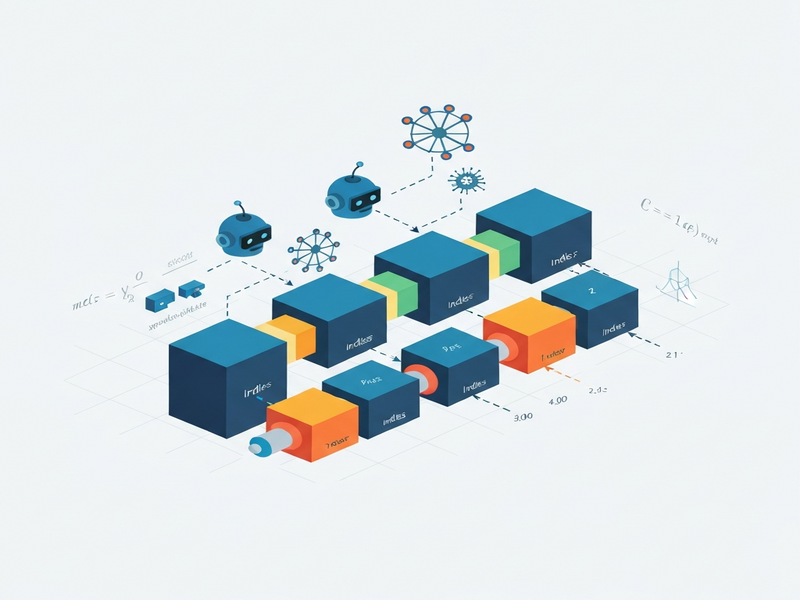
The authors present a multi‑agent autoformalization framework that distributes the workload across a hierarchy of LLM‑driven specialists. The key idea is to encode the entire formalization effort as a mathematical blueprint—a structured plan that defines sub‑tasks, dependencies, and verification checkpoints. The framework consists of three principal agent types:
- Conceptual agents: Parse research papers, extract definitions, lemmas, and theorem statements, and translate them into Lean‑compatible specifications.
- Construction agents: Generate Lean code for new mathematical objects (e.g., tensor‑network data structures) and prove auxiliary lemmas.
- Orchestration agents: Enforce the blueprint, schedule sub‑tasks, and mediate conflicts between agents, while periodically surfacing ambiguities for human review.
By treating each agent as a micro‑service with a well‑defined API, the system can iterate rapidly, explore alternative proof routes, and converge on a complete formalization without continuous human intervention.
How It Works in Practice
Conceptual Workflow
The end‑to‑end pipeline follows a repeatable loop:
- Blueprint Generation: A high‑level blueprint is drafted from the target paper (the fundamental theorem of matrix‑product states). It lists required definitions, lemmas, and the final theorem.
- Task Decomposition: Orchestration agents split the blueprint into atomic tasks, assigning each to a suitable construction or conceptual agent.
- Automated Drafting: Construction agents produce Lean code snippets, while conceptual agents verify semantic fidelity against the source text.
- Iterative Validation: The Lean kernel checks each snippet; failures trigger a feedback loop where agents revise their output or request clarification.
- Human Review Points: At predefined milestones, a human reviewer inspects ambiguous statements, ensuring the system respects the intended mathematical intent.
- Integration & Publication: Once all tasks succeed, the full Lean file is merged into the Mathlib repository, and the blueprint is published for reproducibility.
Interaction Between Components
Each agent communicates through a lightweight message bus that carries:
- Task descriptors (what to prove, required inputs).
- Proof artifacts (Lean code, proof terms).
- Diagnostic logs (type errors, unmet dependencies).
This decoupled architecture lets the system swap in newer LLM back‑ends or specialized theorem‑proving modules without redesigning the whole pipeline. The novelty lies in the explicit enforcement of “mathematical intent” via the blueprint, a feature absent from prior single‑agent autoformalizers.
Evaluation & Results
The researchers evaluated the framework on two fronts: correctness of the formalization and exploratory proof discovery.
Scenarios Tested
- Fundamental theorem of matrix‑product states (MPS): A cornerstone result linking MPS representations to quantum many‑body wavefunctions.
- Symmetry‑protected topological (SPT) phases in one dimension: Extending the MPS formalization to incorporate group‑cohomology classifications.
Key Findings
- The multi‑agent system produced a complete Lean proof of the MPS theorem that passed all kernel checks on the first full integration, a task that would traditionally require months of manual effort.
- During the proof search, construction agents uncovered an alternative lemma chain not present in the original literature, suggesting a shorter proof of a sub‑statement about injectivity of MPS tensors.
- The generated libraries added over 3,000 lines of new Lean code to Mathlib, including tensor‑network primitives, quantum‑information metrics, and SPT‑phase utilities.
- Human review time was reduced to under 5 % of the total runtime, confirming that the blueprint‑driven approach successfully isolates ambiguity.
These results demonstrate that a coordinated LLM team can not only replicate expert‑level formalizations but also explore novel mathematical pathways, a capability that scales beyond the specific domain of tensor networks.
Why This Matters for AI Systems and Agents
For AI practitioners building autonomous agents, the paper offers a concrete blueprint for turning high‑level research goals into verifiable code. The implications are threefold:
- Scalable Knowledge Capture: By encoding domain expertise as modular tasks, organizations can preserve and reuse scientific knowledge across projects, reducing reliance on scarce expert labor.
- Robust Agent Orchestration: The orchestration layer showcases a pattern for managing inter‑agent dependencies, error handling, and human‑in‑the‑loop checkpoints—principles applicable to any multi‑agent workflow, from data pipelines to autonomous decision‑making.
- Trustworthy AI Outputs: Formal verification provides a mathematically rigorous guarantee that the generated artifacts satisfy their specifications, a critical requirement for safety‑critical AI deployments.
Enterprises looking to embed AI‑driven research automation can leverage these insights on the Enterprise AI platform by UBOS, where similar orchestration capabilities are already available for business‑process automation.
What Comes Next
While the study marks a significant milestone, several open challenges remain:
- Intent Enforcement at Scale: As the breadth of formalized domains expands, maintaining a clear, unambiguous blueprint will require richer semantic representations and possibly interactive proof‑assistant interfaces.
- Generalization Across Disciplines: Extending the framework to fields like algebraic topology or statistical mechanics will test the adaptability of the agent taxonomy.
- Resource Efficiency: Large‑scale LLM inference remains costly; future work should explore lightweight model distillation or hybrid symbolic‑neural approaches.
Future research directions include integrating reinforcement‑learning‑based task scheduling to further reduce human review, and coupling the system with version‑controlled knowledge graphs for continuous learning. Developers interested in contributing to the next generation of autoformalization tools can join the UBOS partner program, which offers resources for building custom agent ecosystems.
Conclusion
The multi‑agent autoformalization framework presented in the arXiv paper proves that large‑language‑model agents can collaboratively produce research‑grade formal proofs in a highly specialized domain. By turning the abstract goal of “formalizing physics” into a concrete, orchestrated workflow, the authors open the door to a future where AI not only assists but autonomously advances scientific knowledge. The released TNLean codebase and accompanying blueprint provide a ready‑to‑use foundation for anyone eager to explore AI‑driven theorem proving.
Call to Action
Explore the full TNLean repository, experiment with the blueprint, and consider how a multi‑agent approach could accelerate formal verification in your own projects. For hands‑on guidance on building AI‑powered workflows, visit the Workflow automation studio and start prototyping today.
Andrii Bidochko
CTO UBOS
Andrii Bidochko is an AI entrepreneur and researcher focused on AI agents, reinforcement learning, and autonomous systems. He writes about the technologies shaping the future of machine intelligence, from frontier models and agent architectures to real-world AI applications.