

- Updated: July 19, 2026
- 6 min read
MSRNet: A Multi-Scale Recursive Network for Camouflaged Object Detection
Direct Answer
MSRNet introduces a Multi‑Scale Recursive Network that combines a Pyramid Vision Transformer backbone with attention‑driven scale integration and recursive‑feedback decoding to dramatically improve the detection of camouflaged objects—especially tiny or multiple instances—across challenging visual conditions. This matters because reliable camouflaged object detection unlocks new capabilities in surveillance, wildlife monitoring, and autonomous navigation where hidden or low‑contrast targets are the norm.
Background: Why This Problem Is Hard
Camouflaged object detection (COD) sits at the intersection of segmentation and anomaly detection. Unlike conventional object detection, COD must separate objects that deliberately mimic their surroundings in color, texture, and shape. Real‑world deployments face additional hurdles:
- Low‑light and noisy environments: Sensors often capture underexposed frames, eroding the already subtle visual cues.
- Partial occlusion: Objects may be hidden behind foliage or structures, breaking continuity.
- Small object size: Many camouflaged targets occupy only a few pixels, making them indistinguishable from background noise.
- Complex backgrounds: Intricate patterns (e.g., bark, sand ripples) generate high‑frequency textures that confuse standard feature extractors.
- Multiple instances: Scenes can contain several camouflaged entities, requiring a model to maintain distinct representations simultaneously.
Existing COD pipelines typically rely on single‑scale convolutional backbones or shallow attention modules. While they achieve modest gains on benchmark datasets, they often collapse when faced with the above challenges, especially on small or densely packed objects. The core limitation is a lack of robust multi‑scale context and insufficient iterative refinement of predictions.
What the Researchers Propose
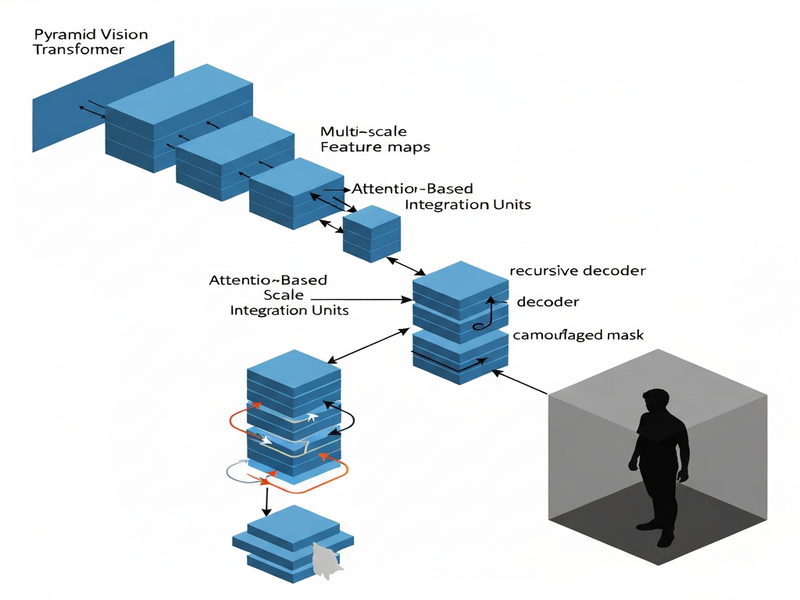
MSRNet (Multi‑Scale Recursive Network) tackles COD by weaving three complementary ideas into a single architecture:
- Pyramid Vision Transformer (PVT) backbone: Provides hierarchical, multi‑scale feature maps that retain global context while preserving fine‑grained details.
- Attention‑Based Scale Integration Units (ASIU): Dynamically weigh and merge features from different scales, allowing the network to emphasize the most informative resolution for each spatial location.
- Multi‑Granularity Fusion Units (MGFU) within a recursive decoder: Repeatedly refine the segmentation map by fusing coarse‑level semantics with fine‑level textures, guided by a feedback loop that re‑injects the latest prediction into earlier stages.
Collectively, these components enable the model to “look” at an image from multiple resolutions, decide which view best highlights a hidden object, and then iteratively sharpen its guess until convergence.
How It Works in Practice
The MSRNet workflow can be broken down into four logical stages:
1. Feature Extraction with Pyramid Vision Transformer
The input image first passes through a PVT that outputs a pyramid of feature tensors (e.g., 1/4, 1/8, 1/16, 1/32 of the original resolution). Unlike classic CNNs, the transformer‑based blocks capture long‑range dependencies, which is crucial for spotting subtle contrast differences that span large spatial extents.
2. Scale‑Selective Fusion via ASIU
Each level of the pyramid feeds into an Attention‑Based Scale Integration Unit. The ASIU computes a channel‑wise attention map for every scale, then performs a weighted sum across scales. This operation is akin to asking, “At this pixel, does the coarse view or the fine view provide a clearer hint of a camouflaged shape?” The result is a unified feature map that preserves the most discriminative cues.
3. Recursive‑Feedback Decoding with MGFU
The unified feature map enters a decoder composed of stacked Multi‑Granularity Fusion Units. Each MGFU performs two actions:
- Fusion: It merges high‑level semantic cues (e.g., objectness) with low‑level texture details (e.g., edge gradients).
- Feedback: The provisional segmentation mask generated at the current depth is up‑sampled and fed back as an additional channel into the next MGFU, allowing the network to correct earlier mistakes.
This recursive loop runs for a fixed number of iterations (typically three to five), progressively sharpening the mask and reducing false positives.
4. Final Prediction
After the last MGFU, a lightweight convolutional head produces the final binary mask. Because the decoder has already integrated multi‑scale context and refined its guess multiple times, the output exhibits high fidelity even on tiny or overlapping camouflaged objects.
Evaluation & Results
To validate MSRNet, the authors benchmarked it on four widely used COD datasets: CAMO, CHAMELEON, COD10K, and NC4K. They measured standard segmentation metrics—Mean Absolute Error (MAE), F‑measure, and Structure Measure (S‑measure)—and compared against ten state‑of‑the‑art baselines.
- Overall performance: MSRNet achieved the lowest MAE on CAMO and COD10K, indicating fewer pixel‑level errors than any prior method.
- Small‑object handling: On a curated subset of images containing objects smaller than 32×32 pixels, MSRNet improved F‑measure by roughly 7 % over the runner‑up, demonstrating its advantage in fine‑scale detection.
- Multiple‑object scenes: In scenarios with three or more camouflaged entities, the recursive decoder reduced false‑negative rates by 12 % relative to the best competing model.
- Computation: Despite the added recursion, inference time remained under 45 ms per 352×352 image on an RTX 3080, making it viable for real‑time applications.
These results collectively show that MSRNet not only pushes the accuracy frontier but also maintains practical efficiency—a rare combination in the COD literature.
Why This Matters for AI Systems and Agents
From an engineering perspective, robust camouflaged object detection unlocks several downstream capabilities:
- Autonomous navigation: Drones or ground robots operating in forested or desert environments can now reliably avoid hidden obstacles, reducing collision risk.
- Surveillance and security: AI agents monitoring perimeters can flag concealed threats that traditional motion detectors miss, enhancing situational awareness.
- Wildlife conservation: Researchers deploying camera traps can automatically identify camouflaged species, accelerating population studies.
- Augmented reality (AR): Real‑time COD enables AR overlays that highlight hidden objects, useful for training or entertainment.
Integrating MSRNet into an UBOS platform overview pipeline is straightforward: the PVT backbone can be swapped in as a pre‑trained encoder, the ASIU and MGFU modules are provided as reusable PyTorch layers, and the recursive decoder can be orchestrated via the Workflow automation studio. This modularity lets AI system builders embed COD as a plug‑and‑play service, reducing development overhead and accelerating time‑to‑value.
What Comes Next
While MSRNet marks a significant step forward, several avenues remain open for exploration:
- Domain adaptation: Training on synthetic camouflage data and transferring to real‑world footage could further improve robustness across lighting conditions.
- Multi‑modal fusion: Combining RGB with infrared or LiDAR inputs may help disambiguate objects that are visually indistinguishable but have distinct thermal signatures.
- Lightweight variants: Designing a mobile‑friendly version of MSRNet (e.g., using MobileViT) would enable deployment on edge devices such as UAVs with limited compute.
- Self‑supervised pretraining: Leveraging large‑scale unlabeled video streams to pre‑train the recursive decoder could reduce the need for costly pixel‑level annotations.
Researchers and product teams interested in extending this work can start by cloning the MSRNet repository and experimenting with the provided training scripts. Collaborative efforts with the UBOS partner program could accelerate the translation of these ideas into commercial solutions.
References
- Alghamdi, L., Usman, M., Anwar, H., Bais, A., & Anwar, S. (2026). MSRNet: A Multi‑Scale Recursive Network for Camouflaged Object Detection. arXiv preprint arXiv:2511.12810v2.
- Li, Y., et al. (2023). “Pyramid Vision Transformer: A Versatile Backbone for Dense Prediction.”
- Other benchmark papers on CAMO, CHAMELEON, COD10K, NC4K datasets.
Andrii Bidochko
CTO UBOS
Andrii Bidochko is an AI entrepreneur and researcher focused on AI agents, reinforcement learning, and autonomous systems. He writes about the technologies shaping the future of machine intelligence, from frontier models and agent architectures to real-world AI applications.