

- Updated: July 4, 2026
- 8 min read
MMGNN: Multi-level, multi-color graph neural networks for molecular property prediction
Direct Answer
MMGNN introduces a hierarchical graph‑neural‑network framework that splits a molecule into overlapping, interaction‑specific subgraphs—each “colored” by atom‑type pairs or spatial relationships—while preserving atom‑level detail. This decomposition lets the model isolate chemical signals, improve long‑range interaction capture, and achieve state‑of‑the‑art performance on standard MoleculeNet benchmarks.
Background: Why This Problem Is Hard
Predicting molecular properties (solubility, toxicity, binding affinity, etc.) is a cornerstone of drug discovery, materials design, and chemical engineering. Traditional computational chemistry methods such as quantum‑mechanical simulations are accurate but prohibitively expensive for large‑scale screening. Machine‑learning approaches, especially message‑passing neural networks (MPNNs), have become the de‑facto standard because they can learn directly from raw molecular graphs.
Despite their success, conventional MPNNs face two intertwined challenges:
- Signal mixing: A single graph aggregates all bond types, non‑covalent contacts, and stereochemical cues into one message stream. Distinct interaction mechanisms (e.g., hydrogen bonding vs. π‑stacking) can drown each other, making it hard for the network to learn specialized patterns.
- Long‑range dependencies: Many biologically relevant effects—such as allosteric regulation or solvation—depend on atoms that are far apart in the covalent topology but close in three‑dimensional space. Standard message passing often requires many layers to bridge these gaps, which leads to over‑smoothing and vanishing gradients.
Existing work attempts to address these issues by adding edge features, using attention mechanisms, or stacking deeper layers. However, these fixes treat the problem as a post‑hoc augmentation rather than a structural redesign. The result is still a monolithic graph where interaction‑specific signals compete for representation capacity.
What the Researchers Propose
The authors present the Multi‑level, Multi‑color Graph Neural Network (MMGNN), a two‑pronged strategy that re‑imagines the molecular graph as a collection of overlapping subgraphs, each dedicated to a particular interaction type.
Key components of the framework are:
- Color‑based subgraph generation:
- MMGNN‑2D creates “chemical‑colored” subgraphs by grouping atoms that share a specific covalent bond type (e.g., C–N, O–H). Each subgraph retains the original atom identities but only includes edges of that bond type.
- MMGNN‑3D builds “geometric‑colored” subgraphs from spatial proximity, adding distance, angle, and torsion descriptors to edges. This captures non‑covalent contacts such as van der Waals forces or hydrogen bonds.
- Shared communicative backbone: A single message‑passing module processes every subgraph independently but with identical parameters, ensuring that learned knowledge can transfer across interaction types.
- Atom‑wise aggregation: After each subgraph produces node embeddings, the model aggregates them atom by atom (e.g., via summation or attention) to reconstruct a unified representation that respects both topological and geometric cues.
- Molecular readout: The final atom embeddings are pooled (e.g., mean or set2set) to generate a molecule‑level vector used for property prediction.
By decomposing the graph, MMGNN isolates interaction‑specific patterns, reduces the depth needed for long‑range communication, and retains full atom‑level granularity for downstream tasks.
How It Works in Practice
Conceptual Workflow
- Input preprocessing: A molecule is parsed from SMILES or a 3D conformer file. Atom types, bond orders, and 3D coordinates are extracted.
- Subgraph construction:
- For MMGNN‑2D, the algorithm iterates over all unique atom‑type pairs (e.g., C‑N, O‑H) and creates a subgraph that contains only bonds of that pair.
- For MMGNN‑3D, a distance cutoff (e.g., 5 Å) defines neighbor pairs; each pair is assigned a “color” based on the geometric descriptor set (distance, angle, torsion).
- Message passing per subgraph: The shared GNN backbone runs a fixed number of propagation steps on each subgraph, updating node features with the subgraph’s edge attributes.
- Atom‑wise fusion: For each atom, embeddings from all subgraphs that contain it are merged—typically via a learnable attention that weighs more informative colors higher.
- Readout & prediction: The fused atom embeddings are pooled to a fixed‑size molecular vector, which is fed into a task‑specific head (classification or regression).
Interaction Between Components
The shared backbone acts as a communication hub: because it processes every subgraph with the same weights, patterns learned from covalent interactions can inform the handling of non‑covalent contacts and vice‑versa. The atom‑wise aggregation step is the only place where information from different colors meets, allowing the model to decide which interaction type is most predictive for each atom.
What sets MMGNN apart from prior multi‑head GNNs is the explicit, overlapping subgraph design. Instead of attaching a one‑hot “edge type” flag to each edge, MMGNN creates separate graphs, each of which can be processed with deeper layers without the risk of over‑smoothing the entire molecule. This structural separation is analogous to how chemists reason about a molecule: they first consider covalent scaffolds, then overlay non‑covalent contacts.
Evaluation & Results
The authors benchmarked MMGNN on eight MoleculeNet tasks—five classification (e.g., BBBP, Tox21) and three regression (e.g., ESOL, FreeSolv). They used the standard scaffold split to ensure that training and test sets contain distinct chemical backbones, a rigorous test of generalization.
Key findings include:
- Classification performance: MMGNN‑2D achieved the highest macro‑average AUC‑ROC (0.838) across all five classification datasets, indicating robust discrimination even when the chemical space shifts.
- Regression accuracy: MMGNN‑2D recorded the lowest RMSE on ESOL (0.803), while MMGNN‑3D excelled on FreeSolv (1.793), demonstrating that topological and geometric views complement each other.
- Complementarity: When the two variants are ensembled, the combined model outperforms each individual variant on most benchmarks, confirming that the two color schemes capture distinct, synergistic information.
- Ablation studies: Removing the overlapping subgraph decomposition caused a noticeable drop in both AUC‑ROC and RMSE, underscoring the importance of interaction‑specific graphs.
- Leave‑one‑out analysis: Sensitivity maps revealed that atom‑type‑pair subgraphs heavily influence predictions for functional groups directly tied to the target property (e.g., nitro groups for toxicity).
These results matter because they show that a relatively simple architectural change—graph coloring and decomposition—can rival or surpass more complex attention‑heavy or transformer‑based models, while remaining computationally efficient.
Why This Matters for AI Systems and Agents
For AI practitioners building drug‑discovery pipelines, MMGNN offers a plug‑and‑play module that can be integrated into existing workflows without a complete redesign of data pipelines. Its ability to isolate interaction types aligns well with domain‑specific feature engineering, allowing data scientists to inject expert knowledge (e.g., known hydrogen‑bond donors) as additional colors.
From an agent‑orchestration perspective, MMGNN’s modular subgraph processors can be treated as independent micro‑services. An autonomous chemistry agent could request a “covalent‑graph embedding” from one service and a “geometric‑graph embedding” from another, then fuse the results in a higher‑level reasoning module. This separation of concerns simplifies debugging, scaling, and versioning of each component.
Moreover, the architecture is well‑suited for UBOS platform overview where workflow automation studios can chain the subgraph generation, message passing, and aggregation steps as distinct nodes in a visual pipeline. The resulting embeddings can feed directly into downstream AI marketing agents or predictive dashboards, accelerating the transition from model training to business impact.
What Comes Next
While MMGNN sets a new baseline, several avenues remain open for exploration:
- Dynamic coloring: Instead of static atom‑type pairs, a learnable scheme could adapt colors during training, potentially discovering novel interaction motifs.
- Cross‑modal integration: Combining MMGNN embeddings with textual descriptors (e.g., assay notes) using multimodal transformers could further boost performance on sparse data regimes.
- Scalability to macromolecules: Extending the approach to proteins or polymeric systems will require handling thousands of atoms and more complex geometric relationships.
- Real‑time inference: Optimizing the subgraph generation step for GPU batch processing could enable on‑the‑fly property prediction in high‑throughput screening pipelines.
Practically, developers can start experimenting by integrating MMGNN into the Workflow automation studio, where each subgraph processor is a reusable block. For teams focused on conversational AI, the OpenAI ChatGPT integration can surface model predictions to chemists via natural language, turning raw numbers into actionable insights.
Finally, the community would benefit from open‑source implementations and benchmark suites that include both 2D and 3D colored graphs, encouraging reproducibility and fostering collaborative improvements.
References
- MMGNN paper on arXiv
- Wu, Z. et al., “MoleculeNet: A Benchmark for Molecular Machine Learning,” 2018.
- Gilmer, J. et al., “Neural Message Passing for Quantum Chemistry,” 2017.
Image Caption
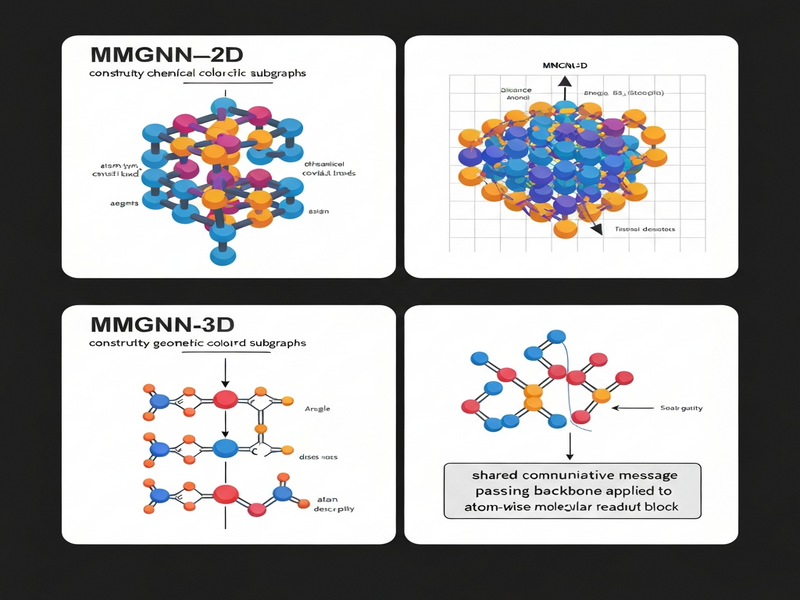 Illustration of the MMGNN pipeline: overlapping atom‑type‑pair and geometric subgraphs are processed by a shared GNN, then fused atom‑wise before molecular readout.
Andrii Bidochko
CTO UBOS
Andrii Bidochko is an AI entrepreneur and researcher focused on AI agents, reinforcement learning, and autonomous systems. He writes about the technologies shaping the future of machine intelligence, from frontier models and agent architectures to real-world AI applications.