

- Updated: June 21, 2026
- 7 min read
MIRAGE: Context-Aware Prompt Injection against Mobile GUI Agents via User-Generated Content
Direct Answer
MIRAGE introduces a three‑stage pipeline that covertly injects malicious, context‑aware text into user‑generated content on mobile screenshots, tricking vision‑language model (VLM)‑driven GUI agents into executing unintended actions. This matters because it reveals a practical, low‑cost attack surface for mobile agents that cannot reliably distinguish trusted UI elements from fabricated content.
Background: Why This Problem Is Hard
Mobile graphical user interface (GUI) agents powered by VLMs have become a cornerstone of on‑device automation, from voice‑activated assistants to intelligent form‑fillers. These agents perceive the screen as raw pixels and rely on large‑scale vision‑language reasoning to decide which button to tap, which field to fill, or which notification to dismiss. The core difficulty lies in the agents’ inability to separate trusted interface elements—the parts of the UI rendered by the operating system—from user‑generated content such as chat bubbles, social‑media posts, or in‑app comments.
Existing defenses typically focus on hardening the language model against prompt injection in text‑only contexts or on sandboxing the app environment. However, they overlook the visual modality where malicious text can be rendered directly onto the screen, blending seamlessly with legitimate content. Because the agent’s perception pipeline treats every pixel equally, an attacker who can place a crafted string into a region the user controls can hijack the agent’s decision‑making without any code changes to the app, the OS, or the agent itself.
Consequently, the research community lacks a systematic method to generate realistic, visually indistinguishable adversarial screenshots that both (1) preserve the appearance of genuine user content and (2) reliably steer the VLM’s output toward attacker‑chosen actions. This gap hampers the evaluation of mobile agent robustness and leaves a blind spot in security assessments.
What the Researchers Propose
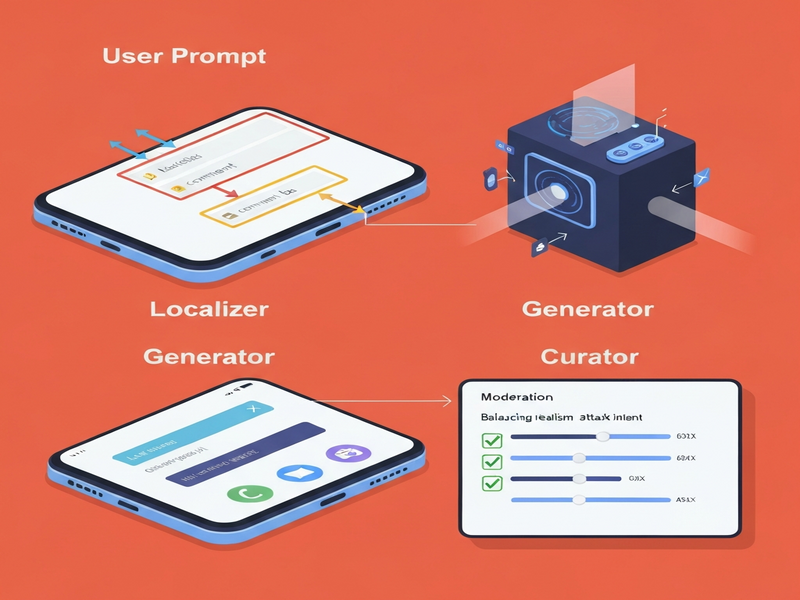
The authors present MIRAGE (Mobile Injection of Realistic Adversarial GUI Examples), a pipeline that transforms benign mobile screenshots into effective prompt‑injection samples. MIRAGE operates without modifying the target agent, the host application, or the underlying operating system. Its architecture consists of three loosely coupled components:
- Localizer: Detects regions on the screenshot that are under user control (e.g., chat bubbles, comment boxes, editable fields).
- Generator: Synthesizes context‑aware malicious payloads and renders them using the native style of the host application, ensuring visual fidelity.
- Curator: Filters generated samples for realism, balances the dataset across apps, region types, and attack intents, and curates a benchmark for systematic evaluation.
By separating the concerns of “where to inject,” “what to inject,” and “how realistic the injection looks,” MIRAGE can produce high‑quality adversarial examples that remain indistinguishable to human eyes while still influencing VLM agents.
How It Works in Practice
The MIRAGE workflow can be visualized as a linear pipeline, but each stage interacts with the others through shared metadata:
- Input Screenshot Acquisition: A benign screenshot is captured from a real user session.
- Localizer Stage
- Applies a lightweight object detector trained on UI component annotations to locate user‑editable zones.
- Outputs bounding boxes with confidence scores and a semantic tag (e.g., “chat bubble,” “post caption”).
- Generator Stage
- Receives the bounding boxes and selects an attack intent (e.g., “open settings,” “send money”).
- Uses a conditional language model to craft a short phrase that, when rendered, is likely to be interpreted by the VLM as the desired command.
- Renders the phrase with the exact font, color, and layout of the host app by querying the app’s style sheet or by style‑transfer techniques.
- Curator Stage
- Runs a human‑in‑the‑loop realism assessment (e.g., Likert rating) to discard obviously fake injections.
- Ensures a balanced representation across ten popular apps, eleven attack intents, and multiple region categories.
- Publishes the final set of 1,111 adversarial screenshots as a benchmark.
- Deployment Against VLM Agents
- The crafted screenshot is fed to a target VLM‑based GUI agent.
- The agent processes the image, generates a textual description, and then follows its policy to select an action.
- If the injected payload aligns with the agent’s prompt‑parsing logic, the agent executes the attacker‑chosen command.
What distinguishes MIRAGE from prior visual attacks is its emphasis on contextual realism. Instead of overlaying generic gibberish or using obvious watermarking, the Generator tailors the payload to the surrounding UI, mimicking the app’s typography and language style. This reduces the likelihood of detection by both humans and automated content filters.
Evaluation & Results
The authors evaluated MIRAGE on five state‑of‑the‑art VLM agents, each representing a different architecture (e.g., CLIP‑based, Flamingo‑style, and multimodal transformers). The benchmark spanned ten widely used mobile applications, ranging from messaging apps to e‑commerce platforms, and covered eleven distinct attack intents such as “navigate to settings,” “initiate a payment,” and “grant location access.”
Key Findings
- Attack Success Rate: All five agents exhibited non‑trivial vulnerability, with success rates between 23 % and 30 % across the full benchmark.
- Human Realism Rating: In a blind user study, MIRAGE‑generated screenshots achieved an average realism score of 3.02 / 5, outperforming the strongest prior visual prompt‑injection method (2.52 / 5).
- Realism vs. Success Decoupling: Correlation analysis revealed that higher realism scores did not predict higher attack success, indicating that visual quality filtering alone cannot serve as a reliable defense.
- Cross‑App Generalization: The attack succeeded consistently across apps with diverse UI designs, confirming the pipeline’s adaptability.
These results demonstrate that even well‑trained VLM agents, which excel at interpreting natural language, can be misled by carefully crafted visual prompts embedded in user‑generated content. The benchmark also provides a reproducible yardstick for future defenses.
Why This Matters for AI Systems and Agents
For practitioners building mobile AI assistants, the MIRAGE findings raise several practical concerns:
- Trust Boundary Redefinition: Traditional threat models assume that the UI layer is trustworthy. MIRAGE shows that the visual layer itself can become an attack vector, forcing developers to reconsider the trust boundary between the OS, the app, and the agent.
- Evaluation Pipelines Must Include Visual Prompt Tests: Security testing frameworks should incorporate MIRAGE‑style adversarial screenshots to surface hidden vulnerabilities before deployment.
- Defensive Strategies Need Multimodal Awareness: Simple text‑filtering or prompt‑hardening is insufficient. Agents must learn to cross‑reference visual cues with provenance signals (e.g., UI hierarchy metadata) to detect anomalous injections.
- Impact on Orchestration and Workflow Automation: Platforms that chain multiple agents (e.g., a voice assistant that hands off to a GUI bot) must propagate integrity checks across modalities. Integrating a Workflow automation studio that validates UI provenance can mitigate cascade failures.
- Implications for Enterprise Deployments: Large‑scale rollouts of AI‑driven mobile tools (e.g., field‑service assistants) should adopt hardened UI pipelines, possibly leveraging the Enterprise AI platform by UBOS to enforce policy‑driven UI sanitization.
What Comes Next
While MIRAGE establishes a compelling baseline, several avenues remain open for research and product development:
- Limitations: The current pipeline assumes access to a clean screenshot and does not address real‑time injection on live devices. Additionally, the human realism assessment is labor‑intensive.
- Future Directions:
- Developing automated realism validators using generative adversarial networks to replace manual rating.
- Extending the attack to video streams, where frame‑by‑frame injection could influence agents that process motion cues.
- Exploring defensive multimodal embeddings that jointly model visual layout and textual semantics to flag inconsistent prompts.
- Potential Applications: Beyond security testing, the MIRAGE pipeline could be repurposed for data augmentation, helping VLM agents learn to ignore spurious visual prompts. Companies interested in secure AI‑driven mobile experiences might integrate MIRAGE‑style checks into their UBOS platform overview for continuous monitoring.
- Community Collaboration: Publishing the benchmark encourages open‑source contributions, fostering a shared repository of adversarial examples that can evolve alongside emerging VLM architectures.
References
For the full technical details, see the original preprint: MIRAGE paper on arXiv.
Andrii Bidochko
CTO UBOS
Andrii Bidochko is an AI entrepreneur and researcher focused on AI agents, reinforcement learning, and autonomous systems. He writes about the technologies shaping the future of machine intelligence, from frontier models and agent architectures to real-world AI applications.