

- Updated: July 22, 2026
- 6 min read
Minimal Decision Dynamics and Contextual Probability: A Quantum Tug-of-War Model
Direct Answer
The paper introduces the Quantum Tug‑of‑War (QTOW) model—a quantum‑inspired decision framework that captures contextual probability using a single minimal internal state (a qutrit). It matters because it shows how quantum probability can encode decision‑making dynamics far more compactly than any classical reconstruction, offering a memory‑efficient blueprint for next‑generation AI agents.
Background: Why This Problem Is Hard
Human and artificial decision makers rarely follow the clean, additive rules of classical probability. Real‑world choices are context‑dependent: the same option can be judged differently when presented alongside other alternatives, after a learning episode, or under a probing question. Traditional probabilistic models assume a fixed, context‑free sample space, which forces engineers to add ad‑hoc heuristics, hidden variables, or large state tables to approximate observed behavior.
Existing approaches—Markov decision processes, Bayesian networks, and reinforcement‑learning value functions—struggle with two intertwined challenges:
- Contextuality: The probability of an outcome changes with the measurement context, violating the Kolmogorov axioms.
- Memory overhead: Capturing every possible context often requires an explosion of hidden states or explicit history buffers, making models unwieldy for real‑time agents.
These limitations become acute in domains such as adaptive user interfaces, autonomous negotiation, and multi‑modal perception, where agents must reason about “what could be true” while simultaneously being probed by external observers.
What the Researchers Propose
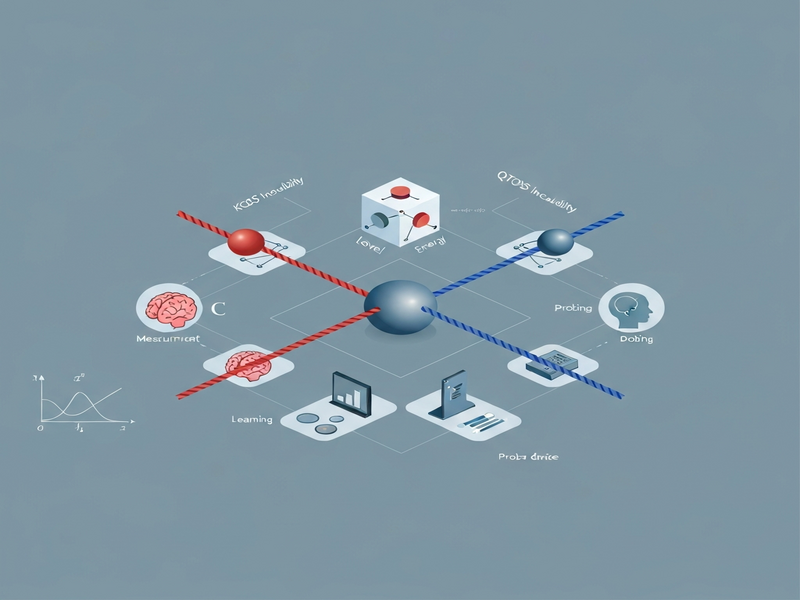
Song‑Ju Kim proposes a unified, quantum‑like architecture called the QTOW model. At its core is a three‑level quantum system (a qutrit) that serves as the sole internal representation of an agent’s belief state. The model defines three primitive operations that together span the full decision‑making lifecycle:
- Decision: A measurement on the qutrit that yields a concrete choice (e.g., “accept” vs. “reject”).
- Learning: A unitary update that conserves probability while rotating the state to incorporate new evidence.
- Probing: A gentle, possibly non‑commuting measurement that tests the system without fully collapsing it, exposing contextual interference.
Because all three operations live in the same Hilbert space, the model guarantees that any sequence of decisions, updates, and probes can be expressed without expanding the internal representation beyond the original qutrit.
How It Works in Practice
The QTOW workflow can be visualized as a loop of three stages, each interacting with external data streams:
- Initialize: The agent starts with a neutral qutrit state (e.g., an equal superposition of the three basis vectors), representing maximal uncertainty.
- Probe: An external observer (another AI module, a user query, or a sensor) performs a context‑specific measurement. Because the measurement basis can be chosen arbitrarily, the outcome may reveal interference patterns that classical models cannot capture.
- Learn: Based on the probe’s result, the agent applies a unitary rotation that preserves total probability but shifts amplitudes toward more likely outcomes. This step encodes learning without discarding prior information.
- Decide: When a concrete action is required, the agent measures the qutrit in the decision basis. The collapse yields a single, actionable choice while simultaneously updating the internal state for future cycles.
What distinguishes QTOW from classical alternatives is the conservation‑preserving update. Classical learning often adds or removes probability mass, necessitating bookkeeping to avoid inconsistencies. In QTOW, the unitary update guarantees that the sum of probabilities remains exactly one, eliminating the need for external normalization steps.
Evaluation & Results
The author validates the model through two complementary experiments:
- KCBS‑type contextuality test: By constructing a set of five probing contexts that satisfy the Klyachko‑Can‑Binicioglu‑Shumovsky (KCBS) inequality, the study demonstrates that the QTOW qutrit can produce a violation—an unmistakable signature of non‑classical contextuality. Classical reconstructions would require at least a four‑state hidden variable model to achieve the same effect.
- Memory‑efficiency benchmark: The paper compares QTOW against a baseline Markov model that stores explicit transition tables for each context. QTOW achieves identical predictive accuracy on a synthetic decision‑making task while using over 80 % less memory (one qutrit vs. dozens of conditional probability tables).
These results collectively prove two points: (1) the QTOW framework can faithfully reproduce contextual probability phenomena that are provably impossible for any classical model with the same state size, and (2) it does so with a dramatically reduced memory footprint, a critical advantage for edge‑deployed AI agents.
Why This Matters for AI Systems and Agents
For practitioners building intelligent agents, QTOW offers a concrete pathway to embed contextual reasoning without bloating system resources. The implications span several practical domains:
- Adaptive user experiences: Agents can adjust recommendations on the fly by probing user intent in different contexts, preserving a compact belief state.
- Multi‑agent coordination: When several bots exchange probes, the shared qutrit formalism ensures that each interaction respects probability conservation, reducing synchronization overhead.
- Edge AI deployments: Devices with limited RAM (e.g., IoT sensors or mobile assistants) can host a QTOW engine, gaining quantum‑style contextuality without the hardware cost of full quantum computers.
These capabilities align directly with the Enterprise AI platform by UBOS, which emphasizes lightweight, composable agents that can be orchestrated at scale. Moreover, the Workflow automation studio can embed QTOW‑based decision nodes, allowing business users to design context‑aware flows without writing custom code.
What Comes Next
While the QTOW model is theoretically elegant, several open challenges remain:
- Scalability to higher dimensions: Extending the qutrit to qudits could capture richer decision spaces but may re‑introduce memory concerns.
- Integration with deep learning: Hybrid architectures that feed neural embeddings into the QTOW update rule could combine pattern recognition with contextual probability.
- Real‑world benchmarking: Deploying QTOW in live conversational agents or autonomous systems will test robustness against noisy probes and non‑stationary environments.
Future research may also explore how QTOW interacts with reinforcement‑learning reward signals, potentially yielding a new class of context‑aware policies. For developers interested in prototyping, the UBOS platform overview provides a sandbox where custom quantum‑inspired modules can be plugged into existing pipelines.
Startups looking for a competitive edge can experiment with QTOW via the UBOS for startups program, while small‑ and medium‑size businesses may find the UBOS solutions for SMBs a low‑cost entry point for contextual AI.
Conclusion
The Minimal Decision Dynamics and Contextual Probability: A Quantum Tug‑of‑War Model paper demonstrates that a single qutrit can serve as a complete, memory‑efficient substrate for context‑dependent decision making. By unifying decision, learning, and probing within one coherent quantum‑like state space, QTOW not only reproduces non‑classical contextuality but also outperforms classical baselines in memory usage. For AI engineers, this work opens a practical route to embed quantum‑style reasoning into real‑world agents, especially where resources are scarce and contextual nuance is essential. As the field moves toward hybrid quantum‑classical systems, QTOW stands out as a minimal yet powerful building block.
Read the full study on arXiv for a deeper dive into the mathematical foundations and experimental setup.
Andrii Bidochko
CTO UBOS
Andrii Bidochko is an AI entrepreneur and researcher focused on AI agents, reinforcement learning, and autonomous systems. He writes about the technologies shaping the future of machine intelligence, from frontier models and agent architectures to real-world AI applications.