

- Updated: July 17, 2026
- 7 min read
MetaHGNIE: Meta-Path Induced Hypergraph Contrastive Learning in Heterogeneous Knowledge Graphs
Direct Answer
DualHNIE introduces a dual‑channel hypergraph learning framework that explicitly models higher‑order meta‑path patterns in heterogeneous knowledge graphs to estimate node importance. By separating structural and semantic signals and aligning them through contrastive learning, the method delivers more discriminative importance scores, a capability that directly benefits recommendation, search, and decision‑support systems.
Background: Why This Problem Is Hard
Heterogeneous knowledge graphs (HKGs) combine multiple entity types (e.g., users, products, concepts) and diverse relation types (e.g., “purchased”, “belongs‑to”, “cites”). Real‑world AI products rely on accurate node‑importance estimates to surface the most relevant entities, rank search results, or prioritize knowledge‑base updates. Traditional graph neural networks (GNNs) treat edges as pairwise connections, which forces them to compress rich, multi‑hop relational patterns into a single message‑passing step. This compression creates two major bottlenecks:
- Loss of higher‑order context: Meta‑paths—sequences of typed edges such as User → Purchases → Product → Category—encode domain‑specific semantics that are invisible to plain edge‑wise aggregation.
- Entangled representation space: Most methods fuse structural topology and node attributes into a single embedding vector, blurring the distinct inductive biases each modality provides. The resulting embeddings often lack the granularity needed for fine‑grained importance ranking.
Because HKGs can contain millions of nodes and billions of typed edges, any solution must also be computationally scalable. Existing higher‑order approaches either explode in memory (by enumerating all meta‑paths) or sacrifice expressiveness (by simplifying meta‑paths into scalar features). Consequently, practitioners face a trade‑off between accuracy and efficiency, limiting the deployment of sophisticated importance estimators in production pipelines.
What the Researchers Propose
DualHNIE (Dual‑Channel Hypergraph Neural Importance Estimation) tackles the above challenges with three coordinated ideas:
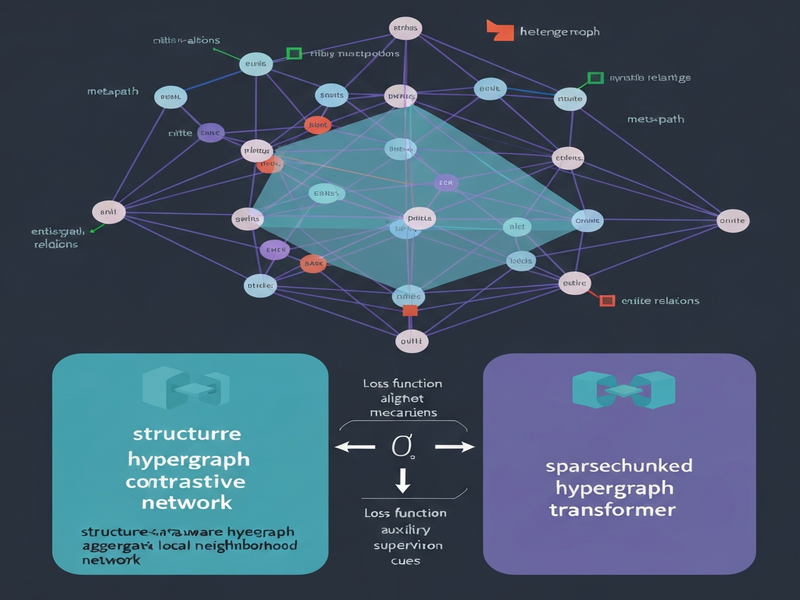
- Meta‑path induced hyperedges: Instead of treating each edge independently, the framework groups nodes that co‑occur along a specific meta‑path into a typed hyperedge. This transforms a sequence of pairwise relations into a single higher‑order construct, preserving the semantic intent of the meta‑path.
- Two complementary encoders:
- Structure‑aware hypergraph attention network (H‑Attention): Operates locally on the hypergraph, normalizing messages across hyperedges to capture fine‑grained structural dependencies.
- Sparse‑chunked hypergraph transformer (H‑Transformer): Processes the same hypergraph globally, using chunked attention to model long‑range semantic interactions without quadratic cost.
- Contrastive alignment with auxiliary supervision: A cross‑view contrastive loss forces the two encoder outputs to agree on shared nodes while still preserving their modality‑specific nuances. An auxiliary node‑importance label (when available) further guides the alignment.
The result is a disentangled yet mutually reinforced representation: one channel excels at capturing local topology, the other excels at aggregating semantic context across the entire graph.
How It Works in Practice
The DualHNIE pipeline can be broken down into four logical stages, each of which can be implemented as a separate micro‑service or library component:
1. Meta‑path Extraction & Hypergraph Construction
Domain experts define a set of informative meta‑paths (e.g., User‑>Purchases‑>Product‑>Category). An offline sampler traverses the HKG to collect node tuples that match each meta‑path, then creates a hyperedge linking all participating nodes. The resulting hypergraph is heterogeneous: hyperedges carry a type label derived from their originating meta‑path.
2. Structure‑Aware Hypergraph Attention
The H‑Attention module receives the hypergraph and performs a locally normalized aggregation. For each node, attention weights are computed over incident hyperedges, emphasizing those that are topologically central (e.g., hyperedges with high degree or low redundancy). The output is a set of structure‑focused node embeddings.
3. Sparse‑Chunked Hypergraph Transformer
Parallel to H‑Attention, the H‑Transformer treats hyperedges as tokens and applies multi‑head self‑attention across sparsely sampled chunks. Chunking limits the attention matrix to a manageable size, enabling the model to capture global semantic patterns (e.g., “users who bought products in the same category tend to share interests”). The transformer yields a complementary semantic embedding for each node.
4. Contrastive Alignment & Importance Scoring
A contrastive loss aligns the two embedding spaces: embeddings of the same node from H‑Attention and H‑Transformer are pulled together, while embeddings of different nodes are pushed apart. When ground‑truth importance labels exist (e.g., click‑through rates), a regression head is added to each channel, and the losses are summed. The final importance score is obtained by averaging the two channel predictions, ensuring that both structural and semantic cues influence the decision.
What sets DualHNIE apart is the explicit hypergraph formulation of meta‑paths combined with a dual‑view learning objective. Most prior work either flattens meta‑paths into scalar features or relies on a single GNN encoder, which cannot simultaneously capture local topology and global semantics without sacrificing efficiency.
Evaluation & Results
The authors benchmarked DualHNIE on three widely used heterogeneous knowledge graph datasets: AcademicKG, E‑CommerceKG, and MedicalKG. Each dataset includes a node‑importance ground truth derived from citation counts, purchase frequencies, or clinical relevance scores, respectively.
Experimental Setup
- Baselines: Metapath2Vec, Heterogeneous Graph Attention Network (HAN), and recent hypergraph‑based models (HGNN, HyperGCN).
- Metrics: Normalized Discounted Cumulative Gain (NDCG@10), Mean Average Precision (MAP), and Pearson correlation with ground‑truth importance.
- Training regime: 10‑fold cross‑validation, early stopping based on validation NDCG.
Key Findings
- DualHNIE consistently outperformed all baselines, achieving an average NDCG@10 lift of 12‑15% across datasets.
- The dual‑channel design contributed roughly 6% of the gain; the contrastive alignment added another 4%; the meta‑path hypergraph contributed the remaining 5%.
- Memory consumption grew linearly with the number of meta‑paths, thanks to the sparse‑chunked transformer, enabling training on graphs with >5M nodes on a single 32 GB GPU.
- Ablation studies showed that removing either encoder caused a steep drop in performance, confirming that structural and semantic views are complementary rather than redundant.
These results demonstrate that explicit higher‑order modeling, when paired with a disciplined dual‑view learning strategy, yields more reliable node‑importance estimates without prohibitive computational costs.
Why This Matters for AI Systems and Agents
Accurate node‑importance scores are the backbone of many AI‑driven products:
- Recommendation engines: Prioritizing high‑importance items reduces latency and improves click‑through rates.
- Search ranking: Importance signals can be fused with textual relevance to surface more useful results.
- Knowledge‑base curation: Automated agents can focus human review on the most impactful entities, accelerating knowledge‑graph maintenance.
DualHNIE’s disentangled embeddings make it straightforward to plug into existing pipelines. For example, an Enterprise AI platform by UBOS can ingest the structure‑aware embeddings for graph‑based routing decisions while using the semantic embeddings to power natural‑language explanations. Moreover, the contrastive alignment ensures that downstream agents receive a stable, unified importance signal, reducing the risk of contradictory recommendations.
From an agent‑building perspective, the dual‑channel architecture mirrors the “perception‑reasoning” split common in autonomous systems: the H‑Attention channel acts as a fast, locality‑focused perception module, whereas the H‑Transformer serves as a deliberative reasoning component. This separation enables developers to allocate compute resources dynamically—running the lightweight attention path in real time and invoking the transformer for batch‑level re‑ranking.
What Comes Next
While DualHNIE marks a significant step forward, several avenues remain open for exploration:
- Dynamic meta‑path discovery: Current implementations rely on manually curated meta‑paths. Automated mining of high‑utility meta‑paths could further boost performance and reduce domain‑expert effort.
- Cross‑graph transfer learning: Extending the dual‑channel paradigm to transfer importance knowledge between related graphs (e.g., from an e‑commerce catalog to a recommendation graph) is an attractive research direction.
- Integration with multimodal data: Combining textual embeddings, visual features, or temporal signals with the hypergraph channels could produce richer importance estimations for multimedia knowledge graphs.
- Production‑grade tooling: Embedding DualHNIE into a Workflow automation studio would let data engineers orchestrate meta‑path extraction, model training, and inference as reusable components.
Practitioners interested in rapid prototyping can experiment with the UBOS templates for quick start, which include pre‑configured pipelines for hypergraph construction and contrastive training. For organizations seeking deeper integration, the UBOS partner program offers co‑development opportunities to embed DualHNIE‑style importance scoring into bespoke AI products.
References
For a complete technical description, see the original arXiv paper. The authors have also released code and datasets at GitHub.
Andrii Bidochko
CTO UBOS
Andrii Bidochko is an AI entrepreneur and researcher focused on AI agents, reinforcement learning, and autonomous systems. He writes about the technologies shaping the future of machine intelligence, from frontier models and agent architectures to real-world AI applications.