

- Updated: August 5, 2026
- 6 min read
MediaWiki Code2Code Search: Neural Retrieval for the Semantic Discovery of Open‑Source Software Entities
Direct Answer
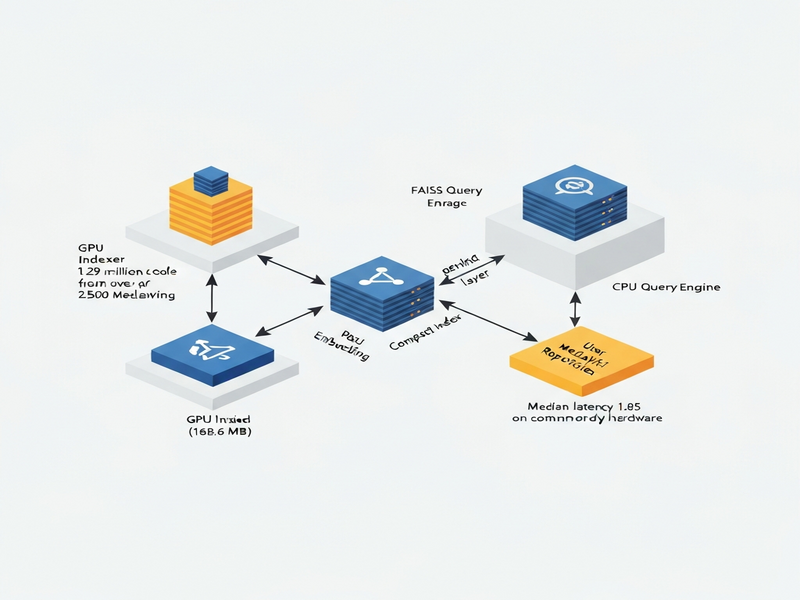
MediaWiki Code2Code Search is a neural‑powered retrieval system that lets developers discover open‑source software entities—functions, types, and templates—by their computational intent rather than by exact keyword matches. By combining a GPU‑heavy offline indexing stage with a lightweight CPU‑only serving layer, the system delivers semantic code‑to‑code search at sub‑2‑second latency while fitting inside the modest 6 GiB RAM budget of Wikimedia Toolforge.
Background: Why This Problem Is Hard
Large‑scale code ecosystems such as the 2,500+ MediaWiki repositories host more than a million distinct software entities. Finding the right piece of code in that sea is difficult for three intertwined reasons:
- Lexical gap: Developers often describe the behavior they need (“parse a CSV”, “render a table”) using natural language that does not overlap with the identifiers or comments present in the source.
- Latency vs. precision trade‑off: Classic information‑retrieval (IR) techniques like BM25 are fast but rely on exact token overlap, leading to poor recall on obfuscated or poorly documented code. Deep‑learning (DL) models capture semantics but typically require GPU inference, which is costly for interactive services.
- Resource constraints: Open‑source hosting platforms (e.g., Wikimedia Toolforge) impose strict memory and CPU limits, making it impractical to keep large dense vectors in memory for every query.
These challenges mean that existing code‑search tools either miss relevant results or cannot scale to the size of modern open‑source ecosystems. As AI‑augmented development tools become mainstream, the need for a fast, semantically aware code search that respects platform constraints has never been more pressing.
What the Researchers Propose
The authors introduce a split‑build architecture that separates the computationally intensive indexing phase from the low‑latency serving phase. The core ideas are:
- Neural embedding of code entities: Each function, type, or template is transformed into a dense vector that captures its computational intent, using a transformer‑based encoder trained on a large corpus of MediaWiki code.
- FAISS IVF‑PQ index: Vectors are stored in a product‑quantized inverted file index (IVF‑PQ), which compresses the representation by 96.6 % compared with a flat float32 matrix, reducing the on‑disk footprint to 168.6 MB.
- CPU‑only serving layer: At query time, a lightweight CPU process loads the compressed index, performs approximate nearest‑neighbor search, and returns the top‑k most semantically similar entities.
By decoupling these stages, the system can leverage powerful GPUs during offline indexing while keeping the online service inexpensive and compliant with Toolforge’s memory limits.
How It Works in Practice
Conceptual workflow
- Data collection: The pipeline crawls 2,500+ MediaWiki repositories, extracting 1.29 million structural entities (functions, types, templates).
- Embedding generation: Each entity’s source code is tokenized and fed into a pre‑trained transformer encoder, producing a 768‑dimensional dense vector.
- Index construction (offline): Vectors are fed into FAISS, which builds an inverted file system (IVF) and applies product quantization (PQ) to compress them.
- Deployment: The compressed index is uploaded to Wikimedia Toolforge, where a CPU‑only service loads it into memory.
- Query handling (online): A user submits a natural‑language or code snippet query. The same encoder produces a query vector, which FAISS searches against the IVF‑PQ index to retrieve the nearest entities.
- Result ranking: Retrieved candidates are re‑scored using a lightweight cross‑encoder to improve precision before being returned via a RESTful API.
Key differentiators
- Semantic focus: Unlike lexical baselines, the system matches on intent, enabling discovery even when identifiers are obfuscated or absent.
- Memory efficiency: The 168.6 MB index fits comfortably within the 6 GiB RAM ceiling, leaving ample headroom for other services.
- Latency guarantee: Median query time of 1.85 seconds on commodity hardware meets interactive expectations for developer tools.
Evaluation & Results
The authors built a 27‑query benchmark that mixes name‑obfuscated tasks (e.g., “find a function that normalizes a vector”) with straightforward lexical queries. Two evaluation modes were used:
- Strict matching: The retrieved entity must exactly implement the requested behavior.
- Relaxed matching: Any entity that plausibly satisfies the intent counts as correct.
Results show a clear advantage over the BM25 baseline:
| Metric | Code2Code Search | BM25 |
|---|---|---|
| P@10 (relaxed) | 0.87 | 0.64 |
| P@10 (strict) | 0.52 | 0.34 |
Performance gains were most pronounced on the name‑obfuscated queries, where lexical methods fell to near‑random recall. The authors also measured storage and latency:
- FAISS IVF‑PQ index size: 168.6 MB (vs. 4.7 GB flat float32).
- Median query latency: 1.85 seconds on a single CPU core.
- Memory usage during serving: <6 GiB, well within Toolforge limits.
These findings demonstrate that neural code retrieval can be both semantically rich and operationally lightweight, a combination rarely achieved in prior work.
Why This Matters for AI Systems and Agents
Semantic code search is a foundational capability for a new generation of AI‑driven development assistants, autonomous agents, and continuous‑integration pipelines. The implications are threefold:
- Agent‑level reasoning: An AI agent tasked with “refactor all CSV parsers” can now locate relevant functions across thousands of repositories without relying on exact naming conventions.
- Toolchain integration: The open RESTful API enables seamless embedding into IDE extensions, CI bots, or low‑code platforms, turning code discovery into a plug‑and‑play service.
- Scalable orchestration: Because the serving layer runs on commodity CPUs, large‑scale orchestration frameworks (e.g., Kubernetes clusters on Wikimedia Toolforge) can spin up many instances to handle bursty developer traffic without incurring GPU costs.
Practically, teams building Enterprise AI platform by UBOS can augment their code‑analysis modules with Code2Code Search to surface reusable components, reducing duplication and accelerating time‑to‑market. Similarly, AI marketing agents that generate promotional scripts can pull in pre‑tested utility functions from the MediaWiki ecosystem, ensuring higher reliability.
What Comes Next
While the prototype proves the concept, several avenues remain open for improvement:
- Multilingual code support: Extending the encoder to handle languages beyond PHP (e.g., JavaScript, Python) would broaden the searchable corpus.
- Dynamic indexing: Incremental updates to the FAISS index could keep the service in sync with rapid upstream repository changes without full re‑builds.
- User feedback loop: Incorporating click‑through data or relevance judgments could fine‑tune the cross‑encoder re‑ranking stage.
- Hybrid retrieval: Combining lexical BM25 scores with neural similarity in a learned fusion model may capture edge cases where exact token matches still matter.
Future research could also explore integrating the service with Workflow automation studio to trigger automated refactoring pipelines, or pairing it with Openclaw (Clawdbot, MoltBot) bots that automatically suggest code improvements based on discovered patterns.
References
For a complete technical description, see the arXiv paper. The live demo and open‑source API are available at code2codesearch.toolforge.org under the Apache 2.0 licence.
Andrii Bidochko
CTO UBOS
Andrii Bidochko is an AI entrepreneur and researcher focused on AI agents, reinforcement learning, and autonomous systems. He writes about the technologies shaping the future of machine intelligence, from frontier models and agent architectures to real-world AI applications.