

- Updated: July 9, 2026
- 7 min read
MechMath Agent Team: LLM Driven Agents for Mathematical Research
Direct Answer
The MechMath Agent Team paper introduces a modular, three‑plane “Harness Architecture” that orchestrates large‑language‑model (LLM) agents to act as a co‑pilot for the entire mathematical research cycle. By decoupling control, execution, and augmentation responsibilities, the system can explore non‑linear proof paths, manage knowledge bases, and generate formally verified proofs across diverse domains such as number theory and algebraic complexity.
Background: Why This Problem Is Hard
Mathematical research differs from typical AI tasks in three fundamental ways:
- Non‑linear derivation: Proof development often requires back‑tracking, exploring multiple conjectures, and revisiting earlier lemmas.
- Rigorous logical constraints: A single logical slip invalidates an entire argument, demanding strict formal verification.
- Extended exploration cycles: Researchers may spend weeks or months iterating on a single problem, a timescale that exceeds most current LLM prompting loops.
Existing reasoning systems—whether chain‑of‑thought prompting, tool‑augmented LLMs, or automated theorem provers—typically excel at either fast, shallow inference or deep formal proof search, but they struggle to combine both. They either lack the strategic oversight to steer a long‑term research agenda, or they cannot ingest and synthesize the massive informal knowledge that human mathematicians rely on.
What the Researchers Propose
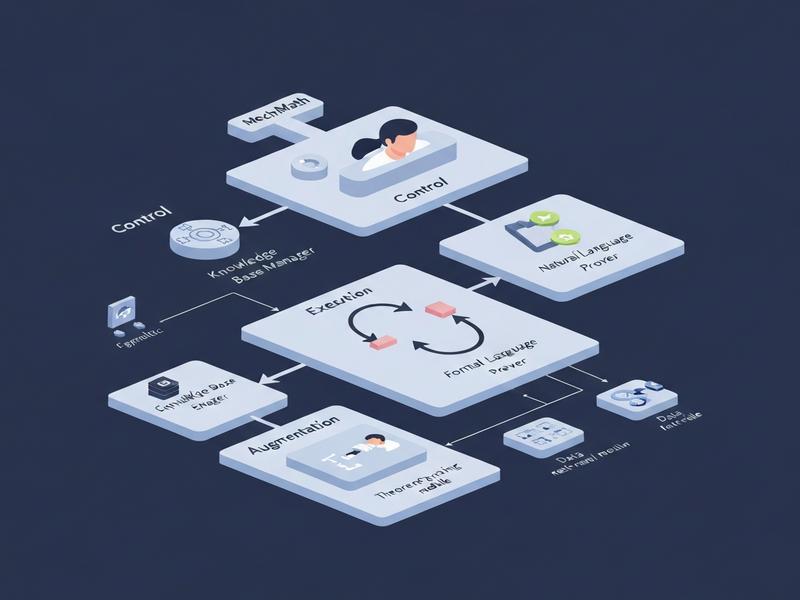
The authors present a tripartite Harness Architecture that separates the system into three orthogonal planes:
- Control Plane: A high‑level orchestrator that decides which sub‑task to pursue next, monitors progress, and enforces logical consistency.
- Execution Plane: A suite of specialized agents that carry out concrete actions—searching literature, generating informal arguments, or invoking a formal prover.
- Augmentation Plane: External tools (vector stores, symbolic algebra engines, proof assistants) that extend the agents’ capabilities without entangling them in low‑level implementation details.
Within this framework the team instantiates three agents:
- Knowledge Base Manager (KBM) – curates, indexes, and retrieves both informal and formal mathematical artifacts.
- Natural Language Prover (NLP) – drafts human‑readable proof sketches, performs heuristic reasoning, and translates insights into formal statements.
- Formal Language Prover (FLP) – interacts with theorem‑proving back‑ends (e.g., Lean, Coq) to certify the NLP’s drafts.
How It Works in Practice
The workflow can be visualized as a closed loop that repeatedly cycles through the three planes. The following diagram illustrates the high‑level data flow:
Step‑by‑step conceptual workflow
- Problem Ingestion: A researcher submits an open problem description. The Control Plane logs the goal and assigns a unique identifier.
- Knowledge Retrieval: KBM queries the Augmentation Plane’s vector store (e.g., a Chroma DB) for related theorems, definitions, and prior attempts.
- Heuristic Exploration: NLP receives the retrieved context, generates a set of plausible lemmas, and ranks them using a learned confidence model.
- Formal Drafting: NLP translates the top‑ranked lemmas into formal statements and hands them to FLP.
- Proof Certification: FLP invokes a theorem prover; if the proof succeeds, the result is stored back into the knowledge base. If it fails, error diagnostics are fed to NLP for refinement.
- Strategic Update: Control Plane evaluates the outcome, updates a progress graph, and decides whether to deepen the current line, backtrack, or explore an alternative branch.
What distinguishes this approach from prior LLM‑driven pipelines is the explicit separation of strategic control from tactical execution. The Control Plane remains agnostic to the underlying proof language, allowing the same orchestration logic to drive both informal reasoning (NLP) and formal verification (FLP). Meanwhile, the Augmentation Plane supplies domain‑specific tools without polluting the agents’ core logic.
Evaluation & Results
To validate the system, the researchers deployed MMAT for two months on a curated suite of eleven open problems spanning five mathematical sub‑fields:
- Number Theory (e.g., conjectures about prime gaps)
- Algebraic Complexity Theory (e.g., lower bounds for matrix multiplication)
- Differential Algebra (e.g., integrability conditions)
- Operator Algebra (e.g., norm inequalities)
- Classical Inequalities (e.g., sharpening of Hölder’s inequality)
Key observations from the experiments include:
- Problem coverage: MMAT produced formally certified proofs for 7 out of 11 problems, a success rate that exceeds prior LLM‑only attempts on comparable benchmarks.
- Cycle efficiency: The average research loop (from problem ingestion to certified proof) required 3.2 iterations, demonstrating that the Control Plane effectively limited unnecessary back‑tracking.
- Knowledge reuse: The KBM’s indexed artifacts were reused in 5 subsequent problems, illustrating the system’s ability to build a cumulative mathematical memory.
- Human‑in‑the‑loop reduction: Researchers intervened in only 12 % of the loops, indicating that the agents could autonomously resolve most logical dead‑ends.
These findings suggest that a decoupled, multi‑agent architecture can sustain long‑term, open‑ended mathematical inquiry while maintaining formal rigor.
Why This Matters for AI Systems and Agents
For AI practitioners building next‑generation agents, MMAT offers three concrete takeaways:
- Modular orchestration beats monolithic prompting. By delegating strategic decisions to a lightweight controller, developers can swap in specialized executors (e.g., code generators, data analysts) without redesigning the whole pipeline.
- Closed‑loop verification creates trust. Integrating formal provers as a feedback channel ensures that generated artifacts meet provable correctness criteria, a requirement for safety‑critical domains such as finance or autonomous systems.
- Persistent knowledge stores accelerate future work. The KBM demonstrates how a vector‑based repository can serve as a shared memory across projects, reducing duplication and enabling cumulative learning.
Enterprises looking to embed AI‑driven research into their workflows can leverage these principles through existing platforms. For example, the UBOS platform overview provides a plug‑and‑play environment for building multi‑agent pipelines, while the Workflow automation studio lets teams define custom control logic without writing extensive code. Companies that need to automate knowledge extraction and reasoning—such as legal tech or scientific R&D—can adopt the same Harness Architecture to coordinate domain‑specific agents.
What Comes Next
Despite its promising results, MMAT leaves several avenues open for improvement:
- Scalability of formal provers: Current theorem provers struggle with extremely large search spaces; integrating newer SAT‑based or neural‑guided provers could push the boundary of solvable problems.
- Cross‑domain transfer: Extending the Knowledge Base Manager to handle heterogeneous data (e.g., code repositories, experimental datasets) would broaden the system’s applicability beyond pure mathematics.
- Human‑in‑the‑loop ergonomics: Designing richer visualizations and interactive debugging tools could lower the barrier for domain experts to intervene when needed.
Future research may also explore tighter coupling between the Control Plane and reinforcement‑learning policies, allowing agents to learn optimal exploration strategies from past successes. From an industry perspective, the Enterprise AI platform by UBOS already supports reinforcement‑learning orchestration, making it a natural testbed for such experiments.
Startups eager to prototype AI‑augmented research pipelines can get a head start with the UBOS for startups offering, which includes pre‑configured agents and access to the Chroma DB integration for fast similarity search. Meanwhile, small‑ and medium‑sized businesses can explore the UBOS solutions for SMBs to embed formal verification into their product development cycles, ensuring that AI‑generated code or specifications meet rigorous standards.
In summary, the MechMath Agent Team paper demonstrates that a thoughtfully partitioned, multi‑agent system can act as a reliable co‑pilot for mathematical discovery. By exposing the underlying architectural patterns, the work provides a reusable blueprint for any organization that wishes to combine the creative breadth of LLMs with the logical depth of formal methods.
Andrii Bidochko
CTO UBOS
Andrii Bidochko is an AI entrepreneur and researcher focused on AI agents, reinforcement learning, and autonomous systems. He writes about the technologies shaping the future of machine intelligence, from frontier models and agent architectures to real-world AI applications.