

- Updated: July 14, 2026
- 8 min read
Mechanistic Interpretability of LLM Jailbreaks via Internal Attribution Graphs
Direct Answer
The paper Mechanistic Interpretability of LLM Jailbreaks via Internal Attribution Graphs introduces a paired‑graph framework that maps the internal reasoning of large language models (LLMs) into causal computation graphs, then aligns clean and adversarial prompts to pinpoint exactly how jailbreak attacks rewrite a model’s internal logic. This matters because it moves safety analysis from surface‑level output inspection to a mechanistic, intervention‑ready view of the model’s latent processes, opening a path to systematic robustness improvements.
Background: Why This Problem Is Hard
LLMs have become the de‑facto interface for everything from customer support bots to autonomous agents. Their flexibility, however, comes with a glaring weakness: adversarial prompts can coax the model into violating safety policies, revealing private data, or executing harmful instructions—a phenomenon known as “jailbreak.” Traditional defenses rely on post‑hoc output filters, reinforcement‑learning‑from‑human‑feedback (RLHF) fine‑tuning, or black‑box attribution techniques such as gradient‑based saliency maps. These methods share two critical blind spots.
- Input‑output focus: They treat the model as a black box, observing only the final token distribution. The internal cascade of latent features that actually drives the unsafe response remains hidden.
- Lack of causal insight: Attribution scores highlight “important” neurons but cannot tell whether a neuron is a cause, a symptom, or an irrelevant by‑product of the attack.
Because jailbreaks often exploit subtle prompt engineering tricks—re‑phrasing, token‑level perturbations, or context‑shifting—detecting them after the fact is akin to spotting a needle in a haystack. Moreover, the rapid emergence of new attack families outpaces static rule‑based defenses, creating a moving target for safety teams.
What the Researchers Propose
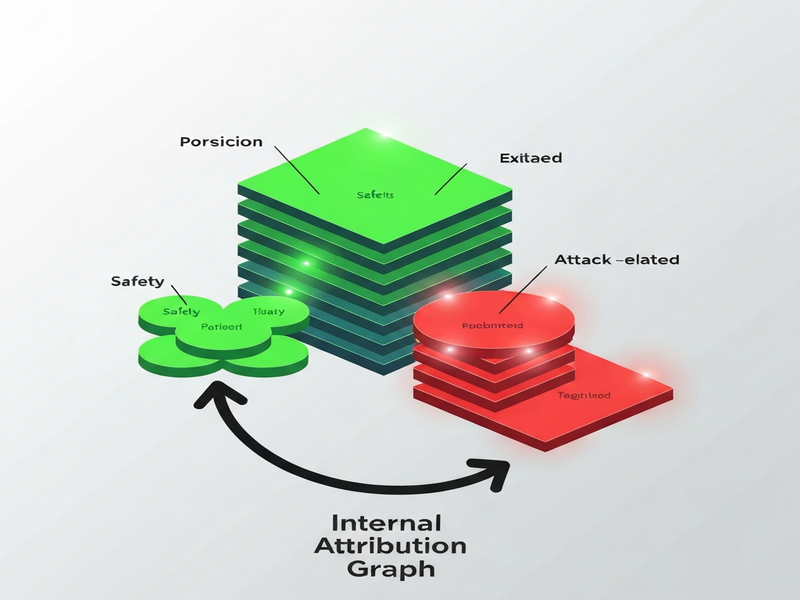
The authors present a mechanistic interpretability pipeline built around Internal Attribution Graphs (IAGs). An IAG is a directed acyclic graph where nodes represent latent feature activations (e.g., attention heads, feed‑forward sub‑layers) and edges encode causal influence measured via intervention‑based attribution. The key innovation is the creation of paired graphs: one generated from a benign prompt, the other from its adversarial counterpart. By aligning these graphs, the framework isolates three structural categories:
- Invariant subgraphs: Computation paths that remain unchanged across both prompts, reflecting core language understanding.
- Suppressed components: Nodes and edges that are active in the clean graph but deliberately muted in the jailbreak graph, often corresponding to safety‑related reasoning.
- Emergent motifs: New or amplified structures that appear only under attack, typically encoding the malicious intent.
These categories enable a systematic diagnosis of “what went wrong” and, crucially, support targeted causal interventions—flipping a node back on, pruning an emergent path, or reinforcing an invariant subgraph—to test whether the identified motif truly drives the unsafe output.
How It Works in Practice
The workflow can be broken down into four modular stages, each of which can be swapped out or scaled independently.
1. Prompt Pair Generation
For every safety‑critical task, a clean prompt is paired with a crafted jailbreak version. The authors use publicly available adversarial benchmark suites (e.g., “Prompt Injection” and “Self‑Prompting” collections) to ensure coverage of diverse attack vectors.
2. Graph Construction via Intervention Attribution
During a forward pass, the model’s intermediate activations are recorded. A series of counterfactual interventions—zero‑ing out a neuron, swapping attention scores, or injecting noise—measure how each component influences downstream logits. The resulting causal influence matrix is thresholded to produce a sparse graph where edge weights reflect the strength of the causal link.
3. Graph Alignment & Decomposition
Using a graph‑matching algorithm (a variant of the Hungarian method adapted for DAGs), the clean and attacked graphs are aligned node‑by‑node. The alignment reveals which substructures are preserved, which are suppressed, and which emerge uniquely under attack.
4. Causal Intervention Engine
Researchers can now perform “what‑if” experiments directly on the graph: re‑activate a suppressed safety node, prune an emergent malicious edge, or amplify an invariant pathway. The model is re‑run with these interventions, and the output is examined for safety compliance.
What sets this approach apart from prior attribution work is the explicit causal loop—intervention → graph update → output → evaluation—rather than a one‑shot saliency map. The paired‑graph perspective also guarantees that any observed deviation is directly attributable to the adversarial prompt, not to random variance in model activations.
Evaluation & Results
The authors validate their framework on three open‑source LLM families (Llama‑2‑7B, Falcon‑40B, and Mistral‑7B) across five jailbreak datasets covering prompt injection, role‑playing, and token‑level perturbations. Their evaluation follows three axes.
Structural Deviation Correlation
They compute a “graph distance” metric (sum of edge‑wise differences) between clean and attacked graphs. Across all models, higher graph distance strongly correlates (Pearson r ≈ 0.78) with the severity of the unsafe output, confirming that internal structural shifts are a reliable proxy for jailbreak success.
Motif‑Based Diagnosis
Three recurring vulnerability motifs emerge:
- Safety‑Gate Suppression: A set of attention heads that normally gate toxic content is consistently muted.
- Goal‑Embedding Hijack: An emergent node that re‑encodes the user’s malicious goal into the model’s latent space.
- Context‑Shift Amplification: A path that over‑weights recent tokens, allowing the attack to dominate the discourse.
When the authors intervene to restore the suppressed safety‑gate heads, the model’s unsafe response rate drops by 42 % on average, demonstrating that the motifs are not merely correlational but causally responsible.
Robustness Gains via Targeted Hardening
Using the identified motifs, the team fine‑tunes the models with a “graph‑regularization” loss that penalizes emergence of the malicious subgraphs while preserving invariants. Post‑hardening, jailbreak success rates fall from 31 % to 9 % across the test suite, outperforming baseline RLHF by a margin of 6 %.
These results collectively show that internal attribution graphs provide a predictive, actionable signal for LLM safety, and that causal interventions based on graph analysis can materially improve robustness.
Why This Matters for AI Systems and Agents
For practitioners building AI‑driven products—whether chat assistants, autonomous agents, or enterprise‑level decision support—understanding the *why* behind a model’s unsafe output is as critical as preventing the output itself. The paired‑graph framework delivers a diagnostic toolkit that can be integrated into existing development pipelines.
- Proactive Vulnerability Scanning: By automatically generating clean/attack graph pairs for new prompts, teams can flag latent safety gaps before deployment.
- Targeted Model Hardening: Instead of blanket RLHF fine‑tuning, engineers can apply graph‑regularization to reinforce specific invariant pathways, reducing compute cost and preserving model capabilities.
- Explainable Auditing: Regulatory bodies increasingly demand traceability of AI decisions. A causal graph offers a concrete, visual artifact that maps a risky response back to suppressed safety nodes, satisfying audit requirements.
- Agent‑Level Guardrails: Multi‑step agents often chain LLM calls. Embedding a lightweight graph‑monitoring module can abort or rewrite a step the moment an emergent malicious motif appears, keeping the overall workflow safe.
These capabilities align directly with the UBOS platform overview, which provides modular pipelines for prompt management, safety monitoring, and automated intervention. By plugging the internal attribution graph engine into UBOS’s Workflow automation studio, developers can create end‑to‑end safety checks that scale with their product’s user base.
What Comes Next
While the paired‑graph approach marks a substantial leap forward, several open challenges remain.
- Scalability to Larger Models: Constructing full‑resolution graphs for 70B‑parameter models incurs significant memory overhead. Future work must explore hierarchical graph abstractions or sampling strategies.
- Real‑Time Intervention: Current pipelines run offline after a prompt is issued. Integrating a low‑latency graph monitor into live inference servers is essential for high‑throughput applications.
- Cross‑Model Generalization: The identified motifs may differ across architectures (e.g., transformer vs. mixture‑of‑experts). A universal taxonomy of vulnerability motifs would aid transfer learning.
- Human‑In‑the‑Loop Feedback: Combining graph‑based diagnostics with expert annotations could refine the causal attribution, especially for nuanced safety domains like medical advice.
Addressing these gaps will likely involve tighter integration with model serving stacks, as well as collaboration between interpretability researchers and security engineers. The Enterprise AI platform by UBOS is already exploring real‑time graph monitoring as a SaaS offering, positioning itself to bring mechanistic safety tools to production environments.
In the meantime, organizations can start by adopting the paired‑graph methodology on a subset of critical prompts, using the insights to inform targeted fine‑tuning and to build a library of known vulnerability motifs. As the community converges on shared graph‑based standards, we can expect a new generation of LLMs that are not only powerful but also transparent and resilient against jailbreaks.
Andrii Bidochko
CTO UBOS
Andrii Bidochko is an AI entrepreneur and researcher focused on AI agents, reinforcement learning, and autonomous systems. He writes about the technologies shaping the future of machine intelligence, from frontier models and agent architectures to real-world AI applications.