

- Updated: July 30, 2026
- 7 min read
Measure the Sim-to-Real Gap: Designing an Affordable Real-World Benchmark Platform for Reinforcement Learning in AIoT Systems
Direct Answer
The paper introduces a low‑cost, reproducible real‑world benchmark platform that quantifies the Sim‑to‑Real gap for reinforcement‑learning (RL) agents operating in AIoT environments. By letting an edge‑deployed agent control a video‑game via a hardware‑emulated keyboard, the authors expose a dramatic performance drop from simulation to reality, while also proving that direct real‑world training is feasible on modest hardware.
Background: Why This Problem Is Hard
Reinforcement learning thrives on trial‑and‑error, but in the physical world each mistake can be expensive, dangerous, or simply impossible to repeat. AIoT systems—ranging from smart factories to autonomous drones—amplify this tension because they must react to noisy sensor streams, latency, and hardware constraints that simulators rarely capture. Consequently, most research stays inside virtual environments, assuming that a policy that excels in simulation will transfer seamlessly to the field.
In practice, the Sim‑to‑Real gap manifests as:
- Domain shift in visual inputs (lighting, texture, motion blur).
- Non‑deterministic actuation delays caused by edge‑device drivers.
- Resource‑limited compute that forces lower‑precision inference.
- Safety and regulatory constraints that prohibit unrestricted exploration.
Existing approaches to bridge this gap—domain randomization, system identification, and sim‑to‑real fine‑tuning—rely on bespoke hardware rigs or expensive testbeds that are inaccessible to most research labs and startups. Moreover, there is no universally accepted benchmark that isolates the RL component from the surrounding AIoT stack, making it difficult to compare algorithms on a level playing field.
What the Researchers Propose
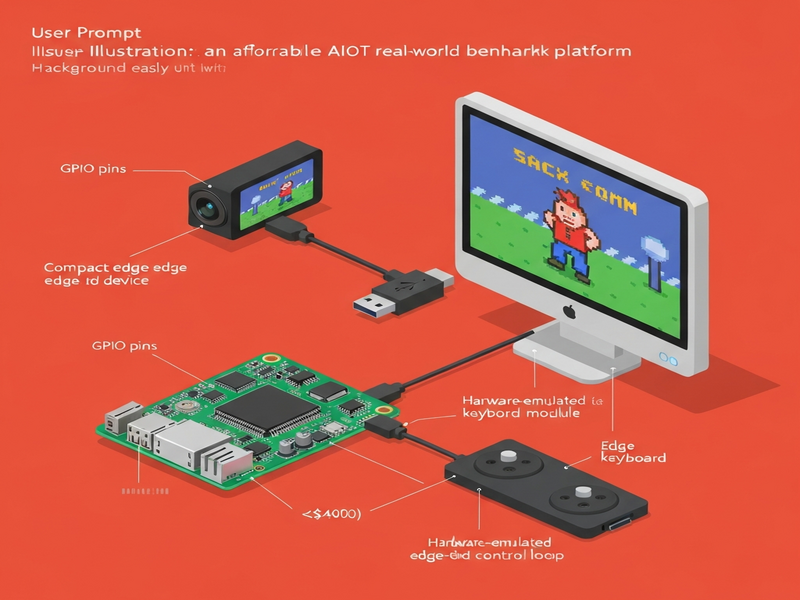
The authors present an affordable, modular benchmark platform built from off‑the‑shelf components costing under USD 400, plus two standard computers. The core idea is to treat a classic video game as a proxy for a real‑world control task. An RL agent runs on an edge device (e.g., a Raspberry Pi or similar) and receives raw screen captures as visual observations. It then outputs keyboard events through a hardware‑emulated interface that physically presses keys on a host computer running the game. This closed loop mimics the perception‑action cycle of an AIoT system while eliminating safety hazards.
Key components include:
- Edge Agent Node: Executes the RL policy, processes video frames, and issues keystrokes.
- Hardware Keyboard Emulator: A microcontroller that translates digital commands into electrical keypress signals.
- Host Game Machine: Runs the target game, providing the reward signal (score) back to the agent via a lightweight network channel.
- Vision Pipeline: Simple preprocessing (grayscale, down‑sampling) that keeps the perception stack realistic yet lightweight.
By decoupling the RL loop from any proprietary simulation engine, the platform can be reproduced by any lab with a modest budget, enabling systematic measurement of how policies degrade when moving from simulation to a tangible device.
How It Works in Practice
Conceptual Workflow
- Simulation Pre‑training: Researchers first train a deep Q‑network (DQN) in a software emulator of the game, using the same visual preprocessing as the real hardware.
- Policy Export: The trained network weights are transferred to the edge device.
- Real‑World Deployment: The edge device captures live screenshots from the host monitor, feeds them through the DQN, and generates a keyboard command.
- Hardware Emulation: The microcontroller receives the command over USB and electrically closes the appropriate key matrix contacts, causing the host computer to register a keypress.
- Reward Feedback: The host game reports the current score; a lightweight socket transmits this scalar back to the edge device for online learning or evaluation.
Interaction Between Components
The vision pipeline runs at ~30 fps, ensuring the agent perceives the game in near‑real time. The keyboard emulator introduces a deterministic latency of ~5 ms, which is deliberately measured and logged to study its impact on policy performance. All communication uses standard TCP/IP, allowing the system to be scaled across a LAN or even a Wi‑Fi network without custom drivers.
What Sets This Approach Apart
- Cost Efficiency: No specialized robotics arms or custom sensor rigs are required.
- Safety by Design: The “game score” objective eliminates any physical risk to humans or equipment.
- Reproducibility: Bill of materials and wiring diagrams are fully open, enabling exact replication.
- Edge‑Centric Focus: By running the policy on a constrained device, the benchmark reflects real AIoT deployment constraints.
Evaluation & Results
Test Scenarios
The researchers selected a classic arcade game (e.g., “Space Invaders”) as the testbed because its reward structure is simple (score maximization) and its control scheme maps cleanly to a keyboard. Two experimental tracks were pursued:
- Sim‑to‑Real Transfer: Policies trained exclusively in simulation were deployed on the hardware platform.
- Direct Real‑World Training: The DQN algorithm was run end‑to‑end on the edge device, learning directly from the live game feed.
Key Findings
- Simulation‑trained agents suffered a 1160 % performance degradation relative to human baseline when evaluated on the physical platform, confirming a substantial Sim‑to‑Real gap.
- When trained directly on the hardware for 10 million steps, the agent achieved roughly 38 % of human‑level score, demonstrating that real‑world RL on low‑cost edge hardware is viable.
- Latency analysis revealed that each additional 10 ms of actuation delay reduced score by ~5 %, highlighting the sensitivity of RL policies to timing jitter.
- Resource profiling showed the edge device consumed < 150 mW on average, underscoring the platform’s suitability for battery‑operated AIoT deployments.
These results collectively validate the benchmark’s ability to surface both algorithmic weaknesses (e.g., over‑fitting to simulated dynamics) and system‑level constraints (e.g., latency, compute budget) that are often invisible in pure simulation studies.
Why This Matters for AI Systems and Agents
For practitioners building AIoT solutions, the paper delivers a concrete yardstick to measure how far a policy can be trusted outside the lab. The benchmark’s affordability means startups and research groups can iterate rapidly, testing domain‑randomization tricks, meta‑learning approaches, or hardware‑aware network compression without incurring prohibitive costs.
From an engineering perspective, the platform forces developers to confront real‑world bottlenecks—sensor noise, actuation latency, and limited compute—early in the development cycle. This leads to more robust agent architectures that are less reliant on perfect simulation fidelity.
Moreover, the open‑source nature of the benchmark encourages community‑driven extensions, such as swapping the game for a custom UI that mirrors a specific IoT control panel. By providing a shared reference point, the work paves the way for standardized reporting of Sim‑to‑Real metrics across papers, much like ImageNet did for computer vision.
Organizations looking to accelerate AI adoption can integrate the benchmark into their Enterprise AI platform by UBOS to automatically evaluate new RL models before deployment, reducing costly field failures.
What Comes Next
While the platform proves that low‑cost real‑world RL is possible, several limitations remain:
- Task Diversity: Current experiments focus on a single arcade game; expanding to multi‑modal tasks (e.g., sensor fusion, multi‑agent coordination) will broaden relevance.
- Scalability: The benchmark runs a single agent per host; future work could orchestrate fleets of edge devices to study distributed learning.
- Domain Randomization Integration: Systematic evaluation of randomization strategies on this hardware would quantify their true benefit.
- Hardware Variability: Testing across different edge processors (e.g., NVIDIA Jetson, Coral TPU) would reveal architecture‑specific trade‑offs.
Addressing these gaps could lead to a full‑featured UBOS platform overview for AIoT research, where teams spin up virtual twins, run Sim‑to‑Real benchmarks, and deploy validated agents with a single click.
Potential applications extend beyond gaming proxies. Imagine a smart‑grid controller that learns to balance load in a simulated environment, then validates its policy on a physical test‑bed that mimics real power‑line latency and sensor drift. The same methodology could accelerate autonomous vehicle perception stacks, warehouse robotics, or even personalized health‑monitoring wearables.
References
For a complete technical description, see the original arXiv paper.
Illustration
Andrii Bidochko
CTO UBOS
Andrii Bidochko is an AI entrepreneur and researcher focused on AI agents, reinforcement learning, and autonomous systems. He writes about the technologies shaping the future of machine intelligence, from frontier models and agent architectures to real-world AI applications.