UBOS Asset Marketplace: MCP Server - Revolutionizing AI Context for Real-Time Applications
In the rapidly evolving landscape of Artificial Intelligence (AI), the ability of AI models to access and interact with external data sources and tools is paramount. This is where the Model Context Protocol (MCP) comes into play. MCP is an open protocol that standardizes how applications provide context to Large Language Models (LLMs). The MCP Server, a critical component in this ecosystem, acts as a bridge, enabling AI models to access and interact with external data sources and tools. Within the UBOS Asset Marketplace, the MCP Server takes on a specific, powerful form: a client-ASRS-AzureFunction prototype designed for real-time chat applications. This overview delves into the intricacies of this MCP Server, its use cases, key features, and its integration with the UBOS platform.
Understanding the MCP Server: A Deep Dive
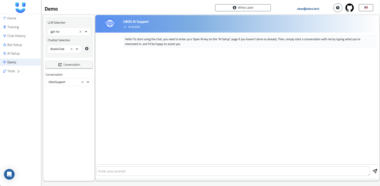
The MCP Server available on the UBOS Asset Marketplace is not just any server; it’s a specialized prototype built on Azure Functions and Azure SignalR Service’s serverless WebSocket feature. This combination allows for the creation of real-time, interactive chat applications with unparalleled scalability and efficiency. The prototype showcases how to implement a simple chat application where users can exchange messages in real-time, leveraging the power of serverless architecture.
Key Components
- Azure Functions: These are event-driven, serverless compute services that allow you to run code without provisioning or managing servers. In this prototype, Azure Functions handle the logic for processing and routing chat messages.
- Azure SignalR Service: This service simplifies adding real-time web functionalities to applications. The serverless WebSocket feature enables persistent connections between clients and the server, facilitating real-time communication.
- Client-ASRS Architecture: The architecture involves a client application (e.g., a web browser) communicating with Azure SignalR Service (ASRS) through WebSocket connections. The ASRS then triggers Azure Functions to process messages and broadcast them to other connected clients.
Use Cases: Transforming Real-Time Communication
The MCP Server prototype opens up a wide array of use cases, transforming how real-time communication can be integrated into various applications and industries:
- Real-Time Chat Applications: This is the most evident use case. The prototype provides a foundation for building real-time chat applications for customer support, internal communication, or community engagement.
- Live Collaboration Tools: Beyond simple chat, the MCP Server can be extended to support live collaboration features in document editing, project management, and other collaborative applications.
- Interactive Gaming: Real-time communication is crucial in online gaming. The MCP Server can facilitate real-time interactions between players, enhancing the gaming experience.
- Live Event Streaming: In live event streaming scenarios, the MCP Server can enable real-time chat and Q&A sessions between viewers and presenters.
- IoT Device Communication: The server can be adapted to facilitate real-time communication between IoT devices and a central server, enabling applications such as remote monitoring and control.
Key Features: Powering Real-Time Interactions
The MCP Server prototype boasts several key features that make it a powerful tool for building real-time applications:
- Serverless Architecture: Leveraging Azure Functions and Azure SignalR Service, the prototype eliminates the need for managing servers, reducing operational overhead and scaling costs.
- Real-Time Communication: The use of WebSockets ensures low-latency, real-time communication between clients and the server.
- Scalability: Azure Functions and Azure SignalR Service are designed for scalability, allowing the application to handle a large number of concurrent users without performance degradation.
- Customizable: The prototype provides a solid foundation that can be customized and extended to meet specific application requirements.
- Easy Integration: The MCP Server can be easily integrated with other Azure services and third-party tools, enabling a wide range of possibilities.
- Authentication and Authorization: While the demo uses a simple query parameter for authentication, the prototype can be extended to support more robust authentication mechanisms, such as Azure Active Directory (AAD).
- Upstream Configuration: The server supports upstream configuration, allowing you to define how Azure SignalR Service interacts with your Azure Functions.
Setting Up and Running the MCP Server Prototype
To get started with the MCP Server prototype, you’ll need to follow these steps:
- Prerequisites: Ensure you have Node.js, Visual Studio Code, the Azure Functions extension, and ngrok installed.
- Configuration: Configure the application settings in
local.settings.jsonwith your Azure SignalR Service connection string. - Run Locally: Open the
./chat/serverlessfolder in VS Code and run the Azure Functions. - Expose with ngrok: Use ngrok to expose your local port to the public internet.
- Set Upstream: Configure the upstream URL pattern in Azure SignalR Service to point to your ngrok URL.
- Run the Chat: Visit
http://localhost:7071/api/home?name=yournameto start chatting locally.
Diving into the Code: Understanding the Implementation
The MCP Server prototype consists of two main Azure Functions:
- Home Function: This function hosts the static webpage for the chat application. It simply returns the content of
index.html, providing the Azure SignalR Serverless WebSocket endpoint. - Messages Function: This function handles WebSocket requests. It processes incoming messages and broadcasts them to other connected clients.
Upstream Configuration: A Closer Look
The prototype leverages the upstream configuration feature of Azure SignalR Service. This allows you to define how the service interacts with your Azure Functions. The upstream URL pattern supports three parameters: {event}, {hub}, and {category}. These parameters are dynamically evaluated and replaced by Azure SignalR Service for each client request.
For example, when a client connects to the WebSocket endpoint /ws/client/hubs/chat, the Azure SignalR Service will send a POST request to the configured upstream URL with the event parameter set to connect.
Integrating with the UBOS Platform
The UBOS platform is a full-stack AI Agent Development Platform that empowers businesses to orchestrate AI Agents, connect them with enterprise data, build custom AI Agents with their LLM models, and create Multi-Agent Systems. The MCP Server, as an asset on the UBOS Marketplace, seamlessly integrates into this ecosystem.
Benefits of Integration
- Enhanced AI Context: By providing a standardized way for applications to provide context to LLMs, the MCP Server enhances the ability of AI Agents to understand and respond to user queries.
- Real-Time Capabilities: The real-time communication capabilities of the MCP Server enable AI Agents to interact with users and other systems in real-time.
- Scalability and Reliability: The serverless architecture of the MCP Server ensures scalability and reliability, making it suitable for demanding AI applications.
- Simplified Development: The UBOS platform provides a simplified development environment for building and deploying AI Agents that leverage the MCP Server.
Use Cases within the UBOS Ecosystem
- Real-Time Customer Support AI Agents: Integrate the MCP Server with customer support AI Agents to enable real-time chat and assistance.
- Collaborative AI Agents: Use the server to build collaborative AI Agents that can work together in real-time on complex tasks.
- IoT-Enabled AI Agents: Connect AI Agents to IoT devices using the server to enable real-time monitoring and control.
Conclusion: Empowering Real-Time AI Applications
The MCP Server prototype on the UBOS Asset Marketplace is a powerful tool for building real-time AI applications. By leveraging Azure Functions and Azure SignalR Service, it provides a scalable, reliable, and customizable solution for real-time communication. Its integration with the UBOS platform further enhances its capabilities, enabling businesses to build and deploy sophisticated AI Agents that can interact with users and other systems in real-time. As the AI landscape continues to evolve, the MCP Server will play an increasingly important role in enabling real-time AI applications across various industries.
Serverless WebSocket Chat Sample

Project Details
- vicancy/ws-serverless-sample
- Last Updated: 2/26/2025
Recomended MCP Servers
Next.js project with TypeScript, ESLint, app directory, and TurboPack
World's most advanced database DevSecOps solution for Developer, Security, DBA and Platform Engineering teams. The GitHub/GitLab for database...
Model Context Protocol for strateegia API
MCP Server for interacting with a Steel web browser
A powerful MCP (Model Control Protocol) server for preprocessing and analyzing CSV files. This server provides a suite...
ramp_mcp
Untappd Model Context Protocol Server
A Model Context Protocol (MCP) server that enables AI assistants to query and analyze Azure Data Explorer databases...
Featured Templates
View More