Real-Time Voice Cloning with MCP Server: A Deep Dive
This document provides a comprehensive overview of the Real-Time Voice Cloning project, an implementation of the SV2TTS (Transfer Learning from Speaker Verification to Multispeaker Text-To-Speech Synthesis) framework. This system, detailed in the paper Transfer Learning from Speaker Verification to Multispeaker Text-To-Speech Synthesis, allows users to clone a voice from a short audio sample and generate arbitrary speech in real-time. We will explore its architecture, capabilities, setup, and integration possibilities, particularly within the context of the UBOS AI Agent Development Platform.
Core Technology: SV2TTS
At its heart, the system leverages the SV2TTS framework, a deep learning pipeline consisting of three key stages:
- Voice Encoding: This stage creates a digital representation (embedding) of a speaker’s voice from just a few seconds of audio. This embedding captures the unique characteristics of the voice, allowing the system to differentiate between speakers.
- Speech Synthesis: This stage takes the speaker embedding and arbitrary text as input and generates a corresponding spectrogram. It effectively translates text into the acoustic features of the desired voice.
- Vocoding: The final stage converts the spectrogram into raw audio. This stage uses a neural vocoder to synthesize the audio signal, ensuring high-quality and natural-sounding speech.
The combination of these three stages enables the system to perform real-time voice cloning with impressive accuracy. The original implementation used the WaveRNN vocoder, known for its efficiency and ability to generate high-quality audio. Other models, like Tacotron, also play a role in the overall architecture.
Key Features and Capabilities
- Real-Time Voice Cloning: Clone a voice from a short audio sample (around 5 seconds) and generate speech in real-time.
- Arbitrary Text-to-Speech: Generate speech from any text input, using the cloned voice.
- Speaker Verification to TTS: Leverages transfer learning from speaker verification to improve the quality and naturalness of the synthesized speech.
- Modular Architecture: The system is built with a modular architecture, allowing for easy experimentation with different components and models.
- Open Source: The project is open-source, making it accessible for research and development purposes.
Use Cases
The Real-Time Voice Cloning technology has numerous potential use cases, including:
- Personalized Voice Assistants: Create personalized voice assistants with the user’s own voice.
- Content Creation: Generate realistic voiceovers for videos, podcasts, and other content.
- Accessibility: Provide text-to-speech functionality for users with visual impairments, using a voice that they are familiar with.
- Gaming: Develop interactive characters with unique and realistic voices.
- Customer Service: Automate customer service interactions with personalized voices.
- AI Agents integration: Allow AI agents to speak with a consistent, user-defined voice, enhancing personalization and user experience.
Setup and Installation
Setting up the system involves the following steps:
- Install Requirements: Ensure you have Python 3.7 (or a compatible version), ffmpeg, and PyTorch installed. A GPU is recommended for faster training and inference.
- Install Dependencies: Install the remaining dependencies using
pip install -r requirements.txt. - (Optional) Download Pretrained Models: Pre-trained models for the encoder, synthesizer, and vocoder are required for optimal performance. These are now downloaded automatically, but can also be downloaded manually if needed.
- (Optional) Download Datasets: Download datasets like LibriSpeech for training and experimentation. This is optional, as you can use your own audio data.
- Launch the Toolbox: Run
python demo_toolbox.pyto launch the interactive toolbox, which allows you to experiment with voice cloning and text-to-speech synthesis.
Heads Up: Evolving Landscape
It’s important to note that the field of voice cloning and speech synthesis is rapidly evolving. While this repository provides a solid foundation, more advanced and higher-quality solutions are now available.
Consider exploring these alternatives:
- Paperswithcode: A comprehensive resource for finding state-of-the-art research and repositories in speech synthesis.
- CoquiTTS: An open-source repository with improved voice cloning quality and additional functionalities.
- MetaVoice-1B: A large voice model with high voice quality.
Integration with UBOS AI Agent Development Platform
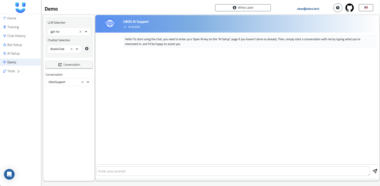
The Real-Time Voice Cloning technology can be seamlessly integrated with the UBOS AI Agent Development Platform. UBOS provides a full-stack environment for building, deploying, and managing AI agents, and the voice cloning capabilities can significantly enhance the functionality and user experience of these agents.
Here’s how the integration works:
- Voice Cloning as a Service: The Real-Time Voice Cloning system can be deployed as a microservice within the UBOS platform.
- AI Agent Access: AI agents developed on UBOS can access this service through a simple API, allowing them to generate speech using cloned voices.
- Personalized Interactions: Agents can use different voices for different users, creating a more personalized and engaging experience.
- Multi-Agent Systems: In multi-agent systems, each agent can have its own unique voice, making it easier to distinguish between agents and understand their roles.
- Data Connection and Orchestration: UBOS’s data connection capabilities allow the voice cloning service to access relevant data sources, such as user profiles and preferences, to further personalize the generated speech.
- Custom AI Agent building: By combining UBOS tools you can build custom AI Agents with your LLM model and use Real-Time Voice Cloning to speak with your own voice.
Benefits of Integrating with UBOS
- Simplified Deployment: UBOS simplifies the deployment and management of the voice cloning service, reducing the operational overhead.
- Scalability: The UBOS platform provides a scalable infrastructure for handling a large number of requests.
- Security: UBOS provides robust security features to protect sensitive data and prevent unauthorized access.
- Centralized Management: UBOS provides a centralized management interface for monitoring and controlling all AI agents and services.
- Enhanced Functionality: Integrating with UBOS allows you to combine voice cloning with other AI capabilities, such as natural language processing and machine learning, to create more sophisticated and powerful AI agents.
Technical Details
The SV2TTS implementation relies on several key deep learning models:
- GE2E (Generalized End-To-End Loss for Speaker Verification): This model is used for creating the speaker embeddings. It learns to discriminate between different speakers based on their voice characteristics.
- Tacotron (Synthesizer): This model converts text into a spectrogram, which represents the acoustic features of the speech.
- WaveRNN (Vocoder): This model synthesizes raw audio from the spectrogram.
The system is trained on large datasets of speech data, such as LibriSpeech, to learn the relationships between text, voice characteristics, and audio signals.
Conclusion
The Real-Time Voice Cloning project offers a powerful and versatile solution for generating realistic speech using cloned voices. Its open-source nature and modular architecture make it a valuable tool for researchers, developers, and anyone interested in exploring the potential of voice cloning technology. When integrated with a platform like UBOS, its capabilities are significantly amplified, enabling the creation of highly personalized and engaging AI agents. As the field of speech synthesis continues to advance, this project serves as a strong foundation for future innovation and development. Explore the linked repositories like CoquiTTS and MetaVoice-1B for even higher voice quality and broader functionality to remain at the cutting edge of this rapidly evolving technology.
Real-Time Voice Cloning
Project Details
- mucahidbaris/Real-Time-Voice-Cloning
- Other
- Last Updated: 9/15/2024
Recomended MCP Servers
An MCP server for managing todos within LLMs, created for educational purposes
The Joomla MCP Server facilitates interaction between AI assistants (like Claude) and Joomla websites through the Joomla Web...
🚀 Time MCP Server: Giving LLMs Time Awareness Capabilities
A simple Model Context Protocol (MCP) server for generating memes using the ImgFlip API
The AI Browser Automation Framework
mssql mcp server
MCP服务对接inBox笔记API,实现在任意 MCP 客户端以对话形式创建笔记的功能。
Featured Templates
View More