MCP Server for GNU Make: Revolutionizing Development Workflows
In the world of software development, efficiency and precision are paramount. The MCP Server for GNU Make is a groundbreaking tool that bridges the gap between large language models (LLMs) and traditional development environments. By leveraging the Model Context Protocol, this server allows LLMs to execute make targets from any Makefile, providing a seamless and controlled interaction with build processes.
Key Features
Safe Execution of Make Targets The MCP Server ensures that LLMs can execute make targets in a secure manner, capturing outputs and handling errors appropriately. This feature is crucial for maintaining the integrity of the development environment while allowing AI models to participate in build processes.
Enhanced Development Assistance With the MCP Server, developers can automate repetitive tasks, receive build system suggestions, and manage project dependencies more effectively. LLMs like Claude can interpret test results, suggest improvements, and even automate release processes, streamlining the entire development workflow.
Working Directory Context Respect The server respects the working directory context, allowing for precise execution of tasks within the intended environment. This ensures that all operations are contextually relevant and accurate.
Compatibility with Any Makefile Whether you use the included opinionated Makefile or your custom build scripts, the MCP Server for GNU Make is designed to work seamlessly with any valid Makefile. This flexibility allows developers to tailor their build processes according to specific project needs.
Use Cases
Automated Project Management: By integrating with Claude, the MCP Server can automate dependency updates and maintain consistent code quality, freeing developers to focus on more complex tasks.
Development Task Automation: Tasks such as running tests, formatting code, and cleaning build artifacts can be automated, reducing manual effort and increasing productivity.
Error Handling and Output Capture: The server’s ability to handle errors and capture outputs ensures that developers have a clear understanding of any issues that arise during the build process.
Integration with UBOS Platform
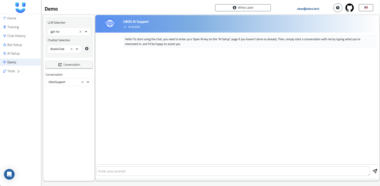
UBOS, a full-stack AI Agent Development Platform, enhances the capabilities of the MCP Server by providing a robust environment for orchestrating AI Agents. With UBOS, businesses can connect AI Agents with enterprise data, build custom AI Agents using LLM models, and develop multi-agent systems. This integration allows for a more comprehensive approach to AI-driven development, ensuring that AI Agents can operate effectively across different business departments.
Getting Started
To begin using the MCP Server for GNU Make, installation is straightforward. Using uv is recommended for ease of use:
uv pip install mcp-server-make
Alternatively, you can use pip:
pip install mcp-server-make
For detailed usage instructions, including configuring the server with Claude Desktop, refer to the comprehensive User Guide.
Conclusion
The MCP Server for GNU Make is a transformative tool for developers seeking to enhance their workflows through AI integration. By providing a secure and efficient means for LLMs to interact with make targets, developers can automate and optimize their build processes like never before. Coupled with the UBOS platform, this server represents a significant step forward in the evolution of AI-driven development tools.
Make Functionality Server

Project Details
- wrale/mcp-server-make
- MIT License
- Last Updated: 4/17/2025
Recomended MCP Servers
📝 A FastMCP tool that automatically saves AI chat conversations to well-formatted Markdown files with timestamps and metadata.
Template to quickly set up your own MCP server
mcp demo ip query
An MCP server that detects potential risks in Solana meme tokens.
MCP (Model context protocol) server with LLMling backend
MCP Server built for use with VS Code / Cline / Anthropic - enable google search and ability...
Featured Templates
View More