UBOS & MCP Servers: Unleashing Context-Aware AI Agents
In the rapidly evolving landscape of Artificial Intelligence, Large Language Models (LLMs) are transforming industries, offering unprecedented capabilities in natural language understanding and generation. However, the true potential of LLMs is unlocked when they are provided with relevant context, enabling them to make informed decisions and generate accurate responses. This is where the Model Context Protocol (MCP) and UBOS come into play.
What is MCP?
MCP, or Model Context Protocol, is an open protocol designed to standardize how applications provide context to LLMs. Think of it as a universal language that allows AI models to access and interact with external data sources and tools. An MCP server acts as a bridge, facilitating seamless communication between the LLM and the external world. This means that your AI agents can leverage real-time data, access proprietary information, and utilize specialized tools to enhance their performance and deliver superior results.
Why MCP Matters for AI Agent Development
Without relevant context, LLMs are limited to the knowledge they were trained on, which can quickly become outdated or irrelevant. By providing access to contextual information, MCP enables AI agents to:
- Generate more accurate and relevant responses: Accessing real-time data and domain-specific knowledge ensures that the AI agent’s responses are tailored to the specific situation.
- Make informed decisions: By considering contextual factors, AI agents can make better decisions and avoid costly mistakes.
- Automate complex tasks: MCP enables AI agents to interact with external tools and services, automating tasks that would otherwise require human intervention.
- Personalize user experiences: By accessing user-specific data, AI agents can provide personalized recommendations and services.
Introducing UBOS: The Full-Stack AI Agent Development Platform
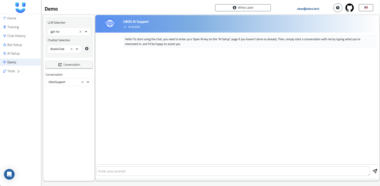
UBOS is a comprehensive AI Agent development platform focused on empowering businesses to integrate AI agents into every department. With UBOS, you can orchestrate AI Agents, connect them with your enterprise data, build custom AI Agents with your own LLM model, and even create Multi-Agent Systems. UBOS simplifies the process of building, deploying, and managing AI agents, allowing you to focus on driving business value.
UBOS and MCP: A Powerful Combination
UBOS seamlessly integrates with MCP servers, providing a robust and flexible environment for developing context-aware AI agents. By leveraging the UBOS platform, you can easily connect your AI agents to a variety of MCP servers, enabling them to access the data and tools they need to perform their tasks effectively. UBOS makes the integration of MCP servers straightforward, abstracting away the complexities of the underlying protocol and allowing you to focus on building intelligent and impactful AI agents.
Use Cases for MCP Servers with UBOS
- Customer Support: Connect your AI-powered chatbot to an MCP server that provides access to customer data, order history, and product information. This allows the chatbot to provide personalized support and resolve customer issues quickly and efficiently.
- Sales & Marketing: Integrate your sales AI agent with an MCP server that provides access to CRM data, marketing campaign results, and market research. This allows the AI agent to identify promising leads, personalize marketing messages, and optimize sales strategies.
- Finance & Accounting: Connect your AI-powered financial analyst to an MCP server that provides access to financial data, market trends, and regulatory information. This allows the AI agent to generate accurate financial reports, identify investment opportunities, and detect fraudulent activities.
- Healthcare: Integrate your AI-powered diagnostic assistant with an MCP server that provides access to patient records, medical research, and diagnostic tools. This allows the AI agent to assist doctors in making accurate diagnoses and developing effective treatment plans.
- Knowledge Management: Imagine an AI agent seamlessly summarizing notes from a custom note-taking application connected via MCP. The UBOS platform could then leverage this summarized knowledge to answer user queries, generate reports, or even train other AI agents. The possibilities for leveraging context in this way are virtually limitless, enabling businesses to unlock the full potential of their data.
Key Features of UBOS for MCP Server Integration
- Seamless Integration: UBOS provides a user-friendly interface for connecting to MCP servers, simplifying the process of integrating external data and tools into your AI agent workflows.
- Orchestration: UBOS allows you to orchestrate multiple AI agents and MCP servers, creating complex and sophisticated AI systems.
- Customization: UBOS enables you to build custom AI agents tailored to your specific business needs, leveraging the power of MCP to access relevant context.
- Scalability: UBOS is designed to scale with your business, allowing you to deploy and manage a large number of AI agents and MCP servers.
- Monitoring and Analytics: UBOS provides comprehensive monitoring and analytics tools, allowing you to track the performance of your AI agents and identify areas for improvement.
Specific Example: Meituan-IP MCP Server
The mcp-meituan-ip MCP server provides a practical example of how context can be incorporated into AI agent interactions. It offers the following components:
- Resources: Implements a simple note storage system, accessible via a custom
note://URI scheme. Each note includes a name, description, and plain text content. - Prompts: Provides a
summarize-notesprompt that creates summaries of all stored notes. This prompt offers an optional “style” argument for controlling the detail level (brief/detailed), generating a prompt combining all current notes with the specified style preference. - Tools: Includes an
add-notetool, which adds a new note to the server, requiring “name” and “content” as string arguments. This tool updates the server state and notifies clients of resource changes.
Getting Started with UBOS and MCP
Integrating an MCP server like mcp-meituan-ip into UBOS empowers users to create a context-rich environment for their AI agents. By adding the configuration details to your Claude Desktop (or similar environment), UBOS can readily access and utilize the server’s resources, prompts, and tools. This, in turn, fuels more informed and effective AI agent interactions within the UBOS platform.
To get started with UBOS and MCP, simply:
- Sign up for a UBOS account.
- Explore the UBOS documentation to learn more about MCP integration.
- Start building your own context-aware AI agents with UBOS and MCP.
Development and Debugging
The mcp-meituan-ip server’s documentation highlights the importance of the MCP Inspector for debugging. Since MCP servers operate over stdio, traditional debugging methods can be challenging. The MCP Inspector provides a dedicated environment for inspecting and troubleshooting MCP server interactions.
Conclusion
UBOS and MCP are revolutionizing the way AI agents are developed and deployed. By providing access to relevant context, UBOS empowers AI agents to generate more accurate responses, make better decisions, and automate complex tasks. With UBOS, you can unlock the true potential of AI and drive significant business value. Embrace the power of context and start building your own context-aware AI agents with UBOS today!
mcp-meituan-ip
Project Details
- aixi134/mcp-meituan-ip
- Last Updated: 4/29/2025
Recomended MCP Servers
A Box model context protocol server to search, read and access files
🪐 MCP IPFS Server
Dify is an open-source LLM app development platform. Dify's intuitive interface combines AI workflow, RAG pipeline, agent capabilities,...
Drug Response Omics association MAp (DROMA, 卓玛)

The (Unofficial) dubco-mcp-server enables AI assistants to manage Dub.co short links via the Model Context Protocol. It provides...
Ein Model Context Protocol (MCP) Server für die Deutsche Bahn Timetable API
Kibela's official MCP Server
MCP Server for https://qase.io
Featured Templates
View More