Frequently Asked Questions about HAProxy MCP Server
Q: What is the HAProxy MCP Server?
A: The HAProxy MCP Server is a Model Context Protocol (MCP) server implemented in Go that allows Large Language Models (LLMs) to interact with HAProxy’s Runtime API. This enables LLMs to manage, monitor, and analyze HAProxy through natural language interfaces.
Q: What is MCP (Model Context Protocol)?
A: MCP is an open protocol that standardizes how applications provide context to LLMs, allowing AI models to access and interact with external data sources and tools.
Q: What are the key features of the HAProxy MCP Server?
A: Key features include full HAProxy Runtime API support, context-aware operations, HAProxy stats page integration, secure authentication, multiple transport options (stdio/HTTP), enterprise-ready design, and Docker support.
Q: How does the HAProxy MCP Server enhance HAProxy management?
A: It allows LLMs to automate configuration management, perform intelligent monitoring and alerting, enable dynamic scaling, create self-healing infrastructure, and analyze traffic for optimization and security threat detection.
Q: How can I install the HAProxy MCP Server?
A: You can install it via Homebrew, by downloading binaries from the releases page, using Go, or through Docker.
Q: What environment variables can I use to configure the server?
A: You can configure variables such as HAPROXY_HOST, HAPROXY_PORT, HAPROXY_RUNTIME_MODE, HAPROXY_STATS_URL, MCP_TRANSPORT, and LOG_LEVEL to customize the server’s behavior.
Q: What security considerations should I keep in mind?
A: Ensure secure authentication to HAProxy’s Runtime API, restrict network connectivity when using TCP4 mode, set proper Unix socket permissions when using Unix socket mode, and validate all inputs to prevent injection attacks.
Q: What MCP tools are available through the server?
A: Available tools cover statistics and process info, topology discovery, dynamic pool management, session control, maps and ACLs, health checks and agents, and miscellaneous utilities for managing HAProxy.
Q: How can I test the HAProxy MCP Server locally?
A: You can test it directly with CLI commands using different connection modes (TCP, Unix socket, Stats page) or test individual MCP tools with JSON-RPC calls.
Q: How can I contribute to the HAProxy MCP Server project?
A: Contributions are welcome! You can submit pull requests on the project’s GitHub repository.
Q: How does HAProxy MCP Server integrate with UBOS platform?
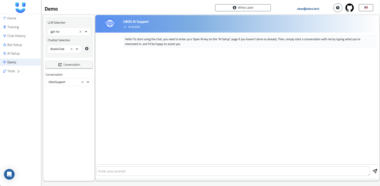
A: UBOS can orchestrate AI Agents that use the HAProxy MCP Server to manage and optimize HAProxy deployments. UBOS can connect AI Agents with HAProxy’s runtime data, enabling them to make informed decisions about load balancing strategies. UBOS allows users to build custom AI Agents that leverage the HAProxy MCP Server to address specific load balancing challenges.
HAProxy Server Management

Project Details
- tuannvm/haproxy-mcp-server
- Last Updated: 6/5/2025
Recomended MCP Servers
Diff & patch JavaScript objects
An mcp server that you can use to store and retrieve ideas, prompt templates, personal preferences to use...
🔍 Prysm MCP Server: Web scraping tools for AI assistants with multiple extraction modes and flexible output formats
PDF to Markdown conversion tool
Expose llms-txt to IDEs for development
일있당께 백엔드
a private MCP server for accessing Linear
MCP Server for Last.FM APIs, built in Swift
Get API document info from mcp server
Featured Templates
View More