Frequently Asked Questions about Covenant AI Platform
Q: What is the Covenant AI Platform? A: The Covenant AI Platform is a full-stack contract analysis platform that uses AI to automate legal document processing, risk assessment, and opportunity identification.
Q: What are the key features of the Covenant AI Platform? A: Key features include AI-powered analysis, risk assessment, opportunity identification, user management, payment integration, and a real-time dashboard.
Q: What technologies are used in the Covenant AI Platform? A: The frontend uses Next.js 14, React Query, Zustand, Shadcn UI, Recharts, and TanStack Table. The backend uses Node.js 20, Express, MongoDB Atlas, Redis, Passport.js, JWT, and the Stripe API.
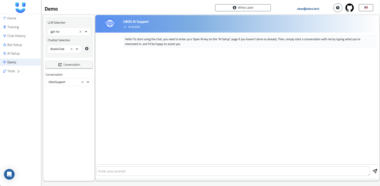
Q: How does the Covenant AI Platform integrate with UBOS? A: The Covenant AI Platform can be seamlessly integrated with UBOS, allowing users to build, orchestrate, and deploy AI agents that automate various aspects of contract management.
Q: What industries can benefit from the Covenant AI Platform? A: Industries such as legal, finance, real estate, healthcare, and supply chain can benefit from the platform.
Q: What is MCP in relation to Covenant AI Platform? A: MCP is an open protocol that standardizes how applications provide context to LLMs. The Covenant AI Platform acts as a bridge, allowing AI models to access and interact with external data sources and tools for contract analysis.
Q: What are the prerequisites for installing the Covenant AI Platform? A: Prerequisites include Node.js 20+, MongoDB 7+, Redis 7+, a Stripe account, and Google OAuth credentials.
Q: How do I set up the client and server environments? A: Follow the instructions in the installation section of the documentation to set up the client and server environments.
Q: What environment variables do I need to configure? A: You need to configure environment variables for both the client and server, including API URLs, Stripe keys, MongoDB URI, Redis URL, Google client ID, Google client secret, and JWT secret.
Q: How do I run the application?
A: Start both the client and server services from the root directory using the concurrently command.
Q: What services are required for the Covenant AI Platform to function? A: Required services include MongoDB for document storage, Redis for PDF text caching, Stripe for payment processing, and Google OAuth for user authentication.
Q: What development scripts are available? A: Development scripts include commands for starting the development server, creating production builds, running ESLint, starting the production server, and running integration tests.
Q: Where can I find the license for the Covenant AI Platform? A: The license is an MIT License and can be found in the LICENSE file.
Q: How does the AI processing workflow work? A: The user uploads a PDF contract, the frontend sends it to the backend, the backend stores the raw PDF in Redis, the backend sends it to the AI for analysis, and the results are persisted in MongoDB and displayed on the frontend dashboard.
Q: How does the Covenant AI Platform handle user authentication? A: The platform uses OAuth authentication with role-based access control to ensure that sensitive contract data is protected and only authorized personnel can access specific information.
Q: What type of support does UBOS provide for the Covenant AI Platform? A: UBOS provides detailed documentation and support to help users get up and running quickly. It also offers a range of services, including consulting, training, and custom development, to help businesses leverage the full power of the platform.
Covenant AI
Project Details
- kumzhijr/Covenant-ai
- Last Updated: 5/4/2025
Recomended MCP Servers
mcp model-context-protocol mysql cursor n8n
Diff & patch JavaScript objects
U-Net Biomedical Image Segmentation
A thin wrapper around the OpenPyXl Python library that exposes some of its features as Model Context Protocol...
A Grey Hack MCP server for Cursor IDE with GitHub code search, Greybel-JS transpilation, API validation and script...
MCP Server for Google Cloud Healthcare API
A CLI tool to convert your codebase into a single LLM prompt with source tree, prompt templating, and...
A Model Context Protocol server for Docker management through ChatGPT
A Model Context Protocol (MCP) server that provides access to NS (Dutch Railways) travel information through Claude AI....
Featured Templates
View More