Bloomy MCP: Bridging the Gap Between AI Agents and Bloom Growth’s GraphQL API
In today’s rapidly evolving landscape of artificial intelligence, AI agents are becoming increasingly crucial for automating tasks and enhancing decision-making processes across various industries. To effectively leverage the potential of these agents, it’s essential to provide them with seamless access to relevant data and functionalities. This is where Bloomy MCP (Model Context Protocol) steps in, acting as a vital bridge between AI agents and Bloom Growth’s GraphQL API.
Bloomy MCP is designed to facilitate interaction with Bloom Growth’s GraphQL API, enabling AI assistants to perform operations against the Bloom Growth platform efficiently. By exposing the API through the Model Context Protocol, Bloomy MCP empowers developers to build intelligent applications that can leverage the full capabilities of Bloom Growth’s services.
Understanding the Model Context Protocol (MCP)
Before diving deeper into the functionalities of Bloomy MCP, it’s essential to grasp the concept of the Model Context Protocol (MCP). MCP is an open protocol that standardizes how applications provide context to Large Language Models (LLMs). In essence, an MCP server acts as an intermediary, allowing AI models to access and interact with external data sources and tools in a structured and secure manner.
Think of MCP as a universal translator that enables AI agents to understand and utilize the information and functionalities offered by various applications. By adhering to the MCP standard, developers can ensure that their applications are easily accessible to a wide range of AI agents, fostering interoperability and accelerating the development of intelligent solutions.
Key Features of Bloomy MCP
Bloomy MCP boasts a comprehensive set of features designed to streamline the integration of AI agents with Bloom Growth’s GraphQL API:
- GraphQL API Querying: Bloomy MCP enables AI agents to directly query Bloom Growth’s GraphQL API, allowing them to retrieve specific data and information as needed.
- Query and Mutation Details Retrieval: Developers can use Bloomy MCP to retrieve detailed information about available queries and mutations, providing AI agents with a clear understanding of the API’s capabilities.
- GraphQL Operation Execution: AI agents can execute GraphQL queries and mutations via MCP tools, enabling them to perform operations against the Bloom Growth platform.
- Authenticated User Information Access: Bloomy MCP provides access to authenticated user information, allowing AI agents to personalize interactions and enforce security policies.
- Automatic Schema Introspection: The server automatically introspects the GraphQL schema, ensuring that AI agents always have up-to-date information about the API’s structure and capabilities.
Use Cases for Bloomy MCP
The versatility of Bloomy MCP makes it suitable for a wide range of use cases, including:
- AI-Powered Customer Service: Integrate Bloomy MCP with AI-powered chatbots to provide customers with instant access to information and support from Bloom Growth’s platform.
- Automated Data Analysis: Use AI agents to automatically analyze data retrieved from Bloom Growth’s API, identifying trends and insights to improve business decision-making.
- Intelligent Workflow Automation: Automate tasks and processes within the Bloom Growth platform by leveraging AI agents that can execute queries and mutations via Bloomy MCP.
- Personalized User Experiences: Deliver personalized experiences to users by leveraging AI agents that can access user information and tailor interactions based on individual preferences.
- AI-Driven Content Creation: Automate the creation of content for the Bloom Growth platform by using AI agents to generate articles, blog posts, and other types of content.
Installation and Setup
To get started with Bloomy MCP, follow these steps:
- Prerequisites: Ensure that you have Python 3.12 or higher installed, along with access to the Bloom Growth API. It is also recommended to install
uvfor package management. - Package Management: Install
uvusing the provided script or follow the instructions in the uv documentation. - Setup:
- Clone the Bloomy MCP repository.
- Set up a Python virtual environment.
- Install the package in development mode using either
pip install -e .oruv pip install -e .(recommended).
- Environment Variables: Create a
.envfile with your Bloom API URL and API token.
Integration with Cursor (AI-Powered IDE)
Bloomy MCP seamlessly integrates with Cursor, an AI-powered IDE, allowing developers to easily access and utilize its functionalities within their development environment. To integrate Bloomy MCP with Cursor:
- Go to Cursor > Cursor Settings > MCP.
- Click on “Add new MCP server”.
- Configure the server with the following details:
- Name: “Bloom Growth” (or any name you prefer).
- Type: Command.
- Command:
uv run --project /path/to/your/repo/ --env-file /path/to/your/repo/.env bloomy-server(Replace/path/to/your/repo/with the actual path to your Bloomy MCP repository).
Streamlining AI Agent Development with UBOS
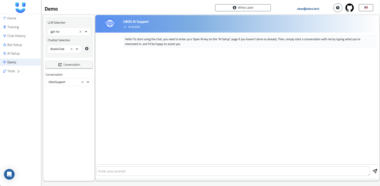
While Bloomy MCP provides a crucial link between AI agents and Bloom Growth’s GraphQL API, the process of developing and managing AI agents can still be complex. This is where UBOS (Unified Business Orchestration System) comes into play, offering a comprehensive platform for AI agent development.
UBOS is a full-stack AI Agent Development Platform focused on bringing AI Agents to every business department. It helps you orchestrate AI Agents, connect them with your enterprise data, build custom AI Agents with your LLM model, and manage Multi-Agent Systems.
By combining the power of Bloomy MCP with the capabilities of UBOS, developers can accelerate the development of intelligent applications that leverage the full potential of both Bloom Growth’s services and AI agents.
Available MCP Tools and Resources
Bloomy MCP provides a set of MCP tools that enable AI assistants to interact with the Bloom Growth API:
get_query_details: Retrieves detailed information about specific GraphQL queries.get_mutation_details: Retrieves detailed information about specific GraphQL mutations.execute_query: Executes a GraphQL query or mutation with variables.get_authenticated_user_id: Retrieves the ID of the currently authenticated user.
Additionally, Bloomy MCP exposes the following MCP resources:
bloom://queries: Provides a list of all available queries.bloom://mutations: Provides a list of all available mutations.
Conclusion
Bloomy MCP is a valuable tool for bridging the gap between AI agents and Bloom Growth’s GraphQL API. By providing a standardized interface for accessing and interacting with the API, Bloomy MCP empowers developers to build intelligent applications that can leverage the full potential of Bloom Growth’s services. Combined with a platform like UBOS, the development and deployment of AI agent-powered solutions become even more streamlined and efficient, opening up new possibilities for businesses across various industries.
Bloom Growth
Project Details
- franccesco/bloomy-mcp
- Last Updated: 2/26/2025
Recomended MCP Servers
Untappd Model Context Protocol Server
MCP server and client for Frontapp
kakao map mcp server
WhatsApp Web MCP Server
A mcp server for interacting with the Scryfall Magic The Gathering API
🤖 功能丰富的微信机器人框架 | AI对话、对接Dify、积分系统、游戏互动、每日新闻、天气查询 | 非Hook非Web实现 | 支持 Windows✅ Linux✅ MacOS✅ | 全新架构解决XYBot第一代痛点!
Connect Supabase to your AI assistants
Featured Templates
View More