Adamik MCP Server: Your Bridge to Multi-Chain Blockchain Interaction
In the rapidly evolving landscape of blockchain technology, interoperability and ease of access are paramount. The Adamik MCP (Model Context Protocol) Server emerges as a vital tool, designed to simplify and streamline interactions with a multitude of blockchain networks. By leveraging the power of the Adamik API and integrating seamlessly with Claude Desktop, this server empowers developers and businesses to harness the full potential of decentralized technologies.
What is Adamik MCP Server?
The Adamik MCP Server is a specialized software component that acts as a conduit between large language models (LLMs), specifically through the Claude Desktop application, and a diverse range of blockchain networks. It implements the Model Context Protocol (MCP), which standardizes how applications provide context to LLMs, enabling AI models to understand and interact with external data sources. This server facilitates read and write operations across more than 60 blockchain networks, providing a unified and enterprise-grade interface for managing transactions, accessing account insights, and engaging with staking and token interactions.
At its core, the Adamik MCP Server is designed to abstract away the complexities of interacting with individual blockchains. Each blockchain has its unique protocol, data structures, and API endpoints. The Adamik MCP Server normalizes these differences, presenting a consistent interface to the user. This simplifies development, reduces integration costs, and accelerates the adoption of blockchain technologies across various industries.
Use Cases: Unleashing the Power of Multi-Chain Interaction
The Adamik MCP Server opens up a plethora of use cases, enabling innovative solutions across various sectors. Here are a few compelling examples:
Decentralized Finance (DeFi):
- Cross-Chain Portfolio Management: Users can monitor their asset holdings across multiple blockchain networks from a single interface. The server can aggregate balances, transaction history, and staking rewards, providing a comprehensive view of their DeFi portfolio.
- Arbitrage Opportunities: By connecting to multiple decentralized exchanges (DEXs) across different chains, the server can identify and execute arbitrage opportunities, maximizing returns for traders.
- Automated Lending and Borrowing: The server can automate the process of lending and borrowing assets on various DeFi platforms, optimizing interest rates and collateralization ratios.
Supply Chain Management:
- Tracking Goods Across Blockchains: The server can track the movement of goods across different blockchain-based supply chain networks, ensuring transparency and traceability.
- Automated Payments: Smart contracts, triggered by events on the supply chain, can automatically release payments to suppliers upon delivery verification, streamlining the payment process.
- Counterfeit Prevention: By verifying the authenticity of products on the blockchain, the server can help prevent the circulation of counterfeit goods.
Gaming and NFTs:
- Cross-Game Asset Management: Players can use the server to manage their in-game assets and NFTs across multiple blockchain-based games.
- Interoperable Gaming Experiences: Game developers can create interoperable gaming experiences where assets and characters can be transferred between different games.
- NFT Marketplaces: The server can facilitate the buying and selling of NFTs across multiple marketplaces, expanding liquidity and reach for creators and collectors.
Enterprise Blockchain Solutions:
- Secure Data Sharing: Enterprises can use the server to securely share data across different blockchain networks, enabling collaboration and data-driven decision-making.
- Automated Compliance: Smart contracts can automate compliance processes, ensuring adherence to regulatory requirements across different jurisdictions.
- Supply Chain Optimization: Enterprises can optimize their supply chains by tracking goods, managing payments, and verifying authenticity on the blockchain.
Key Features: A Deep Dive into Functionality
The Adamik MCP Server boasts a rich set of features designed to empower developers and businesses with seamless multi-chain interaction:
Multi-Chain Support:
- Broad Network Coverage: The server supports a wide range of blockchain networks, including popular chains like Ethereum, Starknet, Cosmos, and Bitcoin, as well as emerging platforms.
- Unified Access: Developers can interact with different blockchains using a consistent interface, simplifying integration and reducing development time.
- Chain Agnostic Development: The server enables developers to build chain-agnostic applications that can seamlessly adapt to different blockchain environments.
Transaction Management:
- Comprehensive Functionality: The server provides a comprehensive set of transaction-related functionalities, including transaction encoding, validation, and broadcasting.
- Transaction Encoding: Preparing transactions for signing with the proper data structures of each chain.
- Transaction Validation: Ensuring transaction validity before submission.
- Transaction Broadcasting: Securely submitting transactions to the network.
- Detailed Status: Retrieving transaction details and status updates.
Account Management:
- Detailed Account Services: The server offers detailed account-related services, such as retrieving account state, checking token balances, and viewing transaction history.
- Account State Retrieval: Accessing real-time account balances.
- Token Balance Checks: Verifying balances for various tokens.
- Transaction History: Viewing a detailed record of account transactions.
Utility Functions:
- Helpful Endpoints: The server provides helpful utility endpoints, such as address validation, public key to address conversion, and chain and token information retrieval.
- Address Validation: Ensuring the validity of blockchain addresses.
- Public Key Conversion: Converting public keys to addresses.
- Chain and Token Information: Retrieving metadata about different blockchains and tokens.
Staking Support:
- Proof-of-Stake Features: The server includes features for proof-of-stake blockchains, such as staking transactions, unstaking, claiming staking rewards, and validator information retrieval.
- Staking Transactions: Submitting staking requests.
- Unstaking: Initiating unstaking processes.
- Reward Claims: Claiming accumulated staking rewards.
- Validator Information: Retrieving details about validators.
Token Interaction:
- Versatile Interaction: The server enables interactions with different token types, including native currency transfers and token transfers across various blockchain standards (ERC20, TRC20, ASA, etc.).
- Native Currency Transfers: Sending native currencies.
- Token Transfers: Facilitating token transfers.
- Token Details Retrieval: Accessing details about various tokens.
Adamik API Documentation: Your Guide to Integration
For detailed API documentation and integration guides, visit https://docs.adamik.io. The documentation provides comprehensive information on all API endpoints, data structures, and authentication methods.
Rate Limits: Choose the Plan That Suits Your Needs
The Adamik MCP Server offers different rate limits to accommodate various use cases:
- Free Tier: 10,000 requests per month
- Premium Tier: Contact us for custom pricing and higher rate limits
UBOS: Enhancing AI Agent Development
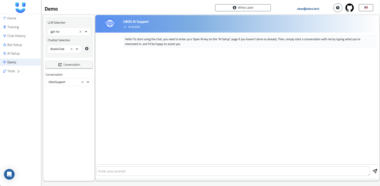
UBOS, the Full-stack AI Agent Development Platform, complements the Adamik MCP Server by providing a robust environment for orchestrating AI Agents and connecting them with enterprise data. UBOS enables you to build custom AI Agents with your LLM model and create Multi-Agent Systems. Integrating the Adamik MCP Server with UBOS allows AI Agents to:
- Access Blockchain Data: Agents can retrieve real-time data from multiple blockchains to inform decision-making.
- Automate Blockchain Transactions: Agents can execute transactions on the blockchain, such as trading assets or managing supply chains.
- Enhance Security: Agents can monitor blockchain activity for anomalies and potential threats.
Conclusion: Embracing the Future of Multi-Chain Interaction
The Adamik MCP Server is a game-changer for developers and businesses seeking to leverage the power of blockchain technology. By providing a unified and enterprise-grade interface for interacting with multiple blockchain networks, this server simplifies development, reduces integration costs, and accelerates the adoption of decentralized technologies across various industries. Whether you’re building DeFi applications, optimizing supply chains, or creating interoperable gaming experiences, the Adamik MCP Server is your bridge to the future of multi-chain interaction.
Adamik MCP Server
Project Details
- AdamikHQ/adamik-mcp-server
- MIT License
- Last Updated: 2/20/2025
Recomended MCP Servers
🤖 A Model Context Protocol server for generating visual charts using @antvis.
Model Context Protocol server for ActivityWatch time tracking data

A Model Context Protocol (MCP) server that enables Claude Desktop to check domain availability across 50+ TLDs. Features...
DataEase 在线文档工程
A self-hostable bookmark-everything app (links, notes and images) with AI-based automatic tagging and full text search
MCP server for shadcn/ui component references
The most reliable AI agent framework that supports MCP.
An MCP server allowing LLMs to interact with Ansys/AGI STK - Digital Mission Engineering Software
Featured Templates
View More