

- Updated: June 16, 2026
- 5 min read
Mathematical Modelling of Ethical AI Use in Higher Education: A Coordination Game Framework for Future‑Facing Learning
Direct Answer
The paper introduces a coordination‑game framework that models how university students collectively adopt either responsible or opportunistic uses of generative AI in assessments. By treating assessment design and peer expectations as strategic levers, the authors show that modest, well‑targeted incentives can trigger rapid, system‑wide shifts toward ethical AI practices.
Background: Why This Problem Is Hard
Generative AI tools such as ChatGPT have become ubiquitous in higher‑education classrooms, enabling students to produce essays, code, and design artifacts with unprecedented speed. While these tools can enhance learning, they also create new vectors for academic misconduct, fairness violations, and erosion of assessment validity.
Current institutional responses rely heavily on policy statements, plagiarism detectors, and punitive sanctions. These approaches share three critical shortcomings:
- Reactive focus: Policies react after misuse is detected rather than shaping the incentives that drive behavior.
- Lack of collective dynamics: Individual compliance models ignore how peer norms amplify or dampen AI use.
- Design inertia: Assessment formats are often static, making it difficult to align incentives with ethical outcomes.
Because student behavior emerges from a complex interplay of perceived fairness, effort, and learning value, a purely top‑down approach struggles to achieve lasting change. Understanding these dynamics requires a formal model that captures both individual payoff structures and the feedback loops created by cohort‑wide expectations.
What the Researchers Propose
The authors propose an evolutionary coordination game that treats each student as a strategic agent choosing between two strategies:
- Responsible AI use: Leveraging generative tools to augment learning while adhering to academic integrity.
- Opportunistic AI use: Exploiting AI to shortcut assessment tasks, prioritizing grades over learning.
Key components of the framework include:
- Payoff matrix: Captures learning value, effort cost, perceived fairness, and transparency of the assessment.
- Reflective assessment incentives: Institutional levers (e.g., AI‑aware rubrics, transparent grading) that modify the payoff for responsible use.
- Evolutionary dynamics: A replicator process that updates the proportion of each strategy based on relative success in the student population.
By embedding the assessment design directly into the payoff structure, the model treats governance not as an external rulebook but as an intrinsic part of the strategic environment.
How It Works in Practice
Translating the abstract game into a campus‑wide policy workflow involves three concrete steps:
- Define reflective incentives: Faculty redesign assignments to reward process documentation, AI‑assisted drafts, and critical reflection on tool usage.
- Communicate peer expectations: Departments publish clear norms about acceptable AI integration, creating a shared belief about what “responsible” looks like.
- Monitor aggregate behavior: Learning analytics dashboards track the proportion of submissions that include AI‑usage disclosures, feeding back into the incentive calibration.
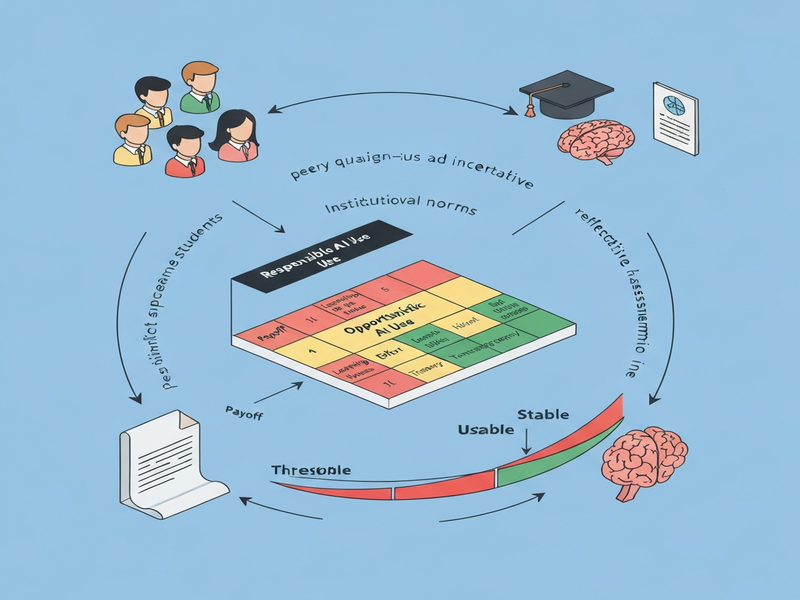
What distinguishes this approach from traditional compliance programs is its focus on positive alignment rather than surveillance. By making responsible AI use a higher‑payoff equilibrium, the system nudges the entire cohort toward ethical behavior without heavy monitoring.
Evaluation & Results
The researchers validated the model through two complementary methods:
Analytical Threshold Analysis
- Derived closed‑form conditions under which the responsible‑use equilibrium becomes stable.
- Identified a critical incentive level (≈ 15 % increase in learning‑value weight) that flips the system from opportunistic dominance to responsible dominance.
Finite‑Population Simulations
Agent‑based simulations with populations of 200–1,000 synthetic students explored dynamic trajectories under varying incentive strengths:
- Weak incentives: The opportunistic strategy persisted, with occasional spikes of responsible use that quickly faded.
- Moderate, well‑calibrated incentives: A rapid, non‑linear transition occurred after a few assessment cycles, stabilizing at > 80 % responsible use.
- Over‑incentivization: Excessive rewards led to “gaming” behaviors, where students superficially complied without genuine learning gains.
These findings demonstrate that small, thoughtfully designed changes to assessment policy can produce outsized cultural shifts, whereas blunt, punitive measures often fail to move the equilibrium.
Why This Matters for AI Systems and Agents
For AI practitioners building educational platforms, the study offers a blueprint for embedding ethical incentives directly into product design:
- Adaptive grading engines: Systems can weight AI‑assisted drafts higher, encouraging transparent usage.
- Agent‑driven tutoring: Conversational agents (e.g., OpenAI ChatGPT integration) can surface reflective prompts that align with the responsible‑use payoff.
- Orchestration layers: Workflow automation tools (Workflow automation studio) can trigger alerts when the proportion of undisclosed AI usage spikes, prompting timely policy adjustments.
By treating governance as a configurable parameter rather than a static rule, platform architects can experiment with incentive levers in real time, measuring impact through built‑in analytics. This aligns product roadmaps with the broader goal of future‑facing learning, where AI augments rather than undermines academic integrity.
What Comes Next
While the coordination‑game model provides a powerful lens, several open challenges remain:
- Heterogeneous student populations: Future work should incorporate varying skill levels, discipline‑specific norms, and cultural attitudes toward AI.
- Longitudinal effects: Tracking how responsible‑use equilibria persist across multiple semesters and curriculum changes.
- Integration with existing LMS ecosystems: Embedding reflective incentives into platforms like Canvas or Moodle will require API‑level collaborations.
Potential extensions include:
- Designing UBOS platform overview modules that automatically generate AI‑usage rubrics based on course objectives.
- Deploying Enterprise AI platform by UBOS to aggregate cross‑institutional data, enabling benchmarking of incentive effectiveness at scale.
By iterating on these fronts, universities can move from ad‑hoc policy statements to data‑driven, adaptive governance that scales with the rapid evolution of generative AI.
References
Mathematical Modelling of Ethical AI Use in Higher Education – Ndidi Bianca Ogbo, Zhao Song, Shatha Ghareeb, The Anh Han, arXiv:2605.27400v1, 2026.
Andrii Bidochko
CTO UBOS
Andrii Bidochko is an AI entrepreneur and researcher focused on AI agents, reinforcement learning, and autonomous systems. He writes about the technologies shaping the future of machine intelligence, from frontier models and agent architectures to real-world AI applications.