

- Updated: July 3, 2026
- 6 min read
Massive Activations Are Architecturally Robust: A Controlled Scratch/Commitment Residual Stream Test
Direct Answer
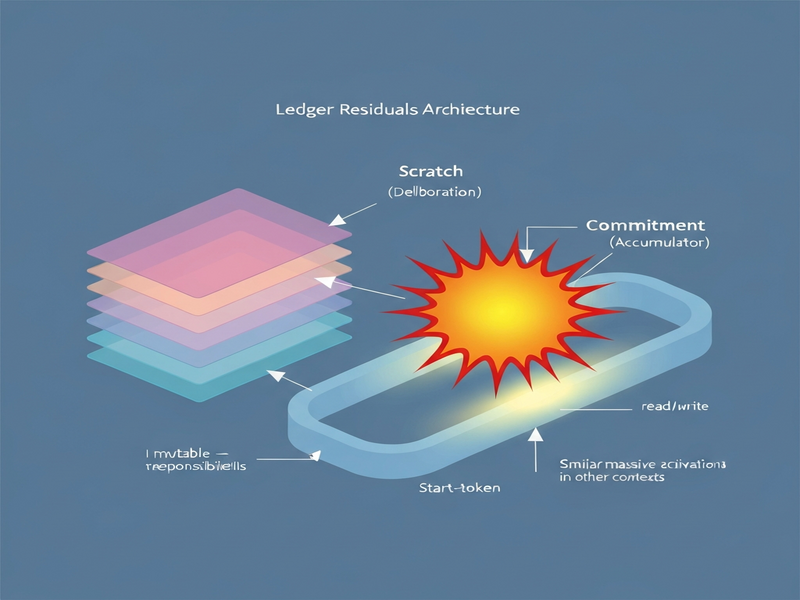
The paper introduces Ledger Residuals, a transformer‑style architecture that separates the residual stream into a mutable “scratch” channel and a protected “commitment” channel. The study shows that even with this split, transformers still generate a concentrated, high‑magnitude activation on the start‑token, proving that massive activations are a functional feature rather than an architectural artifact.
Background: Why This Problem Is Hard
Modern transformer models rely on a single residual stream that carries both intermediate computation results and the final representation read by the decoder. Researchers have repeatedly observed a handful of hidden dimensions that spike to values far above the median—so‑called massive activations. These spikes are almost always anchored to the sequence‑start token, leading to two competing explanations:
- Artifact hypothesis: The residual stream is overloaded, forcing the model to reuse the same dimensions for scratch‑pad work and for the final answer, creating outliers as a side effect.
- Functional hypothesis: The model deliberately creates a high‑energy signal because it is useful for downstream tasks such as token prediction or attention routing.
Distinguishing between these explanations matters for several reasons. If massive activations are merely artifacts, redesigning the residual pathway could yield more efficient, lower‑memory models. If they are functional, any architectural change that suppresses them might degrade performance or stability. Existing work has been limited to observational studies; no controlled intervention has directly tested whether providing a dedicated answer channel eliminates the outliers.
What the Researchers Propose
The authors propose a new architectural split called Ledger Residuals. The design partitions the traditional residual stream into two orthogonal pathways:
- Deliberation (Scratch) stream: A mutable buffer that intermediate layers can read from and write to freely. It behaves like a conventional scratchpad where temporary representations are stored and overwritten.
- Commitment (Answer) stream: A read‑only accumulator that only receives writes from the final layer before decoding. This channel is protected from further modification, ensuring that the representation used for token generation is isolated from the scratch computations.
By forcing the model to separate “thinking” from “answering,” the authors can observe whether the massive activation still appears, and if so, where it resides.
How It Works in Practice
The Ledger Residuals workflow can be visualized as a two‑track conveyor belt:
- Input embedding: Tokens are embedded and injected into both streams simultaneously.
- Layer processing: Each transformer block reads from the Deliberation stream, performs self‑attention, and writes its results back to Deliberation. Simultaneously, a lightweight projection writes a distilled summary to the Commitment stream.
- Final readout: The decoder attends only to the Commitment stream when predicting the next token, guaranteeing that the answer channel is the sole source of output information.
This separation differs from prior attempts that merely added auxiliary losses or regularization; Ledger Residuals enforce a hard architectural boundary. The model still has full expressive power because the Deliberation stream can encode any intermediate computation, while the Commitment stream aggregates the final decision.
Evaluation & Results
The authors trained language models at two scales—160 M and 290 M parameters—using the standard causal language‑modeling loss and a matched‑loss baseline for fair comparison. They then measured activation magnitudes across all hidden dimensions and tokens, focusing on the start‑token position.
Key findings include:
- Re‑emergence of massive activations: Even with a dedicated Commitment stream, models recreated a high‑magnitude outlier that was sharply concentrated on the start token.
- Reduced magnitude but higher concentration: The outlier’s absolute value was smaller than in a vanilla transformer, yet its activation was more tightly localized to the start token, suggesting a more efficient encoding.
- Sparsity penalty effect: Adding an L1‑type sparsity regularizer amplified the persistence of the outlier and further concentrated it on the start token, contradicting the expectation that sparsity would eliminate such spikes.
- Robustness across scales: Both the 160 M and 290 M models displayed the same qualitative behavior, indicating that the phenomenon is not a small‑model artifact.
These results collectively demonstrate that massive activations are not a side effect of a single overloaded residual stream; they are a robust feature that reappears wherever the model’s final representation is read from.
Why This Matters for AI Systems and Agents
Understanding the inevitability of massive activations has practical consequences for anyone building large‑scale language models, autonomous agents, or AI‑augmented workflows:
- Model interpretability: The start‑token outlier can serve as a diagnostic hook. Engineers can monitor its magnitude to detect training instability or drift without invasive instrumentation.
- Memory and hardware planning: Since the outlier occupies a fixed dimension, hardware designers can allocate dedicated high‑precision lanes for it, potentially reducing quantization error for the rest of the network.
- Agent architecture design: When constructing multi‑step reasoning agents, separating scratch and commitment buffers (as Ledger Residuals do) may improve modularity without sacrificing the functional benefits of massive activations.
- Integration with existing platforms: For teams using the UBOS platform overview to orchestrate AI pipelines, the findings suggest that preserving a dedicated “answer” channel in workflow automation can align with the model’s natural tendencies, leading to more stable deployments.
What Comes Next
While the study settles the artifact debate, several open questions remain:
- Generalization to other modalities: Do massive activations appear in vision transformers, multimodal models, or encoder‑decoder setups?
- Interaction with retrieval‑augmented generation: Could a retrieval component exploit the start‑token outlier to bias answer selection?
- Optimization strategies: Can training schedules or curriculum learning be tuned to shape the outlier’s magnitude for better downstream performance?
- Tooling and monitoring: Building observability dashboards that surface the Commitment‑stream outlier could become a standard practice for production AI systems.
Future research may explore hybrid residual designs that combine Ledger Residuals with other sparsity‑inducing mechanisms, or investigate whether the outlier can be repurposed as a controllable “signal channel” for steering model behavior.
For developers interested in rapid prototyping, the Workflow automation studio offers a low‑code environment to experiment with custom residual pathways, while the Enterprise AI platform by UBOS provides the compute backbone needed for large‑scale training runs.
References
- Massive Activations Are Architecturally Robust: A Controlled Scratch/Commitment Residual Stream Test (arXiv:2606.20743)
- About UBOS
- UBOS templates for quick start
Andrii Bidochko
CTO UBOS
Andrii Bidochko is an AI entrepreneur and researcher focused on AI agents, reinforcement learning, and autonomous systems. He writes about the technologies shaping the future of machine intelligence, from frontier models and agent architectures to real-world AI applications.