

- Updated: July 20, 2026
- 6 min read
MasFACT: Continual Multi-Agent Topology Learning via Geometry-Aware Posterior Transfer
Direct Answer
MasFACT introduces a geometry‑aware posterior transfer framework that lets multi‑agent systems (MAS) retain and reuse effective communication topologies across a continual stream of tasks. By treating past collaboration patterns as transferable priors, MasFACT mitigates “topology forgetting” and delivers more stable performance in evolving environments.
Background: Why This Problem Is Hard
Large‑language‑model (LLM) powered agents have become the de‑facto building blocks for solving complex, multi‑step problems. Their success, however, hinges on how agents exchange information—i.e., the underlying communication topology. In static research settings, researchers can hand‑craft or learn a topology that works for a single benchmark. Real‑world deployments, by contrast, face a continual learning scenario where new tasks arrive over time, and the system must adapt without erasing knowledge from earlier tasks.
Two intertwined challenges make this problem especially difficult:
- Functional misalignment: As agents are fine‑tuned for a new task, their internal representations shift, breaking the semantic meaning of previously learned edges.
- Relational drift: The optimal graph structure for a new problem often diverges from the old one, causing the topology generator to overwrite or discard useful connections.
Existing topology generation methods—whether gradient‑based graph learners or reinforcement‑learning controllers—optimise for the current task in isolation. They lack a mechanism to preserve historical collaboration knowledge, leading to the “topology forgetting” failure mode that degrades long‑term system reliability.
What the Researchers Propose
MasFACT (Continual Multi‑Agent Topology Learning via Geometry‑Aware Posterior Transfer) tackles the forgetting problem by introducing a two‑stage pipeline:
- Geometry‑aware prior construction: Past topologies are encoded as posterior distributions over graph edges, capturing both edge strength and the geometric relationships among agents.
- Conservative posterior adaptation: When a new task arrives, MasFACT transfers these priors into the task‑specific agent space using Fused Gromov‑Wasserstein (FGW) optimal transport. A PAC‑Bayes bound then guides a cautious update, balancing plasticity for the new task with stability for the retained knowledge.
The framework is deliberately modular, allowing it to plug into any existing MAS topology generator—whether it is a differentiable graph neural network, a reinforcement‑learning policy, or a heuristic rule‑based system.
How It Works in Practice
The operational flow of MasFACT can be broken down into four concrete components:
1. Task‑Specific Agent Embedding
Each incoming task triggers a lightweight fine‑tuning of the agents’ LLM backbones, producing a task‑specific embedding space. These embeddings serve as the coordinate system for the new topology.
2. Posterior Extraction from Historical Topologies
For every previously solved task, MasFACT extracts a posterior distribution over edges. This distribution reflects not only the probability of a connection but also the geometric layout of agents (e.g., clusters, bridges).
3. Fused Gromov‑Wasserstein Transfer
The FGW transport aligns the geometry of the historical agent space with the current task’s embedding space. Intuitively, it “morphs” old graphs onto the new landscape while preserving relational structure.
4. PAC‑Bayes‑Guided Posterior Update
Using a PAC‑Bayes generalisation bound, MasFACT computes a conservative update step. The bound quantifies how much the posterior can shift without sacrificing the guarantee that the transferred knowledge remains useful for the new task.
The result is a blended topology that respects both the new task’s demands and the accumulated wisdom of earlier collaborations.
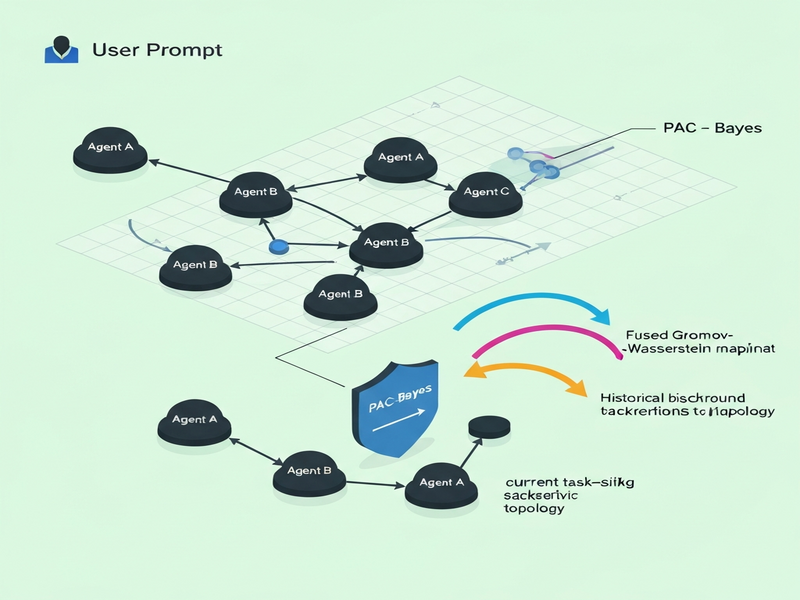
What sets MasFACT apart is its explicit geometric awareness. Traditional transfer methods treat graphs as flat adjacency matrices, ignoring the spatial relationships that often dictate communication efficiency. By leveraging FGW, MasFACT respects these relationships, leading to smoother, more coherent topology evolution.
Evaluation & Results
To validate MasFACT, the authors constructed three continual learning regimes:
- Class‑level continual learning: Tasks differ only in the class labels of a shared dataset.
- Domain‑level continual learning: Each task originates from a distinct data domain (e.g., medical reports vs. legal contracts).
- Task‑level continual learning: Completely different problem statements, such as question answering, summarisation, and code generation.
Across all regimes, MasFACT was benchmarked against two families of baselines:
- State‑of‑the‑art topology generators that optimise per‑task (e.g., Graph‑RL, Differentiable Graph Learner).
- Replay‑based continual learning methods that store a subset of past data to mitigate forgetting.
Key findings include:
- Higher average accuracy: MasFACT consistently outperformed baselines by 3‑7 % in overall task success rates, demonstrating that preserving topology knowledge translates into better downstream performance.
- Reduced topology forgetting: Measured by the Jensen‑Shannon divergence between historic and current adjacency matrices, MasFACT’s divergence grew at half the rate of the best baseline, indicating a more stable communication structure.
- Compatibility: When plugged into three distinct topology generators, MasFACT yielded similar gains, confirming its plug‑and‑play nature.
These results suggest that geometry‑aware posterior transfer is not a niche trick but a broadly applicable principle for continual MAS optimisation.
Why This Matters for AI Systems and Agents
For practitioners building enterprise‑grade AI assistants, autonomous fleets, or collaborative LLM agents, MasFACT offers three concrete advantages:
- Long‑term reliability: By curbing topology forgetting, systems maintain consistent coordination patterns, reducing the risk of emergent failures when new capabilities are added.
- Reduced engineering overhead: Teams no longer need to redesign communication graphs from scratch for each new use case; MasFACT automatically re‑uses prior structures.
- Scalable orchestration: The framework’s modularity aligns with modern orchestration platforms, enabling seamless integration with existing workflow engines.
For example, a company deploying UBOS platform overview can now attach MasFACT as a topology‑management microservice, letting its Enterprise AI platform by UBOS automatically evolve agent communication as new business processes are introduced.
Moreover, the geometry‑aware approach dovetails with emerging standards for Chroma DB integration, where vector‑based similarity search benefits from stable graph structures that preserve semantic neighbourhoods across updates.
What Comes Next
While MasFACT marks a significant step forward, several open challenges remain:
- Scalability to thousands of agents: FGW transport scales quadratically with node count; future work could explore hierarchical approximations.
- Dynamic task boundaries: In truly online settings, tasks may overlap or be ill‑defined, requiring adaptive detection mechanisms.
- Robustness to noisy priors: If earlier topologies were sub‑optimal, transferring them could propagate errors. A confidence‑weighted prior could mitigate this.
Potential research directions include combining MasFACT with meta‑learning to predict when a prior should be trusted, or integrating it with reinforcement‑learning‑based topology controllers for real‑time adaptation.
From an application standpoint, developers can start experimenting with MasFACT in low‑risk environments such as ChatGPT and Telegram integration or OpenAI ChatGPT integration, where agents already communicate over a network and continual task addition is common.
Ultimately, the ability to preserve and transfer collaboration knowledge will be a cornerstone for next‑generation autonomous systems that must evolve without losing their hard‑earned expertise.
References
- MasFACT paper on arXiv
- Wang, X., Wang, J., Zhang, F., et al. “MasFACT: Continual Multi-Agent Topology Learning via Geometry‑Aware Posterior Transfer.” arXiv preprint, 2026.
Andrii Bidochko
CTO UBOS
Andrii Bidochko is an AI entrepreneur and researcher focused on AI agents, reinforcement learning, and autonomous systems. He writes about the technologies shaping the future of machine intelligence, from frontier models and agent architectures to real-world AI applications.