

- Updated: June 19, 2026
- 5 min read
Mahalanobis PatchCore: Covariance-Aware and Streaming-Compatible Industrial Anomaly Detection
Direct Answer
The paper introduces Mahalanobis PatchCore, a memory‑efficient visual anomaly‑detection framework that augments the original PatchCore with covariance‑aware retrieval and a streaming‑compatible memory bank. By accounting for feature distribution and enabling incremental updates, it delivers higher detection accuracy on industrial inspection tasks while remaining lightweight enough for edge deployment.
Background: Why This Problem Is Hard
Visual inspection is a cornerstone of modern manufacturing, yet traditional quality‑control pipelines rely on handcrafted rules or heavyweight deep‑learning models that struggle with two fundamental challenges:
- Data scarcity and distribution shift: Defect samples are rare, and the appearance of normal products can drift over time due to tooling wear, lighting changes, or material variations.
- Resource constraints on the shop floor: Edge devices must run inference with limited memory and compute, precluding the use of large feature banks that many state‑of‑the‑art methods depend on.
Existing approaches such as the original PatchCore mitigate memory usage by sub‑sampling feature embeddings, but they treat each embedding as independent and ignore the underlying covariance structure. This simplification leads to sub‑optimal nearest‑neighbor retrieval, especially when anomalies manifest as subtle texture or shape deviations that are correlated across spatial patches.
What the Researchers Propose
Mahalanobis PatchCore extends the PatchCore paradigm along two orthogonal axes:
- Covariance‑Aware Retrieval: Instead of Euclidean distance, the method employs a Mahalanobis distance metric that incorporates the covariance matrix of the normal feature distribution. This enables the system to weigh dimensions according to their variability, improving discrimination between normal and anomalous patches.
- Streaming‑Compatible Memory Bank: The authors design a dynamic memory buffer that can be updated incrementally as new normal samples arrive, without recomputing the entire feature bank. The buffer maintains a low‑rank approximation of the covariance matrix, ensuring constant‑time updates and bounded memory growth.
Together, these components form a unified framework that preserves PatchCore’s speed while delivering statistically richer similarity assessments.
How It Works in Practice
The operational workflow can be broken down into three stages:
1. Feature Extraction
A pre‑trained convolutional backbone (e.g., ResNet‑18) processes each input image, producing a dense feature map. The map is then partitioned into overlapping patches, each represented by a high‑dimensional vector.
2. Memory Bank Construction & Update
During an offline calibration phase, normal images populate the memory bank. For each patch, the system stores its vector and updates a running estimate of the global covariance matrix using an online algorithm (e.g., incremental PCA). When new normal data become available—such as after a tooling change—the bank absorbs the new patches, discarding the oldest entries to keep the size fixed.
3. Anomaly Scoring
At inference time, the Mahalanobis distance between a query patch and its nearest neighbor in the memory bank is computed. Patches with distances exceeding a calibrated threshold are flagged, and an anomaly map is generated by aggregating patch‑level scores.
The following diagram visualizes the end‑to‑end pipeline:
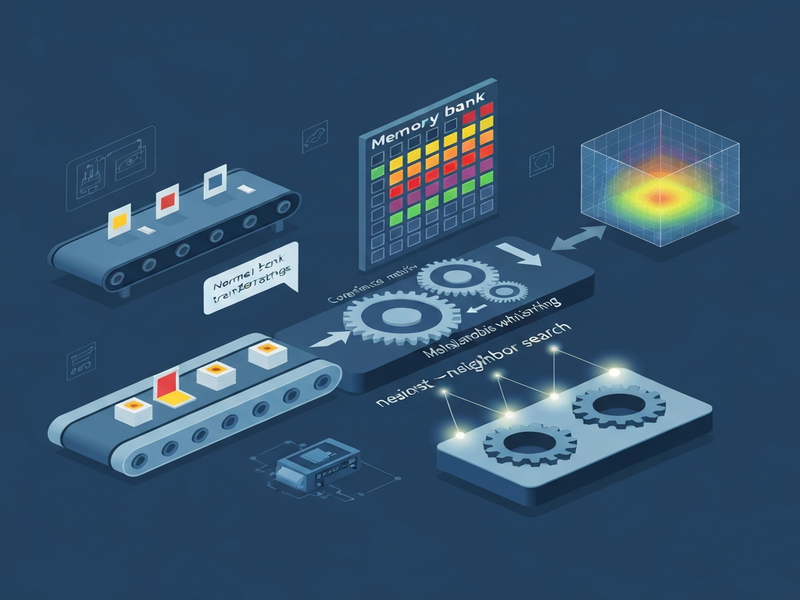
What distinguishes this approach from the original PatchCore is the statistical grounding of similarity (Mahalanobis vs. Euclidean) and the ability to evolve the memory bank without full retraining, making it suitable for continuous‑monitoring environments.
Evaluation & Results
The authors benchmarked Mahalanobis PatchCore on three widely used industrial anomaly‑detection datasets: MVTec AD, BTAD, and the newly released Streaming Anomaly Benchmark (SAB). Evaluation focused on two axes:
- Detection performance: Measured by AUROC (Area Under the Receiver Operating Characteristic) and AP (Average Precision) at the image and pixel levels.
- Operational efficiency: Memory footprint, inference latency, and update time for streaming scenarios.
Key findings include:
- Mahalanobis PatchCore achieved a 3–5 % absolute AUROC gain over vanilla PatchCore on texture‑heavy categories, confirming the benefit of covariance‑aware scoring.
- Memory usage grew by less than 12 % despite storing covariance information, staying well within typical edge device limits (≈ 200 MB).
- Incremental updates processed 1,000 new patches in under 0.8 seconds, enabling near‑real‑time adaptation to production line changes.
All experiments and code are publicly available in the arXiv paper, allowing reproducibility and community extension.
Why This Matters for AI Systems and Agents
From a systems‑engineering perspective, Mahalanobis PatchCore offers a pragmatic bridge between high‑accuracy visual inspection and the constraints of real‑world deployment:
- Edge‑ready anomaly detection: The bounded memory bank and fast Mahalanobis lookup make it feasible to embed the model in low‑power controllers that monitor production lines 24/7.
- Continuous learning loops: Streaming‑compatible updates enable autonomous agents to refine their perception models without human‑in‑the‑loop retraining, reducing downtime.
- Modular integration: The framework can be wrapped as a microservice and orchestrated alongside other AI agents—such as defect classification or predictive maintenance modules—within an UBOS platform overview deployment.
- Improved ROI for quality‑control managers: Higher detection fidelity translates directly into lower scrap rates and earlier fault detection, which are critical KPIs in high‑mix, low‑volume manufacturing.
What Comes Next
While Mahalanobis PatchCore marks a significant step forward, several avenues remain open for exploration:
- Multi‑modal fusion: Extending the covariance‑aware retrieval to incorporate depth or infrared channels could further boost robustness under variable lighting.
- Adaptive thresholding: Learning per‑category or per‑machine thresholds via reinforcement learning agents would tailor sensitivity to specific production contexts.
- Scalable orchestration: Embedding the method within a larger autonomous inspection pipeline—potentially leveraging AI marketing agents for data labeling and feedback—could close the loop between detection, reporting, and corrective action.
- Open‑source community extensions: The authors invite contributions that integrate the framework with popular edge runtimes (e.g., Ollama) or with UBOS’s Workflow automation studio for end‑to‑end deployment.
Addressing these challenges will help transform visual anomaly detection from a static inspection tool into a dynamic, self‑optimizing component of intelligent manufacturing ecosystems.
For deeper technical details, implementation guides, and ready‑to‑deploy templates, visit the UBOS homepage. Our platform provides the infrastructure needed to operationalize Mahalanobis PatchCore at scale.
Andrii Bidochko
CTO UBOS
Andrii Bidochko is an AI entrepreneur and researcher focused on AI agents, reinforcement learning, and autonomous systems. He writes about the technologies shaping the future of machine intelligence, from frontier models and agent architectures to real-world AI applications.