

- Updated: June 12, 2026
- 6 min read
MACReD: A Multi-Agent Collaborative Reasoning Framework for Reaction Diagram Parsing
Direct Answer
MACReD introduces a hierarchical multi‑agent framework that jointly perceives, interprets, and reconstructs chemical reaction diagrams from scientific literature. By coordinating specialized agents for molecule detection, arrow semantics, and text extraction within a vision‑language model (VLM) backbone, MACReD achieves state‑of‑the‑art parsing accuracy on the RxnScribe benchmark, enabling more reliable downstream chemistry AI applications.
Background: Why This Problem Is Hard
Scientific publications are rich sources of chemical knowledge, but much of that knowledge lives in hand‑drawn or publisher‑styled reaction diagrams. These diagrams combine heterogeneous visual elements—structural formulas, reaction arrows, reagents, conditions, and free‑form text—often arranged in non‑standard layouts. Traditional OCR or object‑detection pipelines struggle for three reasons:
- Visual heterogeneity: Molecules can be rendered with varying bond styles, stereochemistry markers, and labeling conventions, while arrows may indicate direction, equilibrium, or multi‑step pathways.
- Spatial interdependence: The meaning of a text label (e.g., temperature, catalyst) depends on its proximity to specific arrows or molecules, requiring a global spatial reasoning capability.
- Integration gap: Existing vision‑language models excel at isolated perception tasks but lack mechanisms to fuse multi‑modal cues into a chemically consistent graph.
Consequently, automated extraction pipelines produce fragmented or chemically invalid representations, limiting their utility for tasks such as reaction prediction, synthesis planning, or knowledge‑base construction.
What the Researchers Propose
MACReD (Multi‑Agent Collaborative Reasoning Framework) tackles these challenges by decomposing the parsing problem into a coordinated set of agents, each expert in a sub‑task, and then unifying their outputs through a multigraph fusion engine. The framework consists of three logical layers:
- Planning Layer: Generates a high‑level parsing plan that determines which agents to activate based on diagram complexity.
- Perception Layer: Hosts four specialized agents:
- Molecule Agent – detects atomic symbols, bonds, and stereochemistry.
- Arrow Agent – interprets arrow types, directions, and multi‑step connections.
- Text Agent – extracts condition labels, reagents, and annotations.
- Layout Agent – captures global spatial relationships to guide downstream reasoning.
- Reasoning Layer: Merges the heterogeneous outputs into a chemically coherent multigraph, enforcing valence rules, reaction stoichiometry, and logical consistency.
How It Works in Practice
The MACReD workflow proceeds in a sequential yet interactive fashion, as illustrated below.
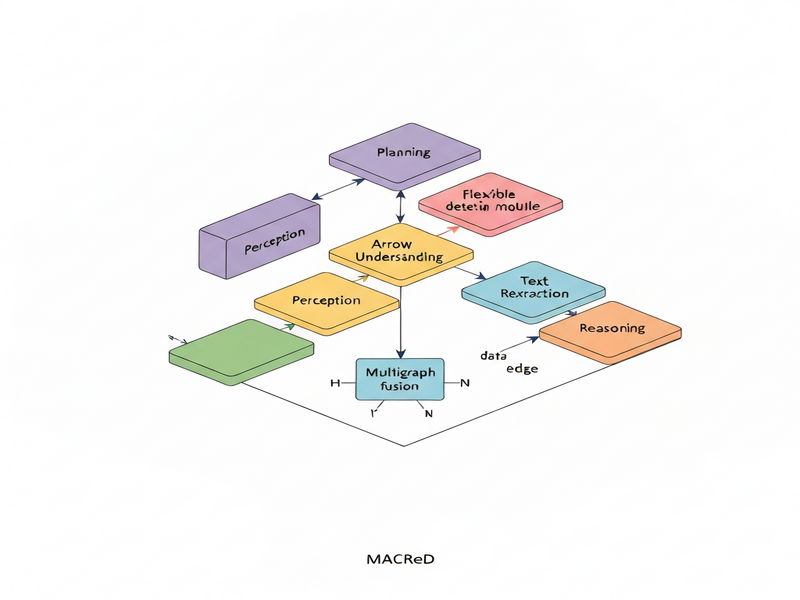
Step 1 – Diagram Ingestion. An input image is fed to a pre‑trained vision‑language model that provides a coarse feature map and initial region proposals.
Step 2 – Planning. The planning module evaluates diagram density, arrow count, and text density to allocate computational budget among agents. For a simple single‑step reaction, only the Molecule and Arrow agents may be invoked; for a tree‑structured synthesis, all agents are activated.
Step 3 – Perception. Each agent operates on the shared feature map but with task‑specific heads:
- The Molecule Agent runs a graph‑based detector that outputs atom nodes and bond edges, preserving stereochemical tags.
- The Arrow Agent classifies arrow glyphs (→, ⇌, ↔) and extracts start‑end coordinates.
- The Text Agent leverages a VLM‑guided OCR stream to capture free‑form labels, then aligns them to nearby visual anchors.
- The Layout Agent builds a spatial adjacency matrix that records relative positions of all detected entities.
Step 4 – Multigraph Fusion. The reasoning layer constructs a heterogeneous multigraph where nodes represent molecules, arrows, and textual conditions, while edges encode spatial adjacency and chemical relationships. A graph neural network (GNN) propagates information across this structure, applying domain‑specific constraints (e.g., valence limits) to prune impossible configurations.
Step 5 – Reaction Reconstruction. The refined multigraph is translated into a standardized reaction representation (e.g., SMILES‑RXN or JSON) that downstream chemistry tools can consume.
What sets MACReD apart is the explicit separation of perception and reasoning, coupled with a collaborative planning stage that dynamically scales agent involvement. This modularity not only improves robustness to layout variations but also enables plug‑and‑play extensions for new visual cues (e.g., isotope labels).
Evaluation & Results
To validate MACReD, the authors benchmarked against RxnScribe, a curated dataset of 5,000 reaction diagrams spanning single‑step, multi‑step, and tree‑structured syntheses. Two matching criteria were reported:
- Hard match: Exact node‑by‑node correspondence with correct atom ordering.
- Soft match: Tolerates minor ordering differences while preserving overall reaction topology.
Under the hard match, MACReD achieved an F1 score of 75.2 %, surpassing the previous RxnScribe baseline (69.1 %). Under the softer criterion, MACReD reached 84.6 % versus the baseline’s 80.0 %. These gains were consistent across diagram categories, with the most pronounced improvement (≈ 8 % absolute) on tree‑structured reactions where spatial reasoning is critical.
Beyond raw metrics, ablation studies demonstrated that removing any single agent reduced performance by 3–5 %, confirming the necessity of the multi‑agent collaboration. Moreover, the planning layer contributed a 2 % boost by preventing over‑allocation of resources to simple diagrams, thereby reducing inference latency.
Why This Matters for AI Systems and Agents
MACReD’s architecture offers a blueprint for building domain‑specific multi‑agent AI pipelines that must reconcile visual, textual, and relational data. For practitioners designing autonomous research assistants, the framework illustrates how to:
- Decompose a complex perception problem into specialist agents, each fine‑tuned on a narrow sub‑task.
- Employ a planning module that dynamically orchestrates agent execution based on input complexity, optimizing compute budgets.
- Fuse heterogeneous outputs through a graph‑centric reasoning layer that enforces domain constraints, a pattern applicable to biomedical imaging, circuit diagram analysis, and more.
In practical terms, a chemistry‑focused AI platform can integrate MACReD to ingest legacy literature, populate reaction databases, and feed high‑quality training data into generative synthesis models. This reduces the manual curation bottleneck that currently hampers large‑scale reaction prediction efforts.
For organizations seeking to embed AI into their R&D workflows, MACReD demonstrates that multi‑agent orchestration can be realized without sacrificing end‑to‑end performance. The approach aligns well with emerging AI marketing agents that coordinate multiple micro‑services to deliver personalized content, suggesting a broader applicability of the underlying principles.
What Comes Next
While MACReD sets a new benchmark, several avenues remain open for exploration:
- Scalability to 3D representations: Extending the perception layer to handle 3D molecular visualizations could unlock parsing of crystallography figures and reaction mechanisms.
- Self‑supervised agent training: Leveraging large corpora of unlabeled diagrams to pre‑train agents may reduce reliance on costly annotation pipelines.
- Cross‑domain transfer: Adapting the planning‑perception‑reasoning triad to other scientific diagram types (e.g., metabolic pathways, circuit schematics) could create a universal diagram‑parsing engine.
- Integration with enterprise AI stacks: Embedding MACReD within an Enterprise AI platform by UBOS would enable seamless workflow automation, from document ingestion to knowledge‑graph population.
Future research may also explore tighter coupling between the VLM backbone and the reasoning GNN, allowing end‑to‑end gradient flow that could further improve chemical consistency. Open challenges include handling ambiguous or erroneous diagrams, and scaling the system to process millions of pages in real time.
References
Andrii Bidochko
CTO UBOS
Andrii Bidochko is an AI entrepreneur and researcher focused on AI agents, reinforcement learning, and autonomous systems. He writes about the technologies shaping the future of machine intelligence, from frontier models and agent architectures to real-world AI applications.