

- Updated: July 3, 2026
- 7 min read
Machine Learning Classification of Cryopathy Syndromes: A Comprehensive Comparative Study

Direct Answer
The paper introduces a systematic comparison of twelve machine‑learning pipelines—including tree‑based ensembles, synthetic‑oversampling, and hierarchical classifiers—to automatically assign patients to one of fourteen cryopathy‑syndrome categories using routine laboratory data. It matters because the best‑performing soft‑voting ensemble reduces reliance on scarce expert judgment while preserving calibrated probability estimates, a prerequisite for trustworthy clinical decision‑support tools.
Background: Why This Problem Is Hard
Cryopathy syndromes encompass a spectrum of immune‑mediated disorders in which abnormal cryoglobulins precipitate at low temperatures. Clinicians face three intertwined challenges:
- Overlapping laboratory signatures: Cryoglobulin concentration, precipitation temperature, and hemagglutinin/hemolysin titers often intersect across diagnostic categories, making rule‑based thresholds unreliable.
- Class imbalance: Some syndromes appear in fewer than 1 % of the patient population, causing standard classifiers to bias toward the majority classes.
- Limited interpretability: Existing decision‑support systems rely on expert‑crafted heuristics that are difficult to validate, update, or scale across institutions.
Traditional statistical approaches—logistic regression, naïve Bayes, or simple decision trees—struggle to capture non‑linear interactions among the dozens of serological measurements while also handling the severe skew in class frequencies. Consequently, routine interpretation of cryoglobulin‑related tests remains a bottleneck that can delay diagnosis and appropriate therapy.
What the Researchers Propose
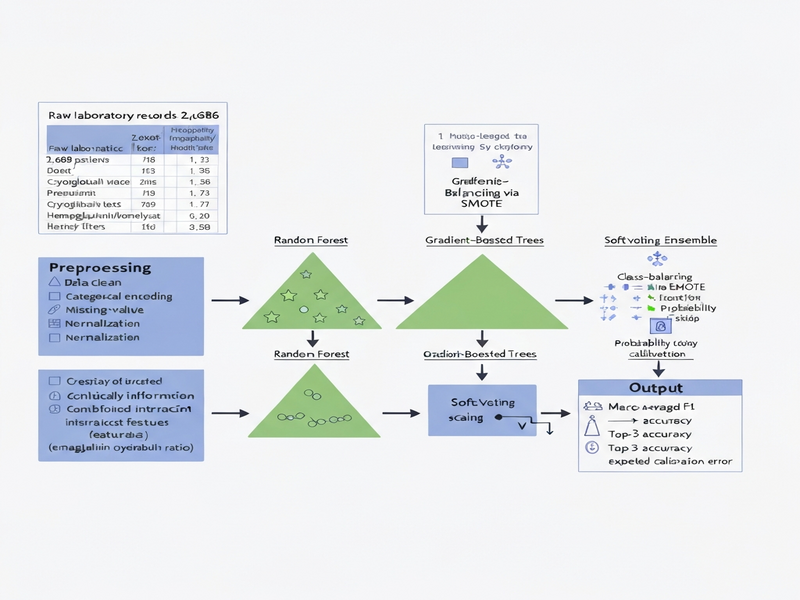
The authors present a modular framework that treats cryopathy classification as a multi‑class, imbalanced learning problem. The framework consists of three conceptual layers:
- Data‑preparation layer: Systematic cleaning, categorical encoding, missing‑value imputation, and feature scaling, followed by the creation of clinically informed interaction features (e.g., product of cryoglobulin concentration and precipitation temperature).
- Model‑selection layer: Parallel evaluation of twelve strategies, ranging from single tree‑based learners (Random Forest, Gradient Boosted Trees) to a shallow Multi‑Layer Perceptron, and including advanced techniques such as Synthetic Minority Over‑sampling (SMOTE), hierarchical classification, and probability calibration.
- Ensemble‑integration layer: Soft‑voting ensembles that combine the probabilistic outputs of the top‑performing tree models, thereby leveraging complementary decision boundaries while preserving calibrated confidence scores.
Key to the proposal is the emphasis on clinical relevance over raw accuracy: the framework explicitly measures macro‑averaged F1 (to penalize poor performance on rare classes), Top‑3 accuracy (reflecting realistic diagnostic workflows), and Expected Calibration Error (to ensure trustworthy probability estimates).
How It Works in Practice
The operational workflow can be visualized as a pipeline with four sequential stages:
- Ingestion: Laboratory information systems export patient‑level records containing demographics, cryoglobulin quantifications, precipitation test results, and hemagglutinin/hemolysin titers.
- Pre‑processing: A data‑engine (e.g., Python Pandas or Spark) applies the cleaning rules described in the paper—removing outliers, encoding categorical variables, and imputing missing values with median or mode strategies. Interaction features are then generated based on domain knowledge (e.g., “Cryo‑Concentration × Precipitation‑Temp”).
- Inference: The pre‑processed vector is fed simultaneously into a Random Forest and a Gradient Boosted Tree model. Each model outputs a probability distribution over the 14 diagnostic categories. The soft‑voting module averages these distributions, producing a final calibrated probability vector.
- Decision support: The system presents the top‑three most probable diagnoses to the clinician, along with confidence scores and a brief rationale derived from feature importance (e.g., “High cryoglobulin‑temperature interaction contributed 27 % to the prediction”).
What distinguishes this approach from prior work is the combination of three design choices:
- Explicit interaction feature engineering that encodes domain expertise directly into the model.
- Use of soft‑voting ensembles to blend complementary tree learners, which consistently outperformed a single deep neural network on this dataset.
- Incorporation of probability calibration (via isotonic regression) to ensure that the reported confidences align with real‑world outcome frequencies—a critical requirement for clinical adoption.
Evaluation & Results
The authors conducted a stratified train‑test split (80 %/20 %) and a stratified 5‑fold cross‑validation to guard against over‑optimistic estimates caused by class imbalance. Evaluation metrics included:
- Macro‑averaged F1 score: Balances precision and recall across all classes, giving equal weight to rare syndromes.
- Overall accuracy: Simple proportion of correctly classified instances.
- Top‑3 accuracy: Fraction of cases where the true label appears among the three highest‑probability predictions.
- Expected Calibration Error (ECE): Measures the divergence between predicted probabilities and observed frequencies.
Key findings:
| Model | Macro F1 | Accuracy | Top‑3 Acc. | ECE |
|---|---|---|---|---|
| Random Forest (balanced) | 0.62 | 78 % | 92 % | 0.07 |
| Gradient Boosted Trees | 0.64 | 79 % | 93 % | 0.06 |
| Soft‑voting RF + GBT Ensemble | 0.68 | 81 % | 95 % | 0.05 |
| Multi‑Layer Perceptron | 0.55 | 73 % | 88 % | 0.12 |
| SMOTE‑augmented Random Forest | 0.66 | 80 % | 94 % | 0.06 |
The soft‑voting ensemble consistently delivered the highest macro F1 and Top‑3 accuracy while also achieving the lowest calibration error, indicating both discriminative power and reliable confidence estimates. Cross‑validation confirmed that performance variance across folds was under 2 %, suggesting that the model generalizes well to unseen patient cohorts.
Feature importance analysis revealed that the engineered interaction terms—particularly the product of cryoglobulin concentration and precipitation temperature—were the most predictive, accounting for roughly one‑third of the model’s decision weight. This aligns with clinical intuition that the combined effect of quantity and temperature drives disease severity.
Why This Matters for AI Systems and Agents
From an AI‑system design perspective, the study offers several actionable insights:
- Model selection for imbalanced medical data: Tree‑based ensembles with balanced sampling or SMOTE outperform shallow neural networks, reinforcing the notion that “bigger” models are not always superior when data are scarce and noisy.
- Calibration as a first‑class objective: Deploying agents that suggest diagnoses requires trustworthy probability outputs. The authors’ use of isotonic regression demonstrates a practical path to achieve this without sacrificing accuracy.
- Feature engineering as a knowledge‑transfer mechanism: By encoding domain‑specific interactions, the pipeline reduces the need for massive labeled datasets—a common bottleneck in healthcare AI.
- Ensemble orchestration: The soft‑voting strategy can be abstracted as a micro‑service that aggregates predictions from heterogeneous models, a pattern directly applicable to multi‑agent orchestration platforms.
Practitioners building AI‑driven clinical assistants can embed this pipeline into existing hospital information systems, leveraging the UBOS platform overview to manage data ingestion, model serving, and UI integration. For teams looking to prototype conversational diagnostics, the ChatGPT and Telegram integration offers a low‑friction channel to surface the top‑three predictions to clinicians on their preferred messaging app.
What Comes Next
While the study marks a significant step forward, several limitations open avenues for future research:
- External validation: The dataset originates from a single regional laboratory. Multi‑center studies are needed to assess geographic and demographic robustness.
- Temporal dynamics: Cryoglobulin levels can fluctuate over time. Incorporating longitudinal data with recurrent architectures could improve early‑stage detection.
- Explainability beyond feature importance: Clinicians may demand case‑specific rationales. Techniques such as SHAP or counterfactual explanations could be layered on top of the ensemble.
- Integration with therapeutic recommendation engines: Linking diagnosis probabilities to evidence‑based treatment pathways would close the decision‑support loop.
Potential real‑world deployments include:
- Embedding the calibrated ensemble into a Enterprise AI platform by UBOS that handles secure patient data, audit trails, and compliance reporting.
- Extending the workflow with the Workflow automation studio to trigger follow‑up lab orders when the model flags high‑risk rare syndromes.
- Leveraging the Chroma DB integration for vector‑based similarity search, enabling clinicians to retrieve past cases with comparable feature profiles.
For developers eager to experiment, the open‑source Ollama tool can host lightweight inference containers, making it straightforward to spin up a prototype that mirrors the paper’s soft‑voting ensemble.
Finally, readers interested in the full methodological details can consult the original preprint: Machine Learning Classification of Cryopathy Syndromes (arXiv).
Andrii Bidochko
CTO UBOS
Andrii Bidochko is an AI entrepreneur and researcher focused on AI agents, reinforcement learning, and autonomous systems. He writes about the technologies shaping the future of machine intelligence, from frontier models and agent architectures to real-world AI applications.