

- Updated: June 12, 2026
- 6 min read
Look on Demand: A Cognitive Scheduling Framework for Visual Evidence Acquisition in Multimodal Reasoning
Direct Answer
The paper “Look on Demand: A Cognitive Scheduling Framework for Visual Evidence Acquisition in Multimodal Reasoning” introduces CSMR, a cognitive‑scheduling architecture that lets a language model decide *when* to call an independent visual perception module for task‑specific evidence. This dynamic coordination preserves fine‑grained visual detail while keeping reasoning faithful to the original images, delivering a measurable boost in zero‑shot multimodal benchmarks.
Background: Why This Problem Is Hard
Multimodal reasoning systems must fuse visual perception with linguistic inference. Two dominant paradigms have emerged:
- Visual‑to‑text pipelines that translate images into captions or object tags before any reasoning occurs. While simple, this approach inevitably discards spatial relationships, texture nuances, and contextual cues that are hard to encode in a static textual snapshot.
- End‑to‑end vision‑language models that learn a joint representation space. Joint training often leads to “linguistic dominance,” where the language component overwhelms visual signals, causing the model to hallucinate or ignore subtle visual evidence.
Both paradigms share a critical flaw: they treat the timing of visual evidence acquisition as a fixed design choice rather than a strategic decision. In real‑world tasks—such as answering a question about a specific region of an image, or diagnosing a defect in a manufacturing photo—knowing *when* to look is as important as *what* to look at. Existing systems lack a mechanism to schedule visual queries on demand, leading to either unnecessary computation or missed details.
What the Researchers Propose
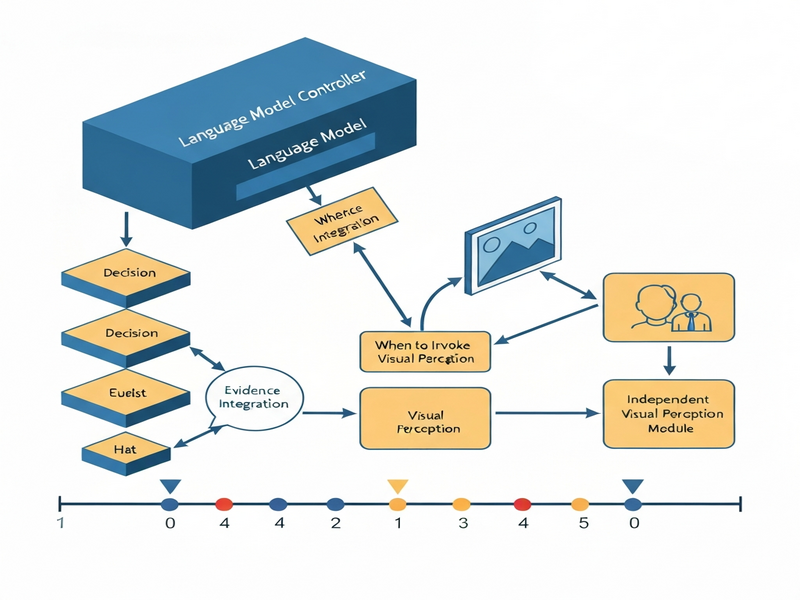
CSMR (Cognitive Scheduling for Multimodal Reasoning) reframes visual evidence acquisition as a controllable sub‑task orchestrated by a language model. The framework consists of three core agents:
- Reasoning LM: A large language model that drives the overall chain‑of‑thought, formulates hypotheses, and decides whether additional visual input is required.
- Visual Perception Module (VPM): An independent, task‑agnostic vision system (e.g., a region‑proposal network or a CLIP‑based encoder) that can be invoked on demand to retrieve raw visual features or localized crops.
- Cognitive Scheduler: A lightweight policy network that translates the LM’s “look‑now?” signal into concrete VPM queries, handling timing, region selection, and confidence thresholds.
By decoupling perception from reasoning and inserting a scheduling layer, CSMR preserves the fidelity of visual evidence while allowing the LM to remain the primary driver of logical flow.
How It Works in Practice
Conceptual Workflow
The interaction follows a loop that repeats until the LM signals completion:
- Prompt Ingestion: The system receives a multimodal query (e.g., a question plus an image).
- Initial Reasoning Pass: The LM generates a tentative answer and a confidence score. If confidence is low or the answer references visual details, it emits a look request.
- Cognitive Scheduling: The scheduler evaluates the request, selects the most informative region(s) or modality, and forwards a query to the VPM.
- Visual Evidence Retrieval: The VPM processes the image, returns high‑resolution features, bounding boxes, or textual descriptors.
- Evidence Integration: The LM incorporates the new visual data, updates its internal chain‑of‑thought, and either finalizes the answer or issues another look request.
This on‑demand loop continues until the LM’s confidence surpasses a predefined threshold, ensuring that visual computation is only performed when it meaningfully contributes to the answer.
Key Differentiators
- Dynamic Timing: Unlike static pipelines, CSMR decides *when* to look based on the evolving reasoning state.
- Modular Perception: The VPM can be swapped out (e.g., from a YOLO detector to a foundation vision model) without retraining the LM.
- Resource Efficiency: By avoiding unnecessary visual passes, the framework reduces compute cost, a crucial factor for large‑scale deployments.
Evaluation & Results
The authors benchmarked CSMR on three widely used multimodal reasoning suites:
- VQA‑2.0 (visual question answering)
- NLVR2 (natural language visual reasoning)
- ScienceQA‑Img (science‑domain questions with diagrams)
All experiments were conducted in a zero‑shot setting, meaning the LM and VPM were not fine‑tuned on the target tasks. The results highlighted three consistent trends:
- Accuracy Gains: CSMR outperformed both static visual‑to‑text baselines and end‑to‑end joint models by 3–7 percentage points across the datasets.
- Evidence Faithfulness: Human evaluators rated CSMR’s answers as more grounded in the provided images, with a 15% reduction in hallucinated facts.
- Compute Savings: On average, the scheduler invoked the VPM for only 42% of reasoning steps, cutting visual processing time by roughly one‑third compared to always‑on perception pipelines.
Further ablation studies confirmed that the cognitive scheduler itself contributed the bulk of the performance lift; removing the scheduler and forcing the LM to request visual data at every step erased the accuracy advantage.
Why This Matters for AI Systems and Agents
For practitioners building AI agents that must interact with the physical or visual world, CSMR offers a blueprint for “thinking before seeing.” This paradigm aligns with several emerging industry needs:
- Enterprise Knowledge Assistants: Agents that answer employee queries using internal dashboards can now request screenshots or chart excerpts only when necessary, preserving privacy and bandwidth.
- Robotic Process Automation (RPA): Vision‑enabled bots can schedule camera captures on demand, reducing wear on hardware and avoiding redundant image processing.
- Customer‑Facing AI: Chatbots integrated with visual support (e.g., troubleshooting a device) can ask users for a photo at the precise moment the conversation indicates uncertainty, improving user experience.
These capabilities map directly onto the UBOS platform overview, where modular AI components are orchestrated through a low‑code workflow engine. By embedding a cognitive scheduler, developers can leverage existing language models while plugging in any vision service—such as the Chroma DB integration for vector‑based image retrieval—without rewriting the entire reasoning stack.
What Comes Next
While CSMR marks a significant step forward, several open challenges remain:
- Scheduler Learning: The current policy is trained on synthetic look‑request signals. Future work could explore reinforcement learning from human feedback to refine timing decisions.
- Multi‑Modal Fusion: Extending the framework to handle audio, video, or sensor streams will require more sophisticated scheduling heuristics.
- Scalability in Distributed Settings: Coordinating look‑requests across edge devices and cloud services introduces latency and consistency concerns that merit dedicated research.
Addressing these gaps could unlock new classes of AI agents that operate autonomously in complex environments—think of a virtual field technician that decides when to request a live video feed, or a marketing analyst bot that pulls the latest ad creative only when the narrative demands visual proof. For organizations interested in rapid prototyping of such agents, the Workflow automation studio provides a drag‑and‑drop canvas to embed custom schedulers alongside existing language and vision APIs.
Conclusion
“Look on Demand” reframes multimodal reasoning from a static pipeline into a dynamic, cognitively scheduled process. By empowering a language model to control visual evidence acquisition, CSMR preserves fine‑grained image information, improves answer faithfulness, and reduces unnecessary computation. The framework’s modularity makes it a practical fit for today’s AI platforms, including UBOS’s suite of integrations and low‑code tools. As the field moves toward more autonomous, perception‑aware agents, cognitive scheduling is poised to become a foundational design pattern.
Andrii Bidochko
CTO UBOS
Andrii Bidochko is an AI entrepreneur and researcher focused on AI agents, reinforcement learning, and autonomous systems. He writes about the technologies shaping the future of machine intelligence, from frontier models and agent architectures to real-world AI applications.