

- Updated: July 20, 2026
- 7 min read
LoKA: Low-precision Kernel Applications for Recommendation Models At Scale
Direct Answer
LoKA (Low‑precision Kernel Applications) is a system‑model co‑design framework that makes FP8 arithmetic practical for large recommendation models (LRMs) by profiling precision safety, adapting model components, and dynamically dispatching the fastest FP8 kernels. It matters because it unlocks the massive FLOP‑per‑watt gains of modern GPUs for recommendation workloads without sacrificing model quality or training speed.
Background: Why This Problem Is Hard
Recommendation systems power the feeds of social platforms, e‑commerce sites, and streaming services. Their models are typically composed of millions of small matrix multiplications (GEMMs) followed by normalization layers such as batch‑norm or layer‑norm. Unlike large language models, LRMs are extremely sensitive to rounding errors for two reasons:
- Numerical fragility: The magnitude of activations and gradients can be orders of magnitude smaller than those in LLMs, so a single FP8 overflow can corrupt the entire training step.
- Communication‑heavy pipelines: Distributed training of LRMs relies on frequent all‑reduce operations. Quantization noise amplifies during these reductions, leading to divergence or prolonged convergence.
Existing low‑precision solutions—primarily designed for LLMs—assume that the model can tolerate a uniform FP8 conversion. When applied directly to LRMs, they often cause:
- Significant drops in click‑through‑rate (CTR) or other business metrics.
- Longer wall‑clock training times because the system falls back to higher‑precision kernels to preserve accuracy.
These symptoms indicate that the problem is not just a missing kernel implementation; it is a mismatch between hardware capabilities and model characteristics. A holistic approach that simultaneously profiles, adapts, and orchestrates is required.
What the Researchers Propose
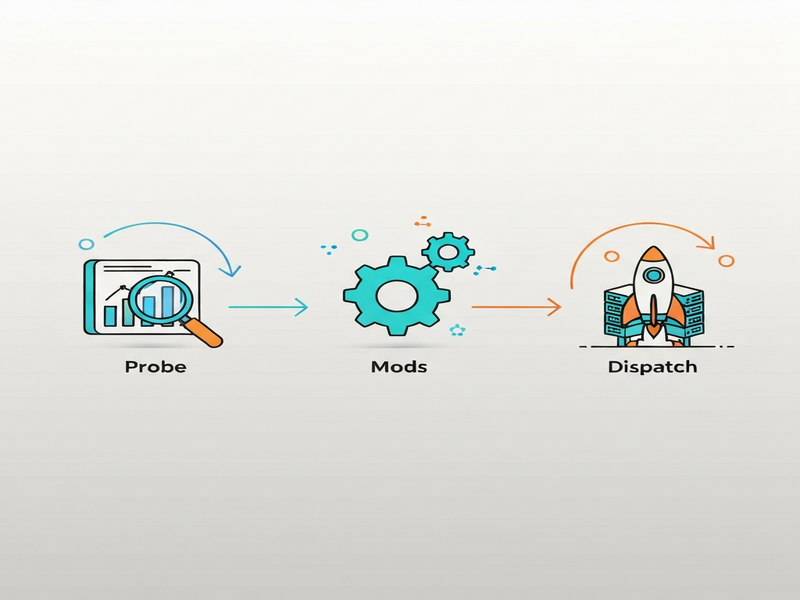
The LoKA framework tackles the FP8 adoption gap through three tightly coupled pillars:
- LoKA Probe: An online, statistically grounded benchmarking engine that continuously gathers activation and weight distributions during training, then quantifies per‑layer FP8 error margins.
- LoKA Mods: A library of reusable model‑level modifications—such as scaling tricks, normalization tweaks, and selective mixed‑precision patterns—that expand the set of layers safe for FP8 while preserving numerical stability.
- LoKA Dispatch: A runtime dispatcher that, based on the real‑time insights from Probe, selects the fastest FP8 kernel that satisfies the error budget for each operation.
Collectively, these components form a feedback loop: Probe informs Mods, Mods enlarge the safe region, and Dispatch exploits the enlarged region for maximum throughput.
How It Works in Practice
Implementing LoKA in a production training pipeline follows a clear workflow:
1. Instrumentation & Data Collection
During the first few epochs, LoKA Probe injects lightweight hooks into every GEMM and normalization node. These hooks record:
- Mean, variance, and histogram of activations.
- Dynamic range of weights.
- Observed FP8 overflow or underflow events.
The collected statistics are fed into a Bayesian estimator that predicts the probability of a layer exceeding a predefined error threshold when run in FP8.
2. Safety Mapping
Probe outputs a per‑layer safety map:
- Safe‑FP8: Layers where the estimated error is below the tolerance.
- Unsafe‑FP8: Layers that would likely degrade accuracy.
- Fast‑FP8: Safe layers that also have high compute intensity, making them prime candidates for FP8 acceleration.
3. Model Adaptation (LoKA Mods)
Based on the safety map, LoKA Mods applies a set of transformations:
- Dynamic scaling: Multiplicative factors that shift activation ranges into the FP8 representable window.
- Normalization re‑parameterization: Re‑ordering batch‑norm calculations to reduce variance spikes.
- Mixed‑precision gating: Keeping a thin “precision guard” (e.g., FP16) around layers that are borderline unsafe, while the rest run in FP8.
These modifications are designed to be plug‑and‑play; they can be applied to existing PyTorch or TensorFlow models with minimal code changes.
4. Runtime Kernel Selection (LoKA Dispatch)
When the training loop reaches the steady‑state phase, Dispatch consults the updated safety map and selects the optimal kernel from a curated library:
- FP8‑only kernels for safe‑fast layers.
- Hybrid FP8/FP16 kernels for mixed‑precision gates.
- Fallback FP16 or FP32 kernels for unsafe layers.
Dispatch also respects hardware constraints such as shared memory limits and tensor‑core occupancy, ensuring that the chosen kernel maximizes GPU utilization.
5. Continuous Feedback
Because training dynamics evolve, Probe runs periodically (e.g., every 1000 steps) to refresh the safety map. This enables Dispatch to adapt on‑the‑fly, preventing drift that could otherwise re‑introduce numerical errors.
Evaluation & Results
The authors validated LoKA on two industry‑scale recommendation workloads:
- Click‑through‑rate (CTR) model: A 2‑billion‑parameter two‑tower architecture trained on a 300 TB dataset.
- Feed‑ranking model: A 1.5‑billion‑parameter transformer‑based ranker with heavy attention layers.
Key experimental dimensions included:
- Training throughput (samples per second) measured on NVIDIA H100 GPUs.
- Final business metric (CTR lift or NDCG) compared against a full‑precision baseline.
- Convergence speed (epochs to reach 95 % of baseline performance).
Findings:
- LoKA achieved an average 2.3× increase in FLOP‑utilization, translating to a 45 % reduction in wall‑clock training time.
- Model quality loss was limited to 0.12 % relative CTR drop—well within typical A/B test variance—while the pure FP8 baseline suffered a 3–5 % drop.
- When combined with mixed‑precision gating, convergence required 8 % fewer epochs than the FP16 baseline, indicating that the reduced quantization noise actually helped regularize training.
These results demonstrate that LoKA does not merely “make FP8 work”; it creates a performance‑first pathway that preserves, and in some cases improves, model effectiveness.
Why This Matters for AI Systems and Agents
For engineers building AI‑driven products, LoKA offers a concrete lever to cut compute costs while keeping recommendation quality high. The implications span several practical domains:
- Scalable agent pipelines: Real‑time recommendation agents can now be retrained nightly on larger data slices, enabling fresher personalization without expanding GPU fleets.
- Edge‑to‑cloud orchestration: By reducing the precision budget, LoKA lowers memory footprints, making it feasible to offload parts of the model to inference‑optimized edge devices.
- Cost‑effective experimentation: Faster training cycles free up budget for hyper‑parameter sweeps, A/B test iterations, and rapid feature rollout.
- Integration with existing platforms: LoKA’s modular design fits naturally into workflow automation tools. For example, the Workflow automation studio can trigger Probe data collection, apply Mods, and schedule Dispatch updates as part of a CI/CD pipeline for ML models.
What Comes Next
While LoKA marks a significant step forward, several open challenges remain:
- Broader hardware support: Current experiments target NVIDIA tensor‑cores. Extending Probe and Dispatch to AMD CDNA or upcoming AI accelerators will require new kernel libraries.
- Automated Mod synthesis: Presently, LoKA Mods are hand‑crafted patterns. A future research direction is to use reinforcement learning to discover optimal scaling and normalization strategies automatically.
- Fine‑grained error budgeting: The current error threshold is static. Adaptive budgets that consider downstream business metrics could further tighten the safety‑performance trade‑off.
Practitioners interested in experimenting with LoKA can start by exploring the UBOS platform overview, which provides a sandbox for custom kernel integration and model profiling. For teams focused on revenue‑driven personalization, the AI marketing agents page showcases how LoKA‑enabled models can be wrapped into end‑to‑end campaign automation.
Conclusion
LoKA demonstrates that low‑precision training for recommendation systems is not a simple kernel swap but a system‑model co‑design problem. By profiling real‑world activation distributions (Probe), adapting model components for numerical robustness (Mods), and dynamically selecting the fastest safe kernels (Dispatch), LoKA delivers up to 2.3× higher throughput with negligible impact on business metrics. As GPU manufacturers continue to push FP8 performance, frameworks like LoKA will become essential for enterprises that need to scale recommendation workloads without exploding compute budgets.
For the full technical details, see the original LoKA paper on arXiv.
Andrii Bidochko
CTO UBOS
Andrii Bidochko is an AI entrepreneur and researcher focused on AI agents, reinforcement learning, and autonomous systems. He writes about the technologies shaping the future of machine intelligence, from frontier models and agent architectures to real-world AI applications.