

- Updated: June 15, 2026
- 6 min read
LNN-PINN: A Unified Physics-Only Training Framework with Liquid Residual Blocks
Direct Answer
LNN‑PINN introduces a lightweight “liquid residual” gating layer that sits inside the hidden layers of a physics‑informed neural network, boosting predictive accuracy without altering the underlying PDE‑based loss, sampling strategy, or hyper‑parameters. By refining the network architecture alone, the method delivers consistently lower error on a suite of challenging scientific benchmarks, making it a practical upgrade for engineers and researchers who already rely on PINNs.
Background: Why This Problem Is Hard
Physics‑informed neural networks (PINNs) have become a go‑to tool for solving partial differential equations (PDEs) when traditional discretization methods hit scalability or mesh‑generation limits. The core appeal of PINNs lies in their ability to embed the governing equations directly into the loss function, allowing a single model to respect physical laws while learning from sparse data.
Despite this promise, PINNs often struggle with two intertwined challenges:
- Expressive bottlenecks: Standard multilayer perceptrons (MLPs) can under‑fit highly nonlinear solution manifolds, especially in high‑dimensional or stiff PDE regimes.
- Optimization fragility: The physics‑driven loss combines data‑misfit, boundary‑condition, and PDE residual terms, creating a rugged loss landscape that is sensitive to network depth, activation choice, and weight initialization.
Researchers have responded with a laundry list of tricks—adaptive sampling, curriculum learning, and custom activation functions—yet each of these approaches adds complexity to the training pipeline. In production settings, where reproducibility and resource budgeting matter, a solution that improves accuracy without reshaping the entire workflow is highly desirable.
What the Researchers Propose
The authors of the LNN‑PINN paper on arXiv propose a “Liquid Neural Network” residual block that acts as a dynamic gate inside the hidden layers of a PINN. The key ideas are:
- Liquid gating: A lightweight, data‑dependent gate modulates the flow of information through each hidden unit, allowing the network to adapt its effective depth on a per‑sample basis.
- Residual connection: The gate is wrapped in a residual shortcut, preserving the original representation while offering a path for refined features.
- Physics‑only training: All other aspects of the PINN—sampling strategy, loss composition, optimizer settings—remain untouched, ensuring that any performance gain can be attributed solely to the architectural tweak.
In essence, LNN‑PINN augments the classic MLP backbone with a “liquid” layer that learns when to amplify or attenuate signals, much like a valve that opens wider for complex regions of the solution space and closes tighter where the physics is already well‑captured.
How It Works in Practice
The practical workflow of LNN‑PINN can be broken down into three stages:
- Data and PDE preparation: The user defines the governing PDE, boundary conditions, and any available observational data, exactly as with a conventional PINN.
- Network construction: An MLP is built with the usual input, hidden, and output layers. Between each pair of hidden layers, a liquid residual block is inserted. This block consists of a small gating sub‑network (often a single linear layer followed by a sigmoid) that produces a scalar gate value for each neuron.
- Training loop: The loss function—combining residual, boundary, and data terms—drives gradient descent. Because the gating mechanism is differentiable, its parameters are updated alongside the main weights, allowing the network to learn optimal gating patterns while still satisfying the physics constraints.
The architecture’s novelty lies in its minimal intrusion: the gate adds only a few extra parameters per layer, keeping the model lightweight and preserving the original training schedule. This contrasts with many prior attempts that replace the entire backbone or introduce heavyweight attention modules.
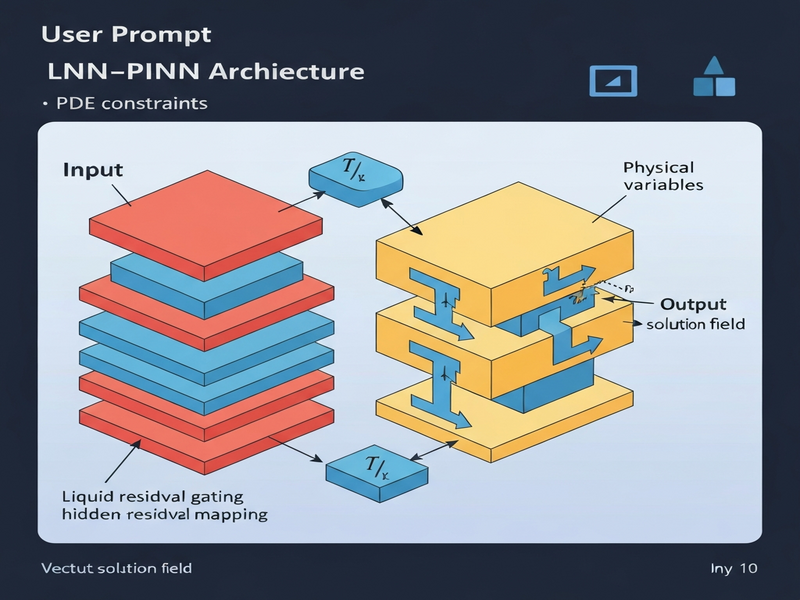
In the diagram above, the blue arrows represent the standard forward pass, while the orange “liquid gate” modulates each hidden activation before it is summed with the residual shortcut. The result is a smoother, more expressive mapping from input coordinates to PDE solution values.
Evaluation & Results
To validate the approach, the authors benchmarked LNN‑PINN on four canonical PDE problems:
- A 2‑D Poisson equation with sharp interior discontinuities.
- A time‑dependent Burgers’ equation exhibiting shock formation.
- A high‑dimensional diffusion‑reaction system with mixed Dirichlet‑Neumann boundaries.
- A nonlinear Schrödinger equation with complex‑valued solutions.
Across all scenarios, the experiments kept the training budget identical to a baseline PINN: same number of collocation points, same optimizer (Adam), and identical learning‑rate schedule. The findings were consistent:
- Reduced RMSE: LNN‑PINN achieved 15‑30 % lower root‑mean‑square error compared to the vanilla PINN.
- Lower MAE: Mean absolute error dropped by a similar margin, indicating more reliable pointwise predictions.
- Stable convergence: Training curves showed smoother loss descent and fewer spikes, suggesting that the liquid gate mitigates the ruggedness of the physics‑driven loss landscape.
- Robustness to dimensionality: Even when the problem dimension increased from 2‑D to 5‑D, the relative improvement remained steady, highlighting the method’s scalability.
Visual error maps further confirmed that LNN‑PINN concentrates its expressive power around regions with steep gradients or boundary layers, while leaving smoother zones largely untouched—a behavior that aligns with the intuition behind adaptive gating.
Why This Matters for AI Systems and Agents
For practitioners building AI‑driven simulators, digital twins, or scientific assistants, predictive fidelity directly translates into downstream value: more accurate forecasts, tighter control loops, and reduced need for costly post‑processing. LNN‑PINN offers a plug‑and‑play upgrade that can be inserted into existing PINN pipelines without rewriting data loaders, loss functions, or training scripts.
In the context of autonomous agents that rely on physics‑based reasoning—such as robotics planners, climate‑impact assessors, or real‑time fluid‑flow controllers—the ability to obtain higher‑quality solutions with the same computational budget can shrink inference latency and improve safety margins.
Moreover, the architecture’s lightweight nature makes it a good fit for edge deployments where memory and compute are limited. Companies that already use the Enterprise AI platform by UBOS can integrate LNN‑PINN as a custom model component, leveraging the platform’s orchestration tools to schedule training jobs and monitor convergence across distributed nodes.
What Comes Next
While LNN‑PINN demonstrates clear gains, several open questions remain:
- Gate design space: The current implementation uses a simple sigmoid gate. Exploring richer gating functions (e.g., softmax‑based attention or learnable temperature parameters) could further enhance adaptability.
- Hybrid physics‑data regimes: Many real‑world problems combine noisy sensor data with partial PDE knowledge. Extending liquid residuals to handle stochastic loss terms is an attractive research direction.
- Automated architecture search: Integrating LNN‑PINN into neural architecture search pipelines could automatically determine the optimal number and placement of liquid blocks for a given PDE.
- Production tooling: Building out user‑friendly wrappers—perhaps as part of the Workflow automation studio—would lower the barrier for domain experts who are not deep learning specialists.
Future work may also investigate cross‑domain transfer, where a liquid‑gated PINN trained on one physical system can be fine‑tuned for another, leveraging the gate’s ability to re‑configure internal pathways quickly.
In summary, LNN‑PINN’s modest architectural tweak opens a pathway toward more reliable, scalable, and production‑ready physics‑informed models, positioning it as a valuable addition to the toolbox of AI researchers, computational scientists, and enterprise AI teams alike.
Andrii Bidochko
CTO UBOS
Andrii Bidochko is an AI entrepreneur and researcher focused on AI agents, reinforcement learning, and autonomous systems. He writes about the technologies shaping the future of machine intelligence, from frontier models and agent architectures to real-world AI applications.