

- Updated: July 13, 2026
- 7 min read
LLT: Local Linear Transformer for PDE Operator Learning
Direct Answer
The paper introduces the Local Linear Transformer (LLT), a neural‑operator architecture that blends linear‑complexity global attention with explicit local spatial mixing to learn partial‑differential‑equation (PDE) solution operators. By doing so, LLT cuts the quadratic cost of standard transformers while preserving the ability to capture long‑range physical interactions, delivering faster training and competitive accuracy across a wide range of simulation domains.
Background: Why This Problem Is Hard
Numerical simulation of PDEs underpins everything from aerospace design to climate modeling. Traditional solvers—finite‑element, finite‑volume, or finite‑difference methods—require handcrafted discretizations and can take hours or days for high‑fidelity meshes. Neural operators promise a data‑driven shortcut: once trained, they map input fields (e.g., material properties, boundary conditions) directly to solution fields, enabling near‑instant inference.
However, two practical obstacles have limited their adoption:
- Scalability. Most neural‑operator designs, especially transformer‑based ones, rely on full‑attention mechanisms that scale as O(N²) with the number of mesh nodes N. For realistic engineering meshes containing tens of thousands of points, memory and compute quickly become prohibitive.
- Lack of locality bias. Physical systems are governed by local interactions (e.g., diffusion, elasticity) that decay with distance. Standard attention treats every pair of points equally, forcing the model to learn locality from data alone, which can waste capacity and hurt generalization on unstructured meshes.
These challenges matter because enterprises increasingly rely on AI‑augmented simulation pipelines to accelerate product development cycles. A neural operator that is both fast and respects the underlying physics can become a core component of digital twins, real‑time control, and design‑space exploration tools.
What the Researchers Propose
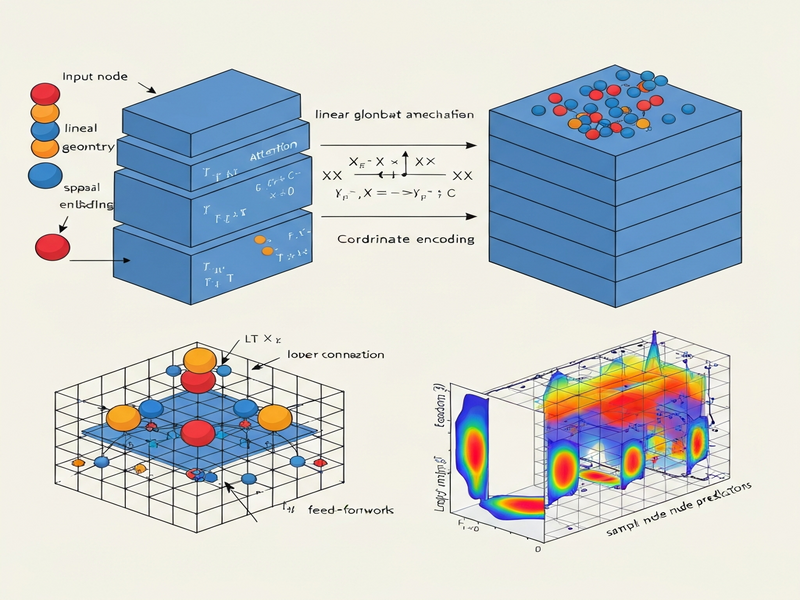
Ovadia and Turkel propose a hybrid architecture called the Local Linear Transformer (LLT). The design rests on three intuitive pillars:
- Linear global attention. By approximating the softmax attention with a kernel that admits a linear‑time implementation, LLT captures long‑range dependencies without the quadratic blow‑up.
- Explicit local mixing. A lightweight convolution‑like module sweeps over spatial neighborhoods, injecting a strong inductive bias toward nearby interactions that mirrors the locality of PDE operators.
- Geometry‑aware encoding. Node coordinates and mesh topology are embedded alongside the physical fields, allowing the model to differentiate between structured grids and irregular, unstructured meshes.
In essence, LLT treats the PDE domain as a two‑stage communication process: first, a fast global broadcast of coarse information, then a focused local refinement that respects the mesh geometry.
How It Works in Practice
The LLT workflow can be broken down into four sequential components, each of which can be implemented as a modular block in modern deep‑learning frameworks:
1. Input Embedding
Raw simulation inputs—such as material coefficients, source terms, and boundary conditions—are concatenated with positional encodings derived from node coordinates. This joint representation preserves both field values and spatial context.
2. Linear Global Attention Layer
Using a kernel‑based approximation (e.g., FAVOR+ or kernelized softmax), the layer computes attention scores in O(N) time. The result is a set of globally aggregated features that convey information from distant parts of the domain, akin to a low‑frequency Fourier mode.
3. Local Spatial Mixer
A depth‑wise convolution or graph‑neighborhood aggregation follows, operating on a fixed-radius or k‑nearest‑neighbor stencil. This step sharpens the global signal by injecting high‑frequency, locality‑specific details, effectively learning the differential operators that dominate PDE behavior.
4. Output Decoder
The refined node features are projected back to the solution space (e.g., displacement fields, pressure, velocity) through a lightweight MLP. Because the decoder sees both global context and local refinement, it can reconstruct accurate field solutions even on coarse training data.
What sets LLT apart from prior transformer‑based operators is the explicit separation of concerns: global attention handles long‑range coupling, while the local mixer enforces physics‑consistent locality. This division reduces redundancy, improves training stability, and enables the model to scale to meshes with >30 k nodes, as demonstrated on a 3‑D car‑aerodynamics dataset.
Evaluation & Results
The authors benchmarked LLT against a suite of established neural operators (Fourier Neural Operator, DeepONet, Graph Neural Operator) and transformer baselines (Transolver, Fourier Transformer). The testbed covered five distinct PDE families:
- Elasticity. Predicting displacement fields on heterogeneous material domains.
- Plasticity. Capturing irreversible deformations under varying load paths.
- Airfoil flow. Solving Navier‑Stokes equations around aerodynamic profiles.
- Pipe flow. Modeling incompressible flow in complex pipe networks.
- Darcy flow. Simulating porous media transport on unstructured grids.
Key findings include:
- Accuracy. LLT achieved equal or lower relative L₂ error compared to the best‑performing baselines on every benchmark, often improving error by 5‑15 % on unstructured meshes.
- Speed. On matched structured discretizations, a single training iteration ran 1.8–2.5× faster than Transolver, confirming the linear‑time advantage of the attention module.
- Scalability. The 3‑D car‑aerodynamics experiment involved 32,186 mesh points per sample; LLT trained without out‑of‑memory failures, whereas full‑attention transformers required aggressive down‑sampling.
- Robustness to mesh type. Because geometry encodings are part of the input, LLT performed consistently across finite‑element, finite‑volume, and finite‑difference discretizations, a rare property among neural operators.
These results demonstrate that LLT not only bridges the performance gap between accuracy and efficiency but also generalizes across disparate simulation pipelines—a critical requirement for production‑grade AI‑enhanced engineering tools.
Why This Matters for AI Systems and Agents
From a systems‑engineering perspective, LLT unlocks several practical advantages for AI‑driven simulation platforms:
- Real‑time inference. The reduced computational footprint enables deployment of neural operators on edge devices or within latency‑sensitive control loops, such as autonomous vehicle dynamics or adaptive mesh refinement.
- Modular integration. LLT’s clear separation of global and local processing aligns with micro‑service architectures. A UBOS platform overview can host the global attention service separately from the local mixer, allowing independent scaling.
- Accelerated design loops. Engineers can query the trained operator millions of times to explore design variations, feeding results directly into AI agents that perform optimization or reinforcement‑learning‑based control.
- Cross‑domain reuse. Because LLT ingests geometry as part of its input, the same model family can be repurposed for new PDE families with minimal retraining, reducing the total cost of ownership for AI‑augmented simulation stacks.
- Enhanced workflow automation. Integrating LLT into a Workflow automation studio enables end‑to‑end pipelines where data ingestion, model inference, and result visualization are orchestrated without manual intervention.
In short, LLT provides a scalable, physics‑aware inference engine that can be wrapped by AI agents, embedded in digital twins, or exposed as a service within enterprise AI platforms.
What Comes Next
While LLT marks a significant step forward, several open challenges remain:
- Adaptive locality. Current local mixers use fixed neighborhoods. Future work could let the model learn adaptive receptive fields based on solution gradients, further aligning computation with physical anisotropy.
- Multi‑physics coupling. Extending LLT to simultaneously learn coupled PDE systems (e.g., fluid‑structure interaction) will require hierarchical attention mechanisms that respect inter‑domain dependencies.
- Uncertainty quantification. Embedding Bayesian or ensemble techniques within LLT could provide confidence bounds essential for safety‑critical applications.
- Hardware acceleration. Tailoring the linear attention kernel to GPUs, TPUs, or specialized AI accelerators could push inference latency into the sub‑millisecond regime.
Potential application domains are vast: from AI marketing agents that simulate consumer flow dynamics, to large‑scale climate emulators that require both global coherence and local detail. Companies interested in building such capabilities can explore the Enterprise AI platform by UBOS for a turnkey environment that supports custom neural‑operator deployment.
For readers who want to dive deeper, the full pre‑print is available on LLT paper on arXiv. The authors also release code and trained checkpoints, making it straightforward to prototype LLT within existing simulation pipelines.
As AI continues to permeate scientific computing, architectures like LLT that respect both computational efficiency and physical locality will become the backbone of next‑generation engineering platforms.
Andrii Bidochko
CTO UBOS
Andrii Bidochko is an AI entrepreneur and researcher focused on AI agents, reinforcement learning, and autonomous systems. He writes about the technologies shaping the future of machine intelligence, from frontier models and agent architectures to real-world AI applications.