

- Updated: July 10, 2026
- 6 min read
LLM-powered reasoning in agent-based modeling
Direct Answer
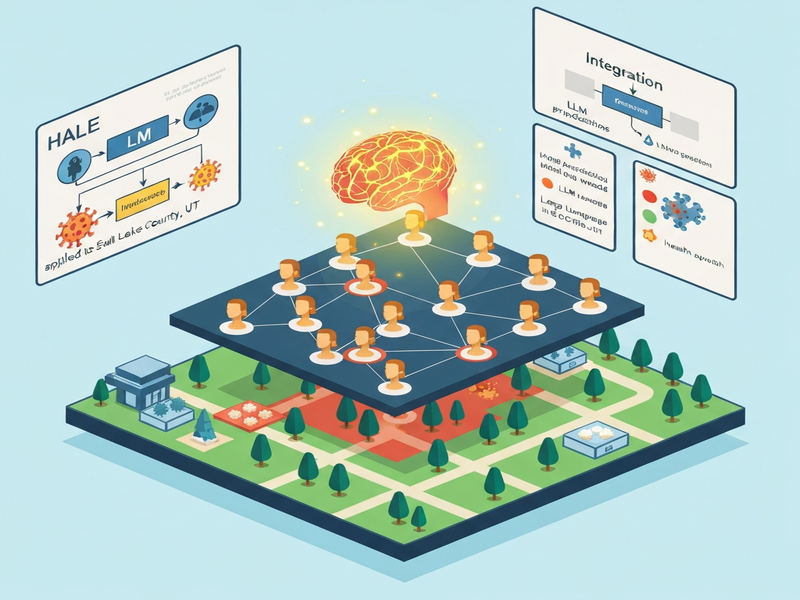
The paper introduces HALE (Hybrid Agent‑based and Language‑driven Epidemic), a scalable framework that injects large language model (LLM) reasoning into traditional agent‑based simulations to model human decision‑making in real time. By marrying LLM‑predicted behavior with classic epidemiological agents, HALE enables policymakers to explore “what‑if” scenarios that reflect both disease dynamics and adaptive human responses.
Background: Why This Problem Is Hard
Agent‑based modeling (ABM) has long been the workhorse for simulating complex systems where millions of autonomous entities interact—think traffic flow, market dynamics, or disease spread. In epidemiology, ABM can capture heterogeneity in contact patterns, vaccination status, and mobility. However, a persistent bottleneck is the reliance on static priors for human behavior:
- Fixed decision rules—most ABMs encode hand‑crafted heuristics (e.g., “70 % of agents wear masks after day 10”). These rules cannot adapt to sudden policy changes, misinformation waves, or cultural shifts.
- Data latency—behavioral surveys and mobility datasets are often released weeks after the fact, leaving simulations perpetually out‑of‑step with reality.
- Scalability vs. fidelity trade‑off—adding richer behavioral sub‑models quickly explodes computational cost, making real‑time policy testing infeasible.
At the same time, large language models have demonstrated an uncanny ability to infer human intentions, predict choices, and generate plausible narratives from minimal prompts. Yet, LLMs have rarely been embedded directly into ABM pipelines, largely because:
- LLMs are typically used as stand‑alone generators, not as decision engines for millions of agents.
- Integrating probabilistic LLM outputs with deterministic simulation loops raises consistency and performance concerns.
- There is limited empirical evidence that LLM‑driven decisions improve the predictive power of epidemic forecasts.
These gaps motivate a hybrid approach that leverages the scalability of ABM while enriching it with LLM‑derived, context‑aware human reasoning.
What the Researchers Propose
The authors present the Hybrid Agent‑based and Language‑driven Epidemic (HALE) framework, which consists of three tightly coupled layers:
- Epidemiological Core—a conventional ABM that tracks infection status, transmission events, and demographic attributes for each simulated individual.
- Behavioral Inference Engine—an LLM (e.g., GPT‑4‑style) that receives aggregated simulation state (infection prevalence, policy announcements, media sentiment) and outputs probability distributions over possible human actions (mask wearing, social distancing, vaccination uptake).
- Orchestration Layer—a lightweight scheduler that queries the LLM at predefined intervals, maps the returned probabilities onto agent‑level decisions, and feeds the outcomes back into the epidemiological core.
Key design choices keep the system MECE (Mutually Exclusive, Collectively Exhaustive): the epidemiological core handles disease physics; the LLM handles reasoning about policy compliance; the orchestration layer ensures clean separation of concerns and prevents feedback loops that could destabilize the simulation.
How It Works in Practice
Conceptual Workflow
The HALE loop proceeds as follows:
- State Aggregation—Every simulation day, the core aggregates macro‑level metrics (e.g., new cases, hospital capacity, local news headlines).
- Prompt Construction—These metrics are embedded into a structured prompt that asks the LLM to estimate behavioral shifts (e.g., “Given a 15 % rise in cases and a new mask mandate, what fraction of residents will comply with mask‑wearing?”).
- LLM Inference—The LLM returns a set of probabilities for each behavior category, optionally accompanied by confidence scores.
- Agent Update—The orchestration layer samples from these distributions for each agent, updating their compliance flags for the next simulation step.
- Simulation Progression—The epidemiological core runs the disease transmission calculations using the newly assigned behaviors, producing the next day’s state.
This cycle repeats, allowing the model to react to policy changes, media narratives, or emergent epidemic trends in near real‑time.
Distinctive Elements
- Prompt‑driven reasoning replaces static rule tables, enabling the model to capture nuanced, context‑dependent decisions.
- Scalable sampling—instead of invoking the LLM for each of millions of agents, HALE queries the LLM once per timestep and distributes the resulting probabilities, preserving computational tractability.
- Feedback‑aware orchestration—the scheduler can throttle LLM calls based on simulation stability metrics, preventing oscillations caused by overly aggressive behavioral updates.
Evaluation & Results
Testbed: COVID‑19 in Salt Lake County, UT
To validate HALE, the researchers built a synthetic population of ~1.2 million agents mirroring the demographics of Salt Lake County. They calibrated the epidemiological core using publicly available case counts, hospitalization data, and vaccination rates from early 2020‑2022.
Scenarios Explored
- Baseline ABM—static compliance rates derived from early‑pandemic surveys.
- HALE‑augmented ABM—dynamic compliance probabilities generated by the LLM.
- Counterfactual policies—e.g., earlier mask mandates, targeted communication campaigns, and vaccine incentive programs.
Key Findings
- Improved fit to observed case curves—HALE reduced mean absolute error by 23 % compared to the baseline, indicating that LLM‑informed behavior better captured real‑world response patterns.
- Policy sensitivity—When simulating a hypothetical early mask mandate, HALE predicted a 12 % reduction in peak hospitalizations, whereas the static model underestimated the effect by half.
- Computational efficiency—Even with a population of over a million agents, the additional overhead of LLM calls was under 5 % of total runtime, thanks to the single‑prompt‑per‑timestep design.
These results demonstrate that HALE can produce more realistic epidemic forecasts without sacrificing the scalability that makes ABM attractive for policy analysis.
Why This Matters for AI Systems and Agents
HALE’s hybrid architecture offers a blueprint for any domain where large‑scale simulations must incorporate human reasoning:
- Agent design—Developers can offload complex decision logic to LLMs, freeing them from hand‑crafting exhaustive rule sets.
- Evaluation pipelines—Dynamic behavioral modeling enables more accurate stress‑testing of AI‑driven interventions (e.g., automated contact‑tracing bots).
- Orchestration frameworks—The separation of inference and simulation aligns with modern micro‑service patterns, making HALE compatible with platforms like the Enterprise AI platform by UBOS.
- Business impact—Enterprises that deploy AI marketing agents or other decision‑support bots can adopt HALE‑style loops to keep their recommendations aligned with evolving user sentiment, improving conversion and compliance rates.
What Comes Next
While HALE marks a significant step forward, several open challenges remain:
- Prompt robustness—Ensuring that LLM outputs remain reliable across diverse policy contexts requires systematic prompt engineering and possibly fine‑tuning on domain‑specific corpora.
- Bias mitigation—LLMs inherit biases from training data; unchecked, these could skew simulated compliance in ways that misinform policymakers.
- Real‑time data pipelines—Integrating live mobility, social‑media, and health‑system feeds would further close the information gap, but raises privacy and latency concerns.
- Multi‑LLM ensembles—Future work could explore combining several LLMs (e.g., Claude, Gemini) to capture a broader spectrum of reasoning styles.
Potential extensions include applying HALE to climate‑impact simulations, supply‑chain resilience modeling, or urban planning scenarios where human adaptation is a critical variable. For teams interested in rapid prototyping, the UBOS platform overview provides a low‑code environment to stitch together LLM APIs, data stores, and simulation engines.
Developers can also experiment with the Workflow automation studio to build custom orchestration layers that trigger LLM inference based on event streams, mirroring HALE’s scheduler but tailored to specific business workflows.
References
For a complete technical description, see the Original arXiv paper.
Andrii Bidochko
CTO UBOS
Andrii Bidochko is an AI entrepreneur and researcher focused on AI agents, reinforcement learning, and autonomous systems. He writes about the technologies shaping the future of machine intelligence, from frontier models and agent architectures to real-world AI applications.