

- Updated: June 30, 2026
- 7 min read
LLM-assisted gNB Parameter Configuration for Radio Access Network
Direct Answer
The paper introduces a large‑language‑model (LLM)‑driven framework that automatically corrects mis‑configured gNB (next‑generation NodeB) parameters in radio access networks (RANs). By synthesizing realistic configuration‑log‑correction data and fine‑tuning a commercial LLM, the system can translate raw error logs into deployable, standards‑compliant gNB settings, dramatically reducing the need for manual troubleshooting.
Background: Why This Problem Is Hard
Radio access networks are the backbone of 5G and emerging 6G services. Each gNB must be tuned with dozens of inter‑dependent parameters—frequency allocations, power levels, scheduling policies, and handover thresholds. A single typo or out‑of‑range value can cascade into dropped calls, latency spikes, or complete cell outages.
Current remediation relies on network engineers poring over massive, semi‑structured log files generated by the gNB. These logs contain cryptic error codes, timestamps, and stack traces that only seasoned specialists can decode. The process is:
- Manual: Engineers read logs, cross‑reference vendor manuals, and edit configuration files.
- Time‑Consuming: A single incident can take hours to resolve, during which users experience degraded service.
- Non‑Scalable: As operators densify networks with thousands of cells, the volume of logs grows faster than the pool of qualified staff.
Traditional automation attempts—rule‑based scripts or static decision trees—fail because they cannot capture the nuanced, context‑dependent reasoning that human experts apply. Moreover, vendor‑specific parameter sets evolve with each software release, making hard‑coded rules brittle.
What the Researchers Propose
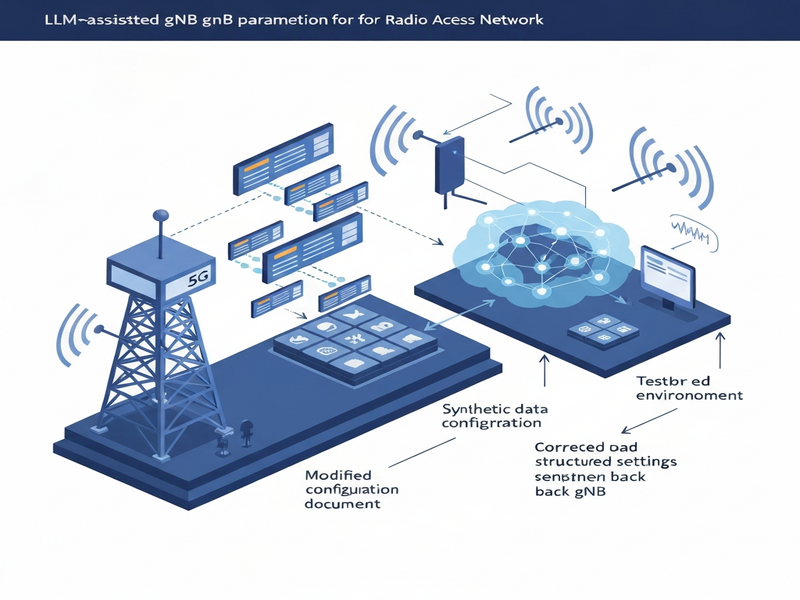
The authors present a three‑stage, LLM‑assisted pipeline that turns raw error logs into correct, ready‑to‑deploy gNB configurations. The framework consists of:
- Synthetic Data Generation: A commercial LLM (e.g., GPT‑4) creates a large corpus of paired examples—each pair contains a deliberately corrupted configuration, the resulting error log, and a step‑by‑step reasoning trace that leads to the correct fix.
- Fine‑Tuning Phase: The synthetic dataset is used to fine‑tune the same LLM, teaching it to map “log → correction” relationships while preserving the vendor‑specific syntax required for deployment.
- Inference & Deployment: In production, the fine‑tuned model receives live error logs, generates a structured correction plan, and outputs a validated configuration file that can be pushed to the gNB without human intervention.
Key agents in the system are:
- Data Synthesizer – orchestrates the creation of diverse misconfiguration scenarios.
- LLM Trainer – handles fine‑tuning, loss monitoring, and checkpoint selection.
- Correction Engine – runs inference, validates syntax, and interfaces with the network management system.
How It Works in Practice
Conceptual Workflow
- Baseline Configuration Extraction: The pipeline starts with a known‑good gNB configuration file and the official 3GPP technical reference.
- Intentional Perturbation: The Data Synthesizer randomly modifies parameters (e.g., setting an illegal carrier frequency) to create a misconfiguration.
- Log Simulation: The perturbed configuration is deployed on an OpenAirInterface (OAI) testbed. The gNB emits error logs that are captured verbatim.
- Reasoning Trace Generation: The LLM, prompted with the log and the original technical reference, produces a human‑readable chain‑of‑thought explaining why the error occurred and how to fix it.
- Dataset Assembly: Each entry now contains three fields—
log,reasoning trace, andcorrected configuration. - Fine‑Tuning: The LLM is trained on this dataset, learning to internalize the mapping from log to correction while preserving the structured output format.
- Live Inference: When a real network issue arises, the Correction Engine feeds the live log to the fine‑tuned model, which returns a validated configuration file.
- Safety Guardrails: Before deployment, a syntax validator checks the output against the 3GPP schema, and a rollback mechanism ensures the previous configuration can be restored if needed.
What Makes This Approach Different
- Data‑Centric Automation: Instead of hand‑crafting rules, the system learns from thousands of synthetic examples that cover a wide parameter space.
- Chain‑of‑Thought Reasoning: By preserving the LLM’s internal reasoning trace, the model gains transparency—operators can audit why a particular change was suggested.
- Retrieval‑Augmented Generation (RAG): The authors augment the fine‑tuned model with a vector store of vendor documentation, allowing the LLM to retrieve exact clause language during inference.
- Zero‑Shot Baseline Comparison: The same commercial LLM, without fine‑tuning, serves as a control, highlighting the value of domain‑specific training.
Evaluation & Results
The framework was validated on an OpenAirInterface gNB testbed using 480 unseen misconfiguration scenarios. Evaluation focused on two metrics:
- Correction Accuracy: The proportion of cases where the model’s output matched the ground‑truth corrected configuration.
- Deployability: Whether the generated configuration passed the 3GPP syntax validator and could be applied without causing additional errors.
Key findings include:
- The zero‑shot commercial LLM achieved only 13.8 % accuracy, confirming that raw LLM knowledge is insufficient for this niche domain.
- Fine‑tuning on the synthetic dataset raised accuracy to 85.4 %, demonstrating that the model successfully internalized the log‑to‑fix mapping.
- Integrating RAG further boosted accuracy to 92.7 %, showing that on‑the‑fly retrieval of vendor clauses adds critical precision.
- All high‑accuracy outputs passed the syntax validator, meaning they were ready for immediate deployment.
These results prove that a data‑driven LLM can replace manual log analysis for a large majority of gNB misconfigurations, turning a traditionally reactive process into a proactive, near‑real‑time service.
Why This Matters for AI Systems and Agents
Automation of RAN configuration is a cornerstone for the next wave of autonomous networks. The paper’s framework illustrates several broader implications for AI practitioners and agent builders:
- Domain‑Specific Fine‑Tuning: Generic LLMs excel at language but falter on telecom‑specific syntax. Fine‑tuning on synthetic, high‑fidelity data bridges that gap, a pattern applicable to any highly regulated domain.
- Chain‑of‑Thought as Auditable Output: Embedding reasoning traces turns a black‑box model into an explainable assistant, aligning with emerging AI governance standards.
- RAG as a Safety Net: Retrieval of official documentation during inference reduces hallucination risk—a technique that can be reused in other agent‑driven troubleshooting scenarios.
- Scalable Orchestration: The modular pipeline (synthesizer → trainer → engine) maps cleanly onto modern workflow automation platforms. For example, the Workflow automation studio can orchestrate data generation, model training, and deployment hooks, enabling continuous improvement as new gNB firmware releases appear.
- Integration with Existing AI Ops Stacks: The corrected configurations can be fed directly into network management systems, while the reasoning traces can be logged into observability dashboards for post‑mortem analysis.
In short, the research provides a template for building AI agents that not only act but also justify their actions, a capability that is increasingly demanded by telecom operators, regulators, and enterprise customers.
What Comes Next
While the results are promising, several limitations and open challenges remain:
- Real‑World Diversity: The evaluation used an OAI testbed. Deploying the model on commercial base stations (e.g., Nokia, Ericsson) will introduce proprietary log formats and additional parameter sets that must be incorporated into the synthetic data generator.
- Continuous Learning: Network upgrades produce new error codes. A lifelong learning loop—where live logs are periodically added to the training corpus—will be essential to keep the model up‑to‑date.
- Safety Guarantees: Although syntax validation prevents malformed configs, deeper semantic checks (e.g., radio interference analysis) are needed before a change is applied in a live network.
- Multi‑Vendor Collaboration: Standardizing a common log schema across vendors would simplify data synthesis and improve cross‑compatibility.
Future research directions could explore:
- Embedding the correction engine within a closed‑loop self‑optimizing RAN controller that not only fixes errors but also proactively tunes parameters for performance.
- Extending the synthetic pipeline to cover 5G core network (5GC) configurations, creating a unified AI‑driven operations stack for end‑to‑end mobile services.
- Leveraging multimodal models that ingest both log text and raw radio metrics (e.g., SINR heatmaps) to generate richer, context‑aware fixes.
Organizations interested in prototyping such capabilities can start by integrating the LLM workflow with the Enterprise AI platform by UBOS, which offers pre‑built connectors for vector stores, model hosting, and secure API gateways. For smaller teams, the UBOS solutions for SMBs provide a cost‑effective sandbox to experiment with synthetic data generation and fine‑tuning pipelines.
By turning error logs into actionable, verified configurations, the LLM‑assisted framework paves the way for truly autonomous RAN operations—an essential step toward the ultra‑reliable, low‑latency services that 6G promises.
Read the full study on arXiv for technical details, dataset specifications, and reproducibility instructions.
Andrii Bidochko
CTO UBOS
Andrii Bidochko is an AI entrepreneur and researcher focused on AI agents, reinforcement learning, and autonomous systems. He writes about the technologies shaping the future of machine intelligence, from frontier models and agent architectures to real-world AI applications.