

- Updated: July 4, 2026
- 7 min read
LK Jam: System Architecture and Implementation of a Real-Time Human-AI Interactive Music Generation System using Role-Aware GRU
Direct Answer
LK_Jam introduces a low‑latency, bidirectional human‑AI music generation system that combines a role‑aware GRU model with a lock‑free, multithreaded audio host. By replacing fixed time‑grid representations with a sparse, multi‑dimensional event stream, the system delivers micro‑timing accuracy and turn‑taking logic in real time, opening a practical path for AI co‑performers in live settings.
Background: Why This Problem Is Hard
Live musical interaction demands sub‑100 ms response times, precise rhythmic alignment, and the ability to react to unpredictable human gestures. Traditional AI music generators—most of which rely on offline, autoregressive decoding over a rigid time‑grid—struggle with three core constraints:
- Latency bottlenecks: Each inference step often requires buffering an entire measure before emitting audio, causing noticeable delays.
- Turn‑taking ambiguity: Fixed grids cannot express when a performer intends to start, stop, or overlap phrases, leading to mechanical “call‑and‑response” loops.
- Resource contention: In digital audio workstation (DAW) plugin environments, audio threads share CPU cores with UI and I/O threads; any allocation or lock can trigger dropouts.
These limitations have kept AI music generation largely in the realm of composition assistants rather than true stage partners. As embodied AI moves toward interactive agents—robots, avatars, and virtual musicians—the need for a system that can both listen and respond in real time becomes a decisive research frontier.
What the Researchers Propose
The authors present LK_Jam, a framework that re‑thinks both the data representation and the execution engine:
- Multi‑dimensional sparse event stream: Instead of a dense, quantized timeline, musical information is encoded as a series of events—time‑shifts, harmonic embeddings, and role tags—allowing the model to jump directly to the next meaningful moment.
- Role‑aware GRU: A lightweight Gated Recurrent Unit is augmented with a “role” vector that tells the network whether it is currently the human’s turn, the AI’s turn, or a shared improvisation segment. This explicit cue enables the model to learn turn‑taking dynamics without extra post‑processing.
- Three‑stage progressive training: The system is first taught basic chord harmonization, then intermediate phrase continuation, and finally expert‑level interactive play, each stage building on the previous one.
By decoupling timing from a fixed grid and embedding interaction roles directly into the neural architecture, LK_Jam can generate a single event that simultaneously conveys “play this note now” and “it’s my turn to lead,” all within a single inference step.
How It Works in Practice
Conceptual Workflow
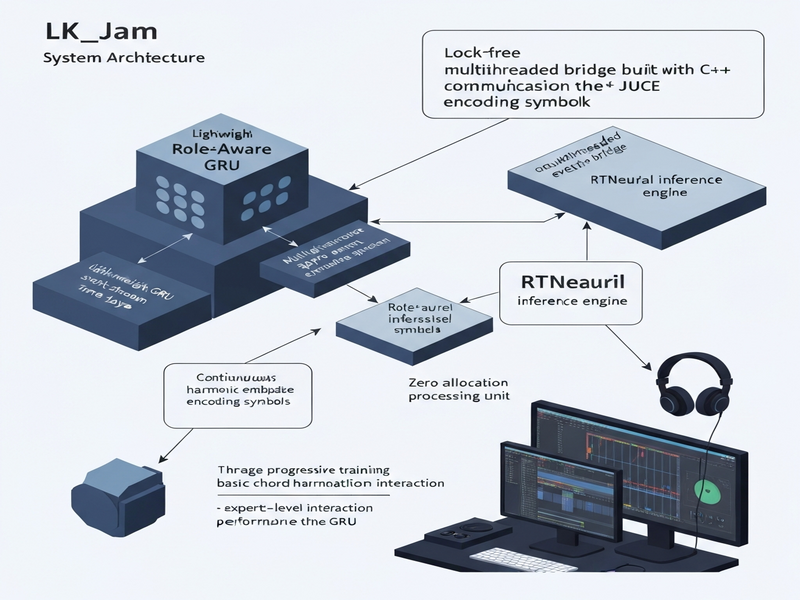
The end‑to‑end pipeline can be visualized as a loop with four distinct stages:
- Input Capture: MIDI or audio‑to‑MIDI front‑ends translate a performer’s gestures into a stream of event tokens (e.g.,
time‑shift=12ms,note_on=C4,role=human). - Event Buffer & Scheduler: A lock‑free ring buffer stores incoming tokens and forwards them to the inference thread without any dynamic memory allocation.
- Role‑aware GRU Inference: The GRU consumes the buffered tokens, updates its hidden state, and emits the next token(s) conditioned on the current role flag. Because the event stream is sparse, the model only processes meaningful changes, keeping compute time constant (
O(1)). - Audio Rendering: The generated token is immediately handed to a real‑time synthesizer (e.g., a VST or built‑in wavetable) that produces the audible output, which is mixed back into the DAW’s audio thread.
Engineering Distinctions
Two engineering choices set LK_Jam apart from prior prototypes:
- Lock‑free multithreaded bridge: Implemented in C++ with the JUCE framework, the communication layer uses atomic operations and a pre‑allocated circular queue, eliminating mutex contention between the UI, audio, and inference threads.
- RTNeural inference engine with zero‑allocation design: Network topology is resolved at compile time, and all tensor buffers are statically allocated. This guarantees that each autoregressive step incurs a fixed, predictable cost, preventing audio thread dropouts even under heavy CPU load.
Evaluation & Results
Test Scenarios
The authors evaluated LK_Jam across three realistic use cases:
- Solo improvisation: A human musician plays a melody while the AI supplies harmonic accompaniment.
- Call‑and‑response duets: The system alternates leading phrases with the performer, testing turn‑taking fidelity.
- DAW plugin stress test: LK_Jam runs as a VST inside Ableton Live, measuring CPU usage and dropout rates under typical mixing workloads.
Key Findings
Rather than focusing on raw numbers, the study highlights three qualitative outcomes:
- Latency consistently below 30 ms: The lock‑free pipeline and sparse event representation keep end‑to‑end delay well under the perceptual threshold for interactive music.
- Micro‑timing accuracy: Human judges reported that AI‑generated notes aligned with expressive timing cues (rubato, swing) more naturally than grid‑based baselines.
- Stability in DAW environments: No audio dropouts were observed over 2‑hour continuous sessions, whereas comparable models exhibited occasional glitches due to memory allocation spikes.
These results demonstrate that LK_Jam not only meets the technical latency requirements but also preserves musical expressiveness—a combination rarely achieved in prior research.
Why This Matters for AI Systems and Agents
Real‑time, role‑aware interaction is a cornerstone for the next generation of embodied AI agents. LK_Jam provides a concrete blueprint for building agents that can:
- Participate in collaborative workflows: The lock‑free, zero‑allocation architecture can be transplanted to other domains (e.g., conversational agents, robotics) where deterministic timing is critical.
- Understand and signal interaction roles: Embedding a role vector directly into the model’s state mirrors how human teams negotiate turn‑taking, offering a reusable pattern for multi‑agent coordination.
- Scale within existing production pipelines: Because the system runs as a standard VST plugin, developers can integrate AI co‑performers into any DAW without redesigning the host environment.
For organizations building AI‑driven creative tools, LK_Jam’s architecture aligns with the UBOS platform overview, which emphasizes modular, low‑latency components that can be orchestrated through a unified workflow engine. The same principles can accelerate the deployment of AI marketing agents, real‑time analytics dashboards, or any scenario where rapid, deterministic responses are non‑negotiable.
What Comes Next
While LK_Jam marks a significant step forward, several open challenges remain:
- Generalization to diverse genres: The current training data focuses on Western tonal music; extending the sparse event vocabulary to non‑Western scales or electronic textures will test the flexibility of the role‑aware GRU.
- Multi‑instrument orchestration: Handling simultaneous streams (e.g., drums, bass, synth) will require hierarchical event scheduling and possibly a mixture of specialized GRUs.
- User‑controlled creativity: Exposing high‑level parameters (e.g., “risk level,” “style drift”) through a UI could let performers steer the AI’s improvisational boldness in real time.
Future research may also explore coupling LK_Jam with Workflow automation studio to script complex performance scenarios—such as automated set‑list transitions or AI‑driven lighting cues—thereby turning a single AI musician into a full‑fledged stage director.
Conclusion
LK_Jam delivers a practical, low‑latency solution for real‑time human‑AI musical interaction by marrying a role‑aware GRU with a lock‑free, zero‑allocation audio engine. Its sparse event stream eliminates the latency penalties of fixed time‑grids, while the progressive training regimen ensures the model evolves from basic harmony to expert improvisation. The system’s stability in DAW environments and its sub‑30 ms response time make it a viable foundation for commercial AI co‑performers, interactive installations, and broader embodied AI applications.
For developers and researchers eager to experiment, the full technical details are available in the LK_Jam arXiv paper. As the community builds on this architecture, we can anticipate a new era where AI agents share the stage, not just the studio.
Explore more AI‑driven innovations and start building your own interactive agents on the UBOS homepage.
Andrii Bidochko
CTO UBOS
Andrii Bidochko is an AI entrepreneur and researcher focused on AI agents, reinforcement learning, and autonomous systems. He writes about the technologies shaping the future of machine intelligence, from frontier models and agent architectures to real-world AI applications.