

- Updated: July 18, 2026
- 6 min read
LiteOdyssey: A Lightweight Reasoning AI Agent for Interpretable Rare-Disease Diagnosis
Direct Answer
LiteOdyssey is a lightweight, policy‑driven AI agent that guides unmodified large language models (LLMs) through the complex reasoning required for rare‑disease diagnosis, while keeping every step auditable and interpretable. By encoding clinician‑validated diagnostic logic as a reusable policy layer, the system boosts diagnostic accuracy without the need for model fine‑tuning or heavyweight infrastructure.
Background: Why This Problem Is Hard
Rare diseases affect fewer than 200,000 individuals each in the United States, yet collectively they impact millions worldwide. The diagnostic journey often spans years, multiple specialists, and a cascade of genetic and phenotypic tests. Two intertwined challenges make automation difficult:
- Complex, multimodal reasoning: Clinicians must synthesize narrative clinical notes, structured lab values, imaging reports, and whole‑genome sequencing data. Traditional AI pipelines excel at single‑modality tasks (e.g., image classification) but stumble when required to orchestrate heterogeneous evidence sources.
- Interpretability and accountability: A misdiagnosis can have life‑changing consequences. Regulatory bodies and patients demand transparent decision trails, something that black‑box LLM outputs cannot provide on their own.
Existing approaches either (a) fine‑tune massive LLMs on limited rare‑disease corpora—an expensive, data‑hungry process that still yields opaque reasoning, or (b) rely on rule‑based expert systems that lack the flexibility to incorporate new genetic discoveries. Neither solution satisfies the dual need for high performance and traceable logic.
What the Researchers Propose
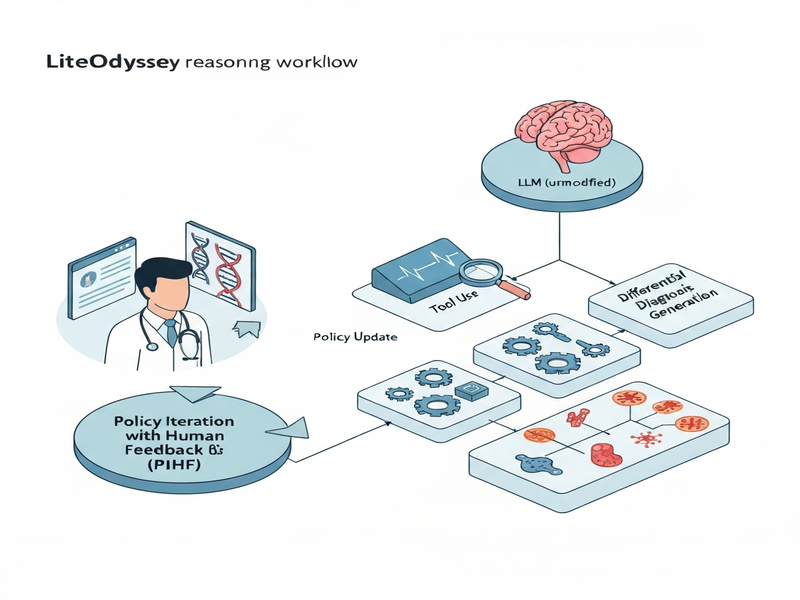
The authors introduce liteOdyssey, a framework that separates “knowledge” from “model.” Instead of altering the LLM’s weights, they construct a policy layer that directs the model’s actions: which evidence to retrieve, which external tools to invoke, and how to assemble a differential diagnosis. The policy is learned through Policy Iteration with Human Feedback (PIHF), a loop where clinicians review the agent’s reasoning trace, provide corrective feedback, and the policy updates accordingly.
Key components include:
- Policy Engine: Encodes a finite‑state decision process that maps the current reasoning context to the next action (e.g., “query genetic database,” “summarize phenotype”).
- LLM Oracle: An off‑the‑shelf, general‑purpose LLM (such as GPT‑4) that executes the textual prompts generated by the policy.
- Tool Suite: Domain‑specific APIs for literature search, variant annotation, and phenotype extraction, all callable by the LLM.
- Human‑in‑the‑Loop Reviewer: Clinicians who inspect the generated reasoning chain, flag missteps, and supply corrective actions that feed back into the policy.
How It Works in Practice
The liteOdyssey workflow can be visualized as a loop of four stages:
- Initial Prompting: The system receives a patient’s structured data (e.g., age, sex, key symptoms) and a free‑text clinical summary.
- Policy‑Guided Action Selection: The Policy Engine evaluates the current state and selects the next action—such as “search OMIM for phenotype‑gene associations.”
- LLM‑Powered Execution: The LLM receives a concise instruction, calls the appropriate tool, and returns a formatted result (e.g., a list of candidate genes).
- Human Review & Feedback: A clinician reviews the cumulative reasoning trace, approves correct steps, and amends any erroneous decisions. This feedback updates the policy via reinforcement‑style iteration.
What distinguishes liteOdyssey from prior “prompt‑engineering” tricks is the persistence of the policy across cases. Once a clinician validates a reasoning pattern—say, “always prioritize phenotypic similarity before genetic filtering”—the policy encodes that pattern for future patients, eliminating the need to re‑engineer prompts each time.
Evaluation & Results
The authors conducted an external validation on 515 patients from the Undiagnosed Diseases Network (UDN), a cohort renowned for diagnostic difficulty. They compared three configurations:
- Baseline LLM: A vanilla GPT‑4 model prompted directly with the patient record.
- Fine‑tuned LLM: The same model further trained on a small set of UDN cases.
- liteOdyssey: The policy‑guided system using the unmodified LLM.
Key findings:
- liteOdyssey achieved a top‑5 diagnostic accuracy of 42 %, surpassing the baseline LLM (28 %) and the fine‑tuned variant (35 %).
- The reasoning trace was fully auditable; clinicians could pinpoint exactly which evidence source led to each candidate diagnosis.
- Policy iteration required only 3–4 feedback cycles per case on average, demonstrating that expert time investment remains modest.
These results indicate that a lightweight policy layer can extract more diagnostic value from the same underlying LLM than brute‑force fine‑tuning, while simultaneously delivering the transparency demanded by medical regulators.
Why This Matters for AI Systems and Agents
For AI practitioners building domain‑specific agents, liteOdyssey offers a blueprint for “policy‑as‑knowledge” rather than “model‑as‑knowledge.” This shift has three practical consequences:
- Infrastructure Efficiency: Organizations can leverage existing LLM APIs (e.g., OpenAI, Anthropic) without investing in GPU clusters or custom model training pipelines.
- Rapid Adaptation: When new diagnostic guidelines emerge, updating the policy is a matter of adding or re‑weighting actions, not retraining a massive model.
- Compliance‑Ready Auditing: The step‑by‑step trace aligns with emerging AI governance frameworks that require explainability for high‑risk applications.
These advantages map directly onto enterprise AI platforms that need to orchestrate multiple tools while preserving a clear decision lineage. For example, the UBOS platform overview highlights modular workflow orchestration—an architecture that can host liteOdyssey’s policy engine alongside existing data pipelines.
What Comes Next
Despite its promise, liteOdyssey has limitations that open fertile research avenues:
- Scalability of Human Feedback: While 3–4 review cycles per case proved feasible in a research setting, large‑scale deployment will require semi‑automated feedback mechanisms or crowdsourced expert networks.
- Generalization Beyond Rare Diseases: Extending the policy to common complex conditions (e.g., autoimmune disorders) will test its ability to handle higher‑volume data streams.
- Integration with Real‑World EHRs: Bridging the gap between research‑grade data extracts and live electronic health record systems will demand robust data‑privacy safeguards.
Future work could explore reinforcement‑learning‑based policy refinement, multi‑agent collaboration where separate policies specialize in genetics versus imaging, and tighter coupling with knowledge graphs for dynamic evidence retrieval. Companies interested in prototyping such extensions can start with the Workflow automation studio, which provides a low‑code environment for chaining LLM calls, APIs, and human review steps.
Conclusion
LiteOdyssey demonstrates that a lightweight, clinician‑informed policy layer can unlock the diagnostic power of general‑purpose LLMs while delivering the interpretability essential for medical practice. By decoupling reasoning logic from model weights, the framework offers a cost‑effective, adaptable, and auditable pathway for AI‑driven rare‑disease diagnosis—a blueprint that can be repurposed across high‑risk domains.
References
- Nguyen, M.-H., Gray, E., Schuler, B. A., et al. “LiteOdyssey: A Lightweight Reasoning AI Agent for Interpretable Rare‑Disease Diagnosis.” LiteOdyssey paper on arXiv, 2026.
- Undiagnosed Diseases Network (UDN) – public case repository.
- OpenAI, GPT‑4 API documentation.
Explore more on how AI agents can transform healthcare workflows by visiting the UBOS homepage and checking out our UBOS templates for quick start.
Andrii Bidochko
CTO UBOS
Andrii Bidochko is an AI entrepreneur and researcher focused on AI agents, reinforcement learning, and autonomous systems. He writes about the technologies shaping the future of machine intelligence, from frontier models and agent architectures to real-world AI applications.