

- Updated: June 17, 2026
- 7 min read
Ligand-Conditioned Discrete Diffusion for Protein Sequence-Structure Co-Design
Direct Answer
ProtLiD2 is a ligand‑conditioned discrete diffusion model that simultaneously generates protein sequences and their corresponding structural tokens while explicitly incorporating small‑molecule information. By doing so, it enables the co‑design of proteins whose folds and active sites are compatible with a target ligand, a capability that can accelerate drug discovery and functional enzyme engineering.
Background: Why This Problem Is Hard
Designing a protein that both folds into a stable three‑dimensional shape and binds a specific small molecule is a two‑fold challenge. First, the amino‑acid sequence must encode a global fold that is thermodynamically viable. Second, the local geometry of the binding pocket must complement the ligand’s chemistry and shape. Traditional pipelines treat these steps separately—structure prediction followed by docking or mutational scanning—leading to costly iterative loops.
Recent AI breakthroughs introduced diffusion models that iteratively denoise either atomic coordinates (continuous diffusion) or tokenized representations (discrete diffusion). Continuous approaches excel at geometry‑level refinement but struggle to incorporate discrete sequence constraints and ligand chemistry in a unified framework. Existing discrete diffusion language models, such as those built on protein‑token vocabularies, generate only sequences or backbone tokens and lack a mechanism to condition on external small‑molecule descriptors. Consequently, they cannot guarantee that the generated pocket will accommodate a given ligand.
These limitations matter because modern biotech enterprises demand end‑to‑end, ligand‑aware design tools that reduce the time from target identification to viable candidate. Without a model that natively respects ligand constraints, researchers must rely on expensive post‑hoc docking and manual redesign, slowing the innovation pipeline.
What the Researchers Propose
The authors introduce ProtLiD2 (Protein Ligand‑conditioned Discrete Diffusion), a framework that extends masked discrete diffusion to the ligand‑aware setting. The core ideas are:
- Joint token generation: The model treats amino‑acid residues and discrete structure tokens (e.g., backbone angles, secondary‑structure symbols) as a single sequence, allowing simultaneous prediction of sequence and fold.
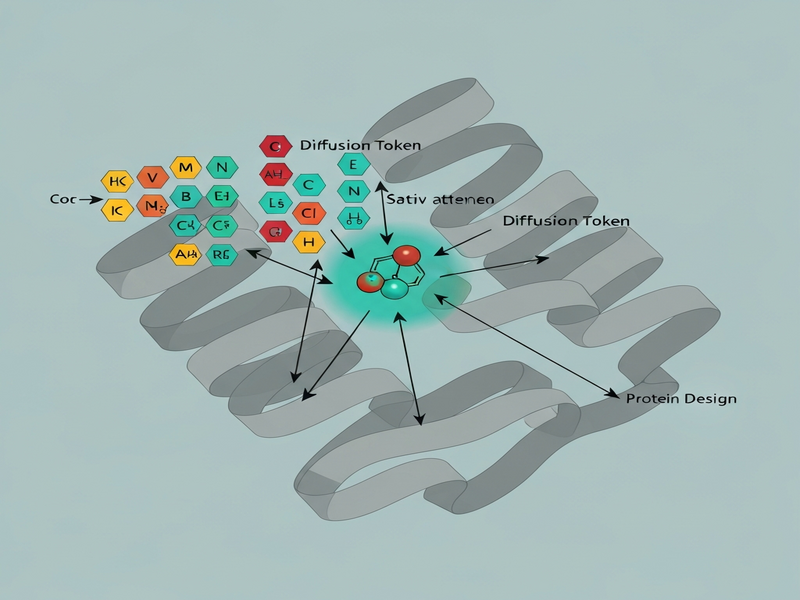
- Geometry‑aware cross‑attention: Ligand information—both chemical features (atom types, bonds) and spatial pose—is injected via a cross‑attention module that aligns ligand embeddings with protein tokens at each diffusion step.
- ReMask decoding: During inference, a confidence‑margin guided “ReMask” strategy retains high‑confidence predictions while re‑masking uncertain positions, enabling self‑correction without additional training.
These components together create a token‑space diffusion process that is explicitly conditioned on the ligand, ensuring that the generated protein is compatible with the small molecule from the outset.
How It Works in Practice
Conceptual Workflow
- Data preparation: Each training example consists of a ligand‑protein complex. The protein is tokenized into a sequence of amino‑acid symbols and discrete structural tokens derived from backbone geometry. The ligand is represented by a graph of atoms and a 3‑D pose.
- Forward diffusion: Random noise is injected into the token sequence over multiple timesteps, gradually corrupting both sequence and structure tokens while preserving the ligand embedding.
- Reverse diffusion (generation): Starting from a fully masked token set, the model iteratively predicts the original tokens. At each step, a cross‑attention layer fuses ligand embeddings with the partially reconstructed protein tokens, guiding the denoising toward ligand‑compatible configurations.
- ReMask decoding: After each denoising step, the model evaluates confidence scores. Tokens whose confidence exceeds a predefined margin are locked in; the rest are re‑masked for the next iteration, allowing the model to focus its capacity on ambiguous regions such as the binding pocket.
- Post‑processing: The final token sequence is decoded into a full‑atom protein model, which can be fed into a structure predictor (e.g., AlphaFold‑like networks) for refinement and validation.
Component Interaction
The architecture consists of three interacting modules:
- Token Encoder: Embeds amino‑acid and structure tokens into a shared latent space.
- Ligand Encoder: Generates a geometry‑aware representation using a graph neural network combined with a positional encoder for the ligand pose.
- Cross‑Attention Diffusion Decoder: At each diffusion timestep, the decoder attends to ligand embeddings while predicting the next set of protein tokens, effectively “seeing” the ligand as a conditioning context.
This design differs from prior discrete diffusion models that either ignore ligand information or treat it as a static conditioning vector. By integrating ligand geometry at every denoising step, ProtLiD2 maintains a tight coupling between pocket formation and overall fold stability.
Evaluation & Results
Experimental Scenarios
The authors benchmarked ProtLiD2 on two complementary tasks:
- Whole‑protein design: Generating full‑length proteins that must adopt a target global fold while being compatible with a bound ligand.
- Pocket co‑design: Refining only the binding site residues around a fixed backbone to improve ligand fit.
Key Findings
- Global fold confidence: ProtLiD2 raised the average TM‑score from 0.672 (baseline Complexa) to 0.802, indicating markedly better structural alignment with the reference fold.
- Per‑residue confidence (pLDDT): The model increased average pLDDT from 64.55 to 73.00, reflecting higher predicted accuracy of the generated structures.
- Pocket geometry: In active‑site backbone RMSD (BB‑RMSD) tests, ProtLiD2 reduced error to 1.97 Å, outperforming FAIR (3.46 Å) and PocketGen (3.40 Å).
- Ligand‑aware docking pass rates: Under a strict docking threshold, the pass rate climbed from 14.86 % (PocketGen) to 59.73 %, and from 6.08 % to 23.49 % under an even tighter criterion.
These results demonstrate that conditioning diffusion on ligand geometry not only improves local pocket fit but also propagates benefits to the overall protein fold, a synergy rarely achieved by separate sequence‑only or structure‑only models.
Why This Matters for AI Systems and Agents
For AI practitioners building drug‑discovery pipelines or autonomous protein‑engineering agents, ProtLiD2 offers several practical advantages:
- End‑to‑end generation: Agents can request a protein design conditioned on a target molecule and receive a ready‑to‑evaluate structure without invoking separate docking or remodeling steps.
- Modular integration: The cross‑attention interface can be wrapped as a micro‑service, allowing orchestration within platforms such as the UBOS platform overview or combined with workflow automation tools like the Workflow automation studio.
- Self‑correcting inference: The ReMask decoding strategy aligns with reinforcement‑learning‑based agent loops, where confidence signals can trigger re‑sampling or additional refinement steps.
- Scalable data handling: Training on a million‑scale ligand‑protein dataset mirrors the data‑intensive workloads of modern AI agents, making ProtLiD2 a realistic component for enterprise‑grade pipelines such as the Enterprise AI platform by UBOS.
In short, the model bridges the gap between generative AI and functional biochemistry, enabling agents to reason about both sequence and chemistry in a single, coherent step.
What Comes Next
While ProtLiD2 marks a significant advance, several avenues remain open for exploration:
- Multi‑ligand conditioning: Extending the cross‑attention mechanism to handle multiple ligands or cofactors could support the design of allosteric enzymes.
- Integration with experimental feedback: Looping back crystallography or cryo‑EM data into the diffusion process would create a closed‑loop design‑test cycle.
- Broader token vocabularies: Incorporating side‑chain rotamer tokens or post‑translational modification symbols could increase chemical realism.
- Real‑time agent deployment: Embedding ProtLiD2 within conversational agents (e.g., OpenAI ChatGPT integration) would let researchers query design suggestions on the fly.
Addressing these challenges will push ligand‑conditioned diffusion toward a universal protein‑design engine, capable of serving both academic discovery and commercial biotech pipelines.
References
Ligand‑Conditioned Discrete Diffusion for Protein Sequence‑Structure Co‑Design (arXiv)
Andrii Bidochko
CTO UBOS
Andrii Bidochko is an AI entrepreneur and researcher focused on AI agents, reinforcement learning, and autonomous systems. He writes about the technologies shaping the future of machine intelligence, from frontier models and agent architectures to real-world AI applications.