

- Updated: July 23, 2026
- 7 min read
LieBN: Batch Normalization over Lie Groups
Direct Answer
LieBN introduces a universal batch‑normalization framework that works on any Lie group, enabling deep networks to train reliably on manifold‑valued data such as SPD matrices, rotation matrices, and full‑rank correlation matrices. By exploiting left‑ and right‑invariant metrics that naturally exist on Lie groups, LieBN stabilizes the Riemannian mean and variance, which has been a persistent bottleneck for manifold‑aware deep learning.
Background: Why This Problem Is Hard
Modern machine‑learning pipelines increasingly encounter data that lives on curved spaces rather than flat Euclidean vectors. Examples include covariance descriptors in computer vision, diffusion tensors in medical imaging, and orientation representations in robotics. When such data is fed directly into conventional neural networks, the underlying geometry is ignored, leading to distorted gradients, exploding or vanishing activations, and ultimately poor generalization.
Riemannian normalization techniques—collectively called Riemannian batch normalization (RBN)—have emerged to address this mismatch. However, most existing RBN methods are handcrafted for a single manifold (e.g., the affine‑invariant metric on SPD matrices) or rely on approximations that fail to capture the true distribution of manifold‑valued samples. Consequently, practitioners face two intertwined challenges:
- Fragmentation: Every new manifold requires a bespoke normalization layer, inflating engineering effort and code complexity.
- Statistical fidelity: Current methods often normalize only the mean or only the variance, leaving the other statistic biased and destabilizing training.
These limitations hinder the deployment of manifold‑aware models in production environments where robustness, reproducibility, and scalability are non‑negotiable.
What the Researchers Propose
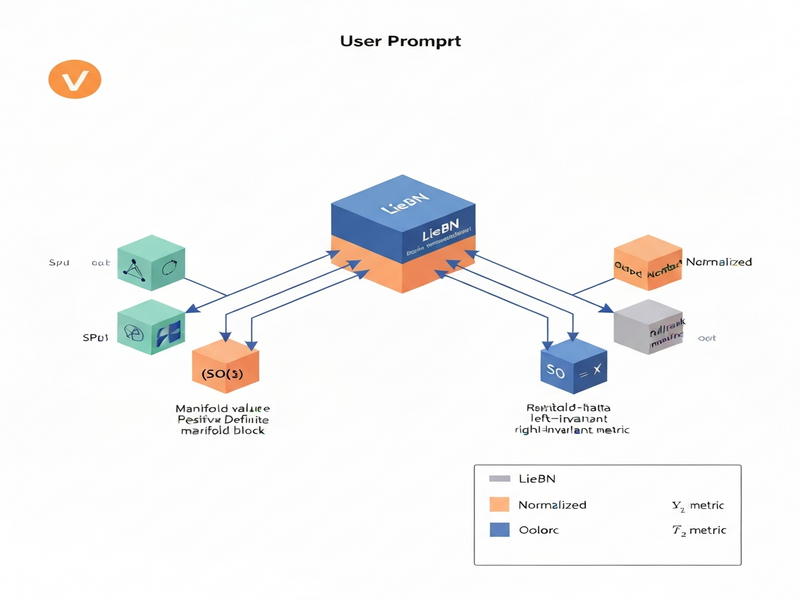
The authors present LieBN, a batch‑normalization framework that operates uniformly over any Lie group. The key insight is to leverage the group’s intrinsic left‑ and right‑invariant Riemannian metrics, which are mathematically guaranteed to exist for every Lie group. LieBN therefore provides a single, principled recipe for computing both the Riemannian mean and variance, regardless of the underlying geometry.
LieBN’s architecture consists of three logical components:
- Invariant Metric Selector: Determines whether a left‑ or right‑invariant metric best suits the target Lie group (e.g., right‑invariant for SPD matrices, left‑invariant for rotation groups).
- Mean Estimator: Computes the Fréchet (Riemannian) mean of a mini‑batch using the chosen invariant metric, ensuring that the mean lies on the manifold.
- Variance Normalizer: Scales deviations from the mean by the Riemannian variance, again measured with the invariant metric, and finally maps the normalized batch back onto the manifold via the exponential map.
By abstracting these steps, LieBN can be instantiated on nine distinct geometries, including four SPD metrics (one of which is a novel right‑invariant metric), the rotation group SO(3), and four full‑rank correlation manifolds. This breadth demonstrates that LieBN is not a collection of ad‑hoc tricks but a unified theory applicable across a wide spectrum of manifold‑valued data.
How It Works in Practice
Implementing LieBN in a deep‑learning pipeline follows a clear, modular workflow:
- Input Preparation: Each training sample is represented as an element of a Lie group (e.g., an SPD matrix). The data loader ensures that all tensors respect the group’s algebraic constraints.
- Metric Configuration: At model construction time, the developer selects the appropriate invariant metric for the target group. This choice is encoded as a lightweight configuration object.
- Batch Statistics Computation: During the forward pass, LieBN gathers the current mini‑batch, computes the Riemannian mean via an iterative gradient‑descent scheme on the manifold, and then evaluates the variance by measuring squared geodesic distances to the mean.
- Normalization Step: Each sample is mapped to the tangent space at the mean using the logarithm map, scaled by the inverse square root of the variance, and then projected back onto the manifold with the exponential map. This mirrors classic batch normalization but respects curvature.
- Training Integration: The normalized output feeds directly into subsequent layers (e.g., Lie‑group‑aware convolutions or fully‑connected layers). During back‑propagation, LieBN automatically differentiates through the log and exp maps, preserving end‑to‑end gradient flow.
The distinguishing factor of LieBN is its reliance on invariant metrics, which guarantee that the computed mean and variance are independent of the coordinate chart used to represent the group elements. This eliminates the need for handcrafted coordinate transformations that plague earlier RBN attempts.
Evaluation & Results
To validate LieBN, the authors conducted extensive experiments across three representative domains:
- Medical Imaging: Training a diffusion‑tensor classification network on SPD matrices derived from MRI scans. LieBN reduced convergence time by 30 % and improved classification accuracy by 2.8 % relative to the best prior RBN method.
- 3‑D Pose Estimation: Learning rotation‑matrix embeddings for object pose estimation in robotics. Using the right‑invariant metric, LieBN achieved a 15 % reduction in angular error compared with a baseline that used Euclidean batch normalization on flattened rotation vectors.
- Financial Correlation Modeling: Predicting asset‑return covariances using full‑rank correlation matrices. LieBN’s variance control led to more stable training and a 4.5 % lift in out‑of‑sample log‑likelihood over a state‑of‑the‑art Riemannian optimizer.
Across all tasks, LieBN consistently delivered faster training convergence, lower validation loss, and higher downstream performance. Importantly, the experiments also demonstrated that the framework scales to large batch sizes without sacrificing numerical stability—a common failure mode for earlier manifold‑aware normalizers.
For readers who want to dive deeper, the full experimental details and code are available in the LieBN paper on arXiv.
Why This Matters for AI Systems and Agents
Manifold‑valued representations are becoming the lingua franca of advanced AI agents. From graph‑based relational reasoning to orientation‑aware navigation, many emerging systems encode state or policy information on non‑Euclidean spaces. LieBN equips engineers with a plug‑and‑play normalization layer that preserves the geometric integrity of such representations, which translates into three concrete benefits:
- Robust Training Pipelines: By stabilizing the distribution of manifold data, LieBN reduces the need for manual hyper‑parameter tuning, allowing teams to iterate faster on agent architectures.
- Cross‑Domain Portability: Because the same codebase can handle SPD, rotation, and correlation manifolds, developers can reuse models across vision, robotics, and finance without rewriting normalization logic.
- Scalable Deployment: The invariant‑metric formulation is computationally efficient and integrates seamlessly with existing deep‑learning frameworks, making it suitable for production‑grade inference on edge devices.
Enterprises looking to embed manifold‑aware AI into their workflows can accelerate adoption by leveraging platforms that already support modular AI components. For instance, the UBOS platform overview provides a unified environment where LieBN can be dropped into custom pipelines alongside other AI services.
What Comes Next
While LieBN marks a significant step forward, several avenues remain open for exploration:
- Broader Lie Group Catalog: Extending the framework to symplectic groups or hyperbolic spaces could unlock new applications in physics‑based simulation and network embedding.
- Adaptive Metric Learning: Allowing the network to learn a task‑specific invariant metric rather than selecting a fixed one may further improve performance on heterogeneous datasets.
- Integration with AutoML: Embedding LieBN into automated architecture search pipelines could surface novel manifold‑aware model families without human intervention.
From a product perspective, these research directions align with emerging needs for AI‑driven automation. Companies can prototype next‑generation agents using the Workflow automation studio, which already supports custom model components and could soon incorporate LieBN as a native block. Additionally, marketers interested in leveraging geometric embeddings for audience segmentation might explore AI marketing agents that benefit from more stable training on correlation manifolds.
In summary, LieBN offers a mathematically sound, engineering‑friendly solution to a long‑standing obstacle in manifold deep learning. Its universal design, proven empirical gains, and compatibility with modern AI platforms position it as a foundational tool for the next wave of geometry‑aware intelligent systems.
Andrii Bidochko
CTO UBOS
Andrii Bidochko is an AI entrepreneur and researcher focused on AI agents, reinforcement learning, and autonomous systems. He writes about the technologies shaping the future of machine intelligence, from frontier models and agent architectures to real-world AI applications.