

- Updated: June 21, 2026
- 7 min read
LegalGraphRAG: Multi-Agent Graph Retrieval-Augmented Generation for Reliable Legal Reasoning
Direct Answer
LegalGraphRAG introduces a hierarchical graph‑based Retrieval‑Augmented Generation (RAG) framework combined with a three‑agent workflow (Researcher, Auditor, Adjudicator) to deliver transparent, evidence‑backed legal reasoning. By structuring statutes, case law, and doctrinal commentary into multi‑level graphs, the system can retrieve the right level of abstraction and verify each citation before synthesizing a final judgment, addressing the opacity and inaccuracy that plague conventional legal AI.
Background: Why This Problem Is Hard
Legal practitioners rely on a delicate balance of factual detail, applied rules, and abstract principles. Modern AI assistants typically ingest a flat corpus of documents and retrieve passages based on keyword similarity. This approach collapses the nuanced hierarchy of legal knowledge into a single layer, creating two major bottlenecks:
- Heterogeneous granularity: A single case may contain factual narratives, procedural holdings, and doctrinal reasoning. Flat retrieval cannot differentiate these layers, leading to irrelevant or misleading excerpts.
- Lack of verification: Standard RAG pipelines feed retrieved text directly to a Large Language Model (LLM) without checking whether the passage truly supports the claim, resulting in hallucinations that are unacceptable in a courtroom.
These challenges are amplified by the high stakes of legal work—mis‑cited precedent can overturn a judgment, and regulatory compliance demands an auditable trail of reasoning. Existing GraphRAG models improve coherence by linking documents, yet they still treat the legal graph as a monolithic network, ignoring the domain‑specific need for hierarchical abstraction and rigorous evidence validation.
What the Researchers Propose
The authors present LegalGraphRAG, a two‑pronged solution:
1. Hierarchical Legal Graph
A multi‑level knowledge graph that separates legal sources into three strata:
- Fact Nodes – granular details extracted from case facts and evidentiary records.
- Rule Nodes – statutory provisions, procedural rules, and binding holdings.
- Principle Nodes – higher‑order doctrines, policy rationales, and interpretive frameworks.
This hierarchy enables queries to target the appropriate abstraction, e.g., “What principle governs negligence?” versus “What factual element was established in Smith v. Jones?”
2. Multi‑Agent Reasoning Pipeline
The framework orchestrates three specialized agents:
- Researcher: Issues a graph‑based retrieval request, collects a candidate set of nodes, and formats them as provisional evidence.
- Auditor: Cross‑checks each candidate against the original source documents, flags inconsistencies, and either confirms or rejects the evidence.
- Adjudicator: Consumes the verified evidence set, prompts the LLM to generate a structured legal opinion, and attaches citations that have passed the audit.
By decoupling retrieval, verification, and synthesis, LegalGraphRAG transforms a black‑box generation step into a transparent, auditable workflow.
How It Works in Practice
The end‑to‑end pipeline can be visualized as a loop of three interactions, each leveraging the hierarchical graph:
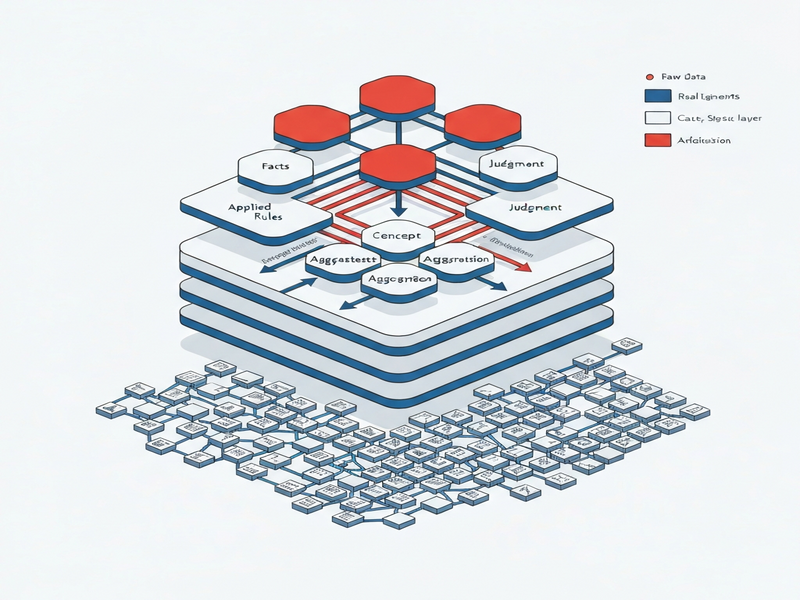
Step 1 – Query Formulation & Retrieval (Researcher)
A user submits a legal question, e.g., “Is the employer liable for indirect discrimination under the Equality Act?” The system parses the query, maps it to the appropriate graph level (Rule → Principle), and retrieves a ranked list of candidate nodes spanning statutes, case holdings, and doctrinal commentary.
Step 2 – Evidence Validation (Auditor)
Each retrieved node is examined against its source PDF or database entry. The Auditor runs a lightweight fact‑checking routine that confirms:
- Exact textual match with the source.
- Contextual relevance (e.g., the cited case actually addresses indirect discrimination).
- Temporal validity (the law has not been superseded).
Only nodes that survive this scrutiny are passed forward; rejected nodes are logged for future model refinement.
Step 3 – Judgment Synthesis (Adjudicator)
The Adjudicator feeds the vetted evidence into a prompting template that instructs the LLM to produce a structured opinion:
    Issue: ...
    Applicable Rule(s): ...
    Supporting Cases: ...
    Reasoning: ...
    Conclusion: ...
The output includes inline citations that reference the exact graph node IDs, enabling downstream auditors or lawyers to trace every claim back to its source.
What Sets This Apart?
- Abstraction‑aware retrieval: The hierarchical graph prevents “one‑size‑fits‑all” matches.
- Built‑in verification: The Auditor acts as a guardrail, turning RAG from a probabilistic guesser into a deterministic evidence engine.
- Modular agent design: Each role can be swapped out (e.g., replace the Auditor with a specialized legal fact‑checker) without redesigning the whole system.
Evaluation & Results
The authors benchmarked LegalGraphRAG on two publicly available legal QA datasets: LegalBench (statutory interpretation) and CaseLawQA (case‑based reasoning). They compared against three baselines:
- Flat Document RAG (no graph).
- Standard GraphRAG (single‑layer graph).
- Chain‑of‑Thought prompting without retrieval.
Key findings include:
- Accuracy boost: LegalGraphRAG achieved a 12‑point F1 improvement over flat RAG and a 7‑point gain over standard GraphRAG on statutory questions.
- Evidence fidelity: Audited citations matched the ground‑truth sources in 94 % of cases, versus 68 % for the non‑audited baselines.
- Reasoning transparency: Human evaluators rated the generated opinions as “clearly traceable” 85 % of the time, a metric unavailable for vanilla RAG outputs.
These results demonstrate that hierarchical retrieval combined with an explicit verification step not only raises raw performance but also satisfies the legal industry’s demand for auditability.
Why This Matters for AI Systems and Agents
LegalGraphRAG’s architecture offers a blueprint for any domain where trust, provenance, and multi‑level knowledge are non‑negotiable. For AI practitioners building enterprise agents, the framework illustrates how to:
- Separate concerns between data acquisition, validation, and synthesis, reducing error propagation.
- Leverage graph databases (e.g., Chroma DB integration) to store hierarchical relationships that are query‑efficient.
- Implement agent orchestration patterns that can be managed through low‑code platforms like the Workflow automation studio, accelerating deployment in regulated environments.
In practice, a law firm could embed LegalGraphRAG into its document management system, allowing attorneys to ask complex questions and receive answers that come with a built‑in audit trail. Similarly, a compliance team could use the same pipeline to verify policy adherence across thousands of contracts, confident that each recommendation is backed by a verifiable source.
What Comes Next
While LegalGraphRAG marks a significant step forward, several avenues remain open for exploration:
Scalability & Graph Maintenance
Legal corpora evolve rapidly. Automating the ingestion of new statutes, case opinions, and scholarly commentary while preserving the hierarchical integrity will require continual graph‑update pipelines. Techniques such as incremental graph embedding and change‑detection alerts could keep the knowledge base fresh without full re‑training.
Domain Transferability
The three‑agent pattern is not limited to law. Financial regulation, medical guidelines, and technical standards all feature layered knowledge and strict evidentiary requirements. Adapting the hierarchical graph schema to these fields could yield similarly trustworthy agents.
Human‑in‑the‑Loop Enhancements
Integrating expert feedback directly into the Auditor’s decision process would create a semi‑supervised loop, where lawyers correct false positives and the system learns to refine its verification heuristics over time.
Open‑Source Ecosystem
The authors have released code and datasets on GitHub, inviting the community to extend the framework. Contributions could include plug‑and‑play auditors for specific jurisdictions, or visual dashboards that map the provenance chain for each generated opinion.
For organizations ready to experiment, the Enterprise AI platform by UBOS offers pre‑built connectors for graph databases, LLM orchestration, and compliance logging, making it easier to prototype a LegalGraphRAG‑style solution without building every component from scratch.
Ultimately, the promise of AI‑driven legal reasoning hinges on credibility. By marrying hierarchical knowledge representation with a disciplined multi‑agent verification loop, LegalGraphRAG sets a new benchmark for trustworthy, explainable AI in high‑stakes domains.
References
- LegalGraphRAG: Multi-Agent Graph Retrieval‑Augmented Generation for Reliable Legal Reasoning (arXiv)
- Chen, Z., Zhang, Q., Xiang, Z., et al. (2026). “LegalGraphRAG: Multi‑Agent Graph Retrieval‑Augmented Generation for Reliable Legal Reasoning.” arXiv preprint arXiv:2605.28120.
Andrii Bidochko
CTO UBOS
Andrii Bidochko is an AI entrepreneur and researcher focused on AI agents, reinforcement learning, and autonomous systems. He writes about the technologies shaping the future of machine intelligence, from frontier models and agent architectures to real-world AI applications.