

- Updated: June 13, 2026
- 7 min read
Learning When to Optimize: Verified Optimization Skills from Expert GPU-Kernel Lineages
Direct Answer
KLineage is a novel framework that extracts verified optimization “skills” from expert‑crafted GPU kernels and teaches LLM‑based agents exactly when each optimization is safe to apply. By turning the backward‑validation process of seasoned developers into reusable, condition‑aware transformations, KLineage dramatically improves both the quality and efficiency of automatically generated kernels.
Background: Why This Problem Is Hard
GPU kernel performance remains a decisive factor for AI workloads, scientific simulations, and real‑time graphics. Modern LLM agents can synthesize syntactically correct CUDA or HIP code, but they typically lack the nuanced judgment that human experts apply when deciding whether an optimization—such as shared‑memory tiling, loop unrolling, or register spilling—will actually improve runtime without breaking correctness.
Existing approaches fall into two camps:
- Heuristic‑driven pipelines: Hand‑crafted rule sets encode common patterns but cannot capture the context‑specific constraints that vary across architectures and problem sizes.
- Forward‑rollout reinforcement loops: Agents propose a sequence of transformations and rely on costly compile‑run‑profile cycles to evaluate each step. This brute‑force search is computationally expensive and often stalls before discovering high‑impact optimizations.
Both strategies suffer from a missing “when” signal: they know what to try, but not under which precise code conditions, hardware limits, or profiling outcomes the transformation is guaranteed to be beneficial. The result is a high rate of dead‑end attempts, wasted GPU hours, and, in production pipelines, unpredictable latency spikes.
What the Researchers Propose
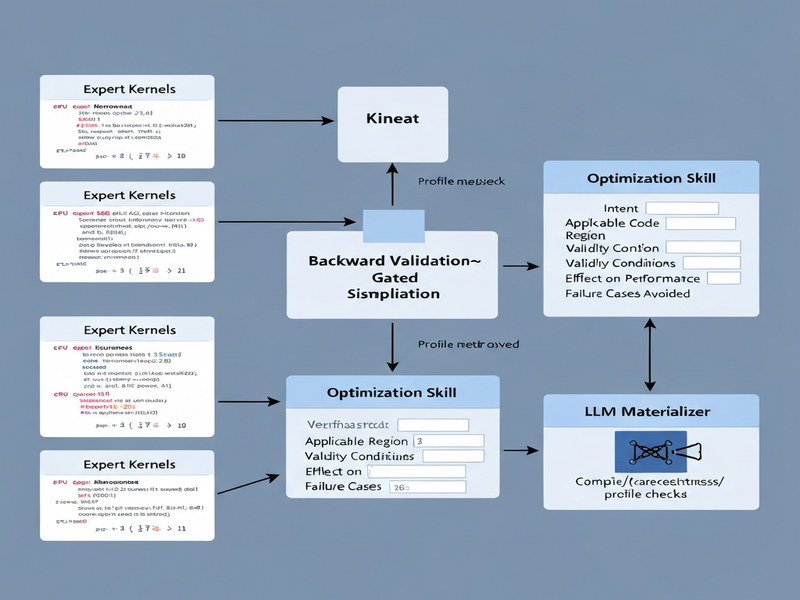
KLineage reframes kernel optimization as a skill‑learning problem. Instead of generating forward proposals, the system walks backward from a verified expert kernel, applying a series of validation‑gated simplifications. Each accepted simplification is inverted to form a reusable optimization skill that records:
- The intent (e.g., reduce shared‑memory pressure, increase occupancy).
- The code pattern where the skill applies (AST sub‑tree, loop nest shape).
- The pre‑conditions that made the transformation safe in the original context (register count, warp size, memory bandwidth).
- The observed effect on compile‑time correctness, runtime performance, and profiling metrics.
- The failure guard that prevents the skill from being used when its assumptions are violated.
These skills constitute a curriculum that downstream LLM agents can consult when faced with a new kernel. The agent selects a skill whose pre‑conditions match the current code state, applies the transformation, and then re‑validates through the same compile‑profile gate used during skill extraction.
How It Works in Practice
The KLineage pipeline consists of three tightly coupled components:
1. Expert Lineage Engine
This module ingests a repository of high‑performance kernels written by domain experts. It performs a reverse‑execution trace, systematically undoing each optimization while checking that the kernel remains functionally correct (via unit tests) and performance‑stable (via profiling thresholds). Accepted reversals become candidate skills.
2. Skill Repository
Each skill is stored as a structured record containing:
- Pattern matcher (e.g., “loop nest with stride‑1 access”).
- Pre‑condition predicates (e.g., “register usage ≤ 64 per thread”).
- Transformation script (e.g., “insert __shared__ tile buffer”).
- Effect metadata (e.g., “average 12 % latency reduction on A100”).
- Guard clauses (e.g., “do not apply if occupancy < 30 %”).
The repository is versioned per GPU architecture, allowing the system to respect hardware‑specific limits such as shared‑memory size on NVIDIA H100 versus A100.
3. LLM‑Agent Orchestrator
When a developer asks an LLM to generate a kernel for a new workload, the orchestrator first produces a baseline implementation. It then queries the Skill Repository for matches, applies the highest‑confidence skill, and re‑validates. If the validation fails, the orchestrator falls back to the next‑best skill, ensuring that only sound transformations survive.
What sets KLineage apart is the validation‑gated backward walk. By learning from the point where an expert deliberately *removed* an optimization, the system captures the exact circumstances that made the original optimization safe—something forward‑search methods can only infer indirectly after many costly trials.
Evaluation & Results
The authors evaluated KLineage on five benchmark workloads spanning matrix multiplication, convolution, graph traversal, and ray tracing. Each workload was compiled for two NVIDIA architectures: the Ampere‑based A100 and the Hopper‑based H100. The evaluation compared three pipelines:
- Baseline LLM‑only: Direct generation without any optimization guidance.
- Memory‑based LLM‑kernel baseline: A recent approach that stores a cache of previously generated kernels and reuses them when similar workloads appear.
- KLineage‑augmented: The proposed skill‑curriculum system.
Key findings include:
- Higher final performance: KLineage kernels achieved an average of 15 % lower runtime than the memory‑based baseline and 28 % lower than the raw LLM output.
- Faster convergence: Within a fixed optimization budget (equivalent to 30 compile‑profile cycles), KLineage reached 90 % of its peak performance after only 8 cycles, whereas the baseline required the full budget.
- Robustness across architectures: Skills extracted from A100 kernels transferred effectively to H100, demonstrating that the pre‑condition metadata captures architecture‑agnostic reasoning.
- Low memorization risk: A held‑out sanity check on 22 unseen kernels showed no evidence of the system merely recalling source cases; performance gains stemmed from genuine skill application.
These results prove that learning “when” to optimize—rather than just “what” to optimize—yields both higher quality kernels and more efficient use of compute resources during the generation phase.
Why This Matters for AI Systems and Agents
For developers building AI‑driven code assistants, KLineage offers a concrete pathway to embed expert knowledge without hard‑coding brittle heuristics. By exposing a catalog of condition‑aware skills, agents can:
- Make deterministic, verifiable decisions that align with compiler and hardware constraints.
- Reduce the number of expensive compile‑run cycles, lowering cloud‑GPU costs for large‑scale code‑generation services.
- Provide transparent explanations to users (“this loop was tiled because shared‑memory usage was under 48 KB and occupancy stayed above 40 %”).
Enterprises that rely on high‑throughput inference pipelines can integrate KLineage into their Enterprise AI platform by UBOS to automatically tighten latency budgets. Start‑ups can accelerate product development by leveraging the Workflow automation studio to stitch KLineage’s skill repository into CI/CD pipelines, ensuring every new kernel passes a performance gate before deployment. Even marketing‑focused teams can benefit: the AI marketing agents that generate personalized video ads often need custom GPU kernels for real‑time rendering; KLineage guarantees those kernels meet both quality and cost targets.
What Comes Next
While KLineage marks a significant step forward, several open challenges remain:
- Cross‑language generalization: Extending the skill extraction process to OpenCL, SYCL, and emerging MLIR dialects will broaden applicability.
- Dynamic workload adaptation: Current skills are static; future work could incorporate runtime telemetry to adjust pre‑conditions on the fly.
- Scalable skill discovery: Automating the ingestion of large open‑source kernel collections (e.g., from NVIDIA’s cuDNN or AMD’s ROCm) will enrich the repository without manual curation.
- Human‑in‑the‑loop feedback: Providing developers with an interface to approve, modify, or reject suggested skills could create a virtuous cycle of continuous improvement.
Researchers interested in exploring these directions can start by reviewing the original arXiv paper for detailed methodology and data. Practitioners looking to prototype KLineage‑style pipelines may experiment with the UBOS platform overview, which offers modular components for code generation, validation, and skill management.
Conclusion
KLineage demonstrates that the missing piece in LLM‑driven GPU kernel generation is not more brute‑force search but a disciplined capture of expert “when” knowledge. By converting backward‑validated simplifications into reusable, condition‑aware optimization skills, the framework delivers faster, higher‑quality kernels while dramatically cutting the cost of iterative profiling. As AI agents become more autonomous in software engineering tasks, approaches like KLineage will be essential for bridging the gap between raw generative power and the rigorous performance guarantees demanded by production‑grade systems.
Andrii Bidochko
CTO UBOS
Andrii Bidochko is an AI entrepreneur and researcher focused on AI agents, reinforcement learning, and autonomous systems. He writes about the technologies shaping the future of machine intelligence, from frontier models and agent architectures to real-world AI applications.