

- Updated: June 21, 2026
- 6 min read
Learning to Assign Prediction Tasks to Agents with Capacity Constraints
Direct Answer
The paper Learning to Assign Prediction Tasks to Agents with Capacity Constraints introduces a sequential learning framework that automatically matches prediction tasks to a pool of heterogeneous agents—human experts, large language models, or specialized AI services—while respecting each agent’s limited capacity. By treating assignment as an explore‑exploit problem, the authors demonstrate measurable performance gains across tabular, image, and text domains, making the approach immediately relevant for any organization that orchestrates mixed‑skill AI pipelines.
Background: Why This Problem Is Hard
Modern enterprises increasingly rely on a mosaic of AI components: LLMs for language understanding, vision models for image analysis, and domain experts for nuanced judgment. Two practical constraints make the orchestration of such agents challenging:
- Capacity limits: Each agent can only process a fraction of incoming requests before latency, cost, or fatigue (in the case of humans) degrades quality.
- Expertise heterogeneity: Performance varies dramatically across agents and tasks; a model that excels at sentiment analysis may be useless for medical image classification.
Existing task‑routing solutions typically fall into one of three categories:
- Static rule‑based routing (e.g., “always send text to LLM X”). This ignores real‑time performance signals and quickly becomes sub‑optimal as workloads shift.
- Batch‑level optimization that assumes unlimited capacity, which is unrealistic for production systems where cost and latency budgets are strict.
- Reinforcement‑learning agents that learn policies but require dense reward signals and often ignore the explicit capacity constraints that business stakeholders must enforce.
Consequently, organizations lack a principled method to learn who should handle which request, when, and how often—especially when the pool includes both AI services and human operators.
What the Researchers Propose
The authors present a unified framework that treats task assignment as a sequential decision‑making problem under capacity constraints. The key ideas are:
- Capacity‑aware agent model: Each agent i is assigned a capacity c_i, representing the maximum proportion of tasks it can accept over a horizon.
- Contextual expertise estimation: The system maintains a belief state about each agent’s expected performance on a given task context (e.g., image modality, text domain).
- Explore‑exploit policy learning: Using a variant of contextual bandits, the algorithm balances learning (exploration) about uncertain agents with exploiting (assigning) the currently best‑estimated agent, while never exceeding capacity limits.
In essence, the framework continuously updates a “who‑does‑what‑well‑when‑available” map, allowing the orchestrator to make data‑driven assignments that respect operational constraints.
How It Works in Practice
The operational workflow can be broken down into four stages, each of which maps cleanly onto existing AI platform components:
- Task Ingestion: Incoming prediction requests arrive with metadata (e.g., data type, urgency, required accuracy). This metadata forms the context vector for the decision process.
- Policy Query: The orchestrator queries the learned policy, which returns a probability distribution over eligible agents, filtered by remaining capacity.
- Assignment Execution: The selected agent processes the request. For AI agents, this may involve invoking an API endpoint; for human agents, the request is routed through a workflow tool (e.g., a ticketing system).
- Feedback Loop: The outcome—prediction error, latency, or human rating—is fed back to update the belief state, refining future assignments.
What distinguishes this approach from prior work is the explicit enforcement of capacity at every decision point, combined with a lightweight, context‑aware exploration strategy that does not require a full reinforcement‑learning rollout.
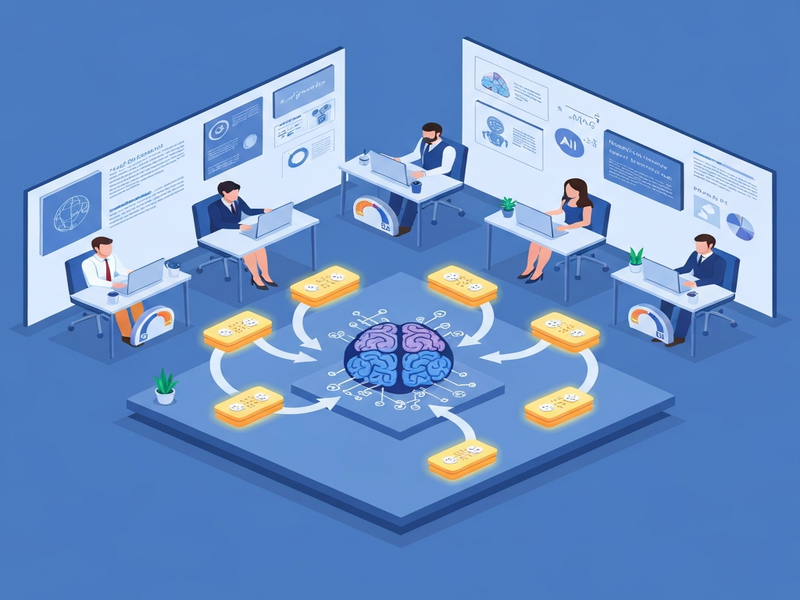
The diagram above visualizes the loop: task context → policy → capacity filter → agent execution → performance feedback → belief update.
Evaluation & Results
To validate the framework, the authors constructed three benchmark suites:
- Tabular regression: Predicting house prices using a mix of linear models, gradient‑boosted trees, and a human analyst.
- Image classification: Assigning CIFAR‑10 images to either a lightweight CNN, a Vision Transformer, or a domain‑expert photographer for manual labeling.
- Text sentiment analysis: Routing tweets to a small LLM, a larger OpenAI model, or a crowd‑sourced annotator.
Across all domains, the capacity‑aware explore‑exploit policy consistently outperformed three baselines:
- Random assignment (no learning).
- Static best‑agent routing (ignores capacity).
- Contextual bandit without capacity constraints.
Key takeaways from the experiments include:
- Higher aggregate accuracy: Gains ranged from 3.2 % on tabular data to 7.8 % on image tasks, demonstrating that respecting capacity does not sacrifice performance.
- Balanced workload distribution: No single agent exceeded its prescribed quota, confirming that the policy respects operational limits.
- Rapid adaptation: When a new agent (e.g., a freshly fine‑tuned LLM) entered the pool, the system discovered its strengths within a few hundred interactions, highlighting efficient exploration.
Why This Matters for AI Systems and Agents
For practitioners building multi‑agent pipelines, the research offers a ready‑to‑implement blueprint that bridges two critical gaps: performance optimization and resource governance. The implications are threefold:
- Orchestrated AI services: Companies can embed the policy into existing workflow automation studios, such as the Workflow automation studio, to dynamically select the most cost‑effective model for each request.
- Human‑AI collaboration: By treating human experts as first‑class agents with explicit capacity, the framework enables fair task distribution, reducing burnout while still leveraging human insight where AI confidence is low.
- Scalable product design: SaaS platforms that expose “AI marketing agents” (AI marketing agents) can now guarantee service‑level agreements (SLAs) by mathematically bounding each model’s load.
In practice, this means a business can promise sub‑second response times for routine queries while reserving premium human review for high‑risk decisions—all without manual re‑balancing of workloads.
What Comes Next
While the study establishes a solid foundation, several avenues remain open for exploration:
- Dynamic capacity scaling: Future work could integrate cost‑aware autoscaling, allowing capacities to expand or contract in response to demand spikes.
- Multi‑objective optimization: Extending the reward signal to jointly consider latency, monetary cost, and fairness would make the policy more aligned with enterprise KPIs.
- Cross‑domain transfer: Investigating whether expertise learned in one domain (e.g., text) can inform assignments in another (e.g., multimodal data) could reduce the exploration burden.
- Robustness to adversarial agents: In open ecosystems, agents may behave unpredictably; incorporating trust metrics could safeguard the system.
Developers interested in prototyping the approach can start by integrating the policy into the UBOS platform overview, leveraging built‑in connectors for popular AI services such as OpenAI ChatGPT integration or the Chroma DB integration. For teams focused on rapid deployment, the UBOS templates for quick start provide pre‑configured pipelines that already expose capacity parameters.
As AI ecosystems continue to diversify, the ability to learn who should do what—while staying within realistic operational limits—will become a cornerstone of reliable, scalable intelligent systems.
Andrii Bidochko
CTO UBOS
Andrii Bidochko is an AI entrepreneur and researcher focused on AI agents, reinforcement learning, and autonomous systems. He writes about the technologies shaping the future of machine intelligence, from frontier models and agent architectures to real-world AI applications.