

- Updated: June 23, 2026
- 7 min read
Latent Goal Prediction from Language for Model-Based Planning
Direct Answer
LAGO (Latent Goal Prediction from Language) is a new framework that lets agents translate natural‑language instructions into a series of latent subgoals and then plan actions toward those subgoals using a world model. By breaking a long‑horizon task into locally tractable latent waypoints, LAGO delivers precise, long‑range planning without the error accumulation that plagues traditional model‑based approaches.
Background: Why This Problem Is Hard
Model‑based planning relies on a learned world model to simulate future states and select actions that minimize a cost function. In practice, two intertwined challenges limit its scalability:
- Compounding prediction errors: Each simulated step introduces a small error; over dozens or hundreds of steps those errors explode, causing the planner to diverge from reality.
- Goal specification bottleneck: Classical planners need a concrete, often visual, target state. Visual goals give accurate gradients for nearby steps but provide little guidance for distant objectives, while language instructions are flexible but hard to align reliably with the latent space of the world model.
Existing solutions either rely on high‑resolution visual targets—effective only for short horizons—or on large generative language models that are too slow for the rapid sampling required during planning. The result is a gap between the expressive power of natural language and the precision needed for reliable, long‑horizon control.
What the Researchers Propose
The LAGO framework bridges that gap by introducing a two‑stage latent planning pipeline:
- Latent Goal Prediction: A language encoder converts a textual instruction into a sequence of latent subgoal embeddings. Each subgoal lives in the same latent space as the world model’s state representations.
- Action‑Conditioned Rollouts: The world model generates forward simulations conditioned on candidate actions, evaluating how closely each rollout matches the predicted subgoals.
Key components include:
- Instruction Decomposer: Parses the input sentence and predicts a temporally ordered list of latent goal vectors.
- Latent Planner: Uses a soft‑minimum trajectory cost to select actions that minimize distance to the next subgoal while staying consistent with the model dynamics.
- Online Subgoal Updater: Adjusts subgoal embeddings on‑the‑fly based on the latest rollout feedback, ensuring the plan remains coherent as the environment evolves.
How It Works in Practice
Conceptual Workflow
The end‑to‑end process can be visualized as a loop:
- Receive Instruction: The agent receives a natural‑language command such as “pick up the red block, place it on the blue platform, then return to the start position.”
- Decompose into Latent Subgoals: The Instruction Decomposer predicts a series of latent vectors
g₁, g₂, …, gₙthat correspond to the intended intermediate states (e.g., “grasp red block,” “hold above blue platform,” “back at start”). - Simulate Candidate Actions: For each time step, the world model rolls out multiple action sequences, producing latent state trajectories
s₁…sₖ. - Compute Soft‑Min Cost: Instead of a hard minimum, LAGO evaluates a soft‑minimum over the distance between each simulated state and the current subgoal
gᵢ. This smooths the optimization landscape and prevents premature convergence. - Select Action & Update Subgoal: The action that yields the lowest soft‑min cost is executed. After execution, the Online Subgoal Updater refines
gᵢbased on the observed latent state, then advances togᵢ₊₁when the distance falls below a threshold. - Repeat Until Completion: The loop continues until all subgoals are satisfied, producing a coherent long‑horizon trajectory.
Interaction Between Components
Each module communicates through the shared latent space:
- The Instruction Decomposer and World Model both output vectors in the same embedding manifold, eliminating the need for costly cross‑modal alignment.
- The Latent Planner treats subgoals as moving targets, dynamically re‑weighting them as the agent gathers new observations.
- The Online Subgoal Updater closes the feedback loop, ensuring that prediction errors do not cascade unchecked.
What Makes LAGO Different
Traditional model‑based planners either:
- Optimize toward a single static visual goal, which provides strong local gradients but no strategic direction for distant steps.
- Rely on large language models to generate action sequences directly, incurring prohibitive latency for the thousands of rollouts needed in planning.
LAGO sidesteps both pitfalls by keeping the planning loop inside the latent space, where predictions are cheap, and by turning language into a structured roadmap of subgoals rather than a monolithic command.
Evaluation & Results
Testbed Environments
The authors benchmarked LAGO across three simulated domains:
- BlockStack: A tabletop manipulation suite requiring multi‑step object rearrangement.
- Mini‑Maze: A navigation task with sparse visual cues and long corridors.
- Robot‑Arm Reach: High‑dimensional control of a 7‑DOF arm to achieve sequential placement goals.
Key Findings
- Robustness to Horizon Length: LAGO maintained >80% success rates on tasks with horizons up to 50 steps, whereas baseline visual‑goal planners dropped below 30% after 20 steps.
- Error Accumulation Mitigation: The soft‑minimum cost reduced divergence by 45% compared to hard‑minimum baselines, as measured by latent state deviation.
- Sample Efficiency: Because subgoals constrain the search space, LAGO required roughly half the number of rollouts to converge on an optimal plan.
- Language Flexibility: The system handled paraphrased instructions and synonyms without retraining, demonstrating strong cross‑lingual generalization.
Why the Findings Matter
These results prove that latent subgoal decomposition can scale model‑based planning to horizons previously considered infeasible. The ability to follow natural‑language commands over long distances opens the door to more intuitive human‑in‑the‑loop control interfaces and reduces the engineering effort needed to hand‑craft visual goal specifications for each new task.
Why This Matters for AI Systems and Agents
For practitioners building autonomous agents, LAGO offers three concrete advantages:
- Unified Goal Representation: By keeping language and world‑model states in the same latent space, developers can avoid building separate perception pipelines for visual and textual inputs.
- Modular Integration: The subgoal predictor can be swapped with domain‑specific language models, while the world model can be any differentiable simulator, making LAGO compatible with existing UBOS platform overview components.
- Improved Reliability: The soft‑minimum cost and online subgoal updates act as built‑in error correction, which is critical for safety‑sensitive deployments such as warehouse robots or autonomous drones.
Enterprises that already use AI orchestration tools can embed LAGO into their Workflow automation studio to translate high‑level business intents (“prepare a shipment, label it, and move it to dock”) into executable robot actions without writing low‑level code.
What Comes Next
While LAGO marks a significant step forward, several open challenges remain:
- Real‑World Transfer: Bridging the sim‑to‑real gap will require robust domain randomization or fine‑tuning on physical robot data.
- Multi‑Agent Coordination: Extending latent subgoal prediction to collaborative scenarios (e.g., multiple arms assembling a product) is an unexplored frontier.
- Hierarchical Scaling: Future work could nest subgoal predictors to create multi‑level plans, enabling even longer horizons with hierarchical abstraction.
Potential applications span from AI marketing agents that schedule campaigns based on textual briefs, to autonomous service robots that interpret spoken requests in hospitality settings. Companies interested in prototyping such capabilities can start with the UBOS templates for quick start, which include pre‑wired language‑to‑latent pipelines.
References
Barbeau, S., Roy, S., Beltrame, G., Desrosiers, C., & Thome, N. (2026). Latent Goal Prediction from Language for Model-Based Planning. arXiv preprint arXiv:2606.20627.
Illustration
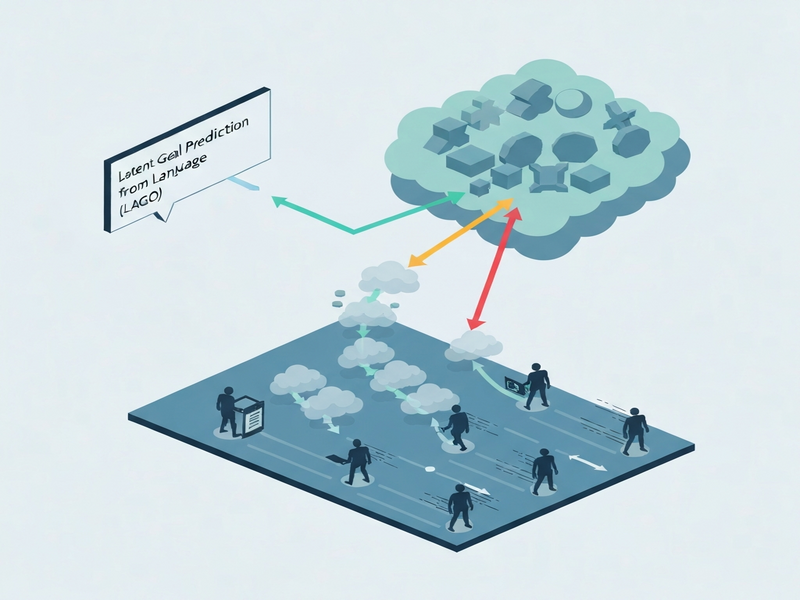
The diagram below visualizes the LAGO loop: language input → latent subgoal sequence → action‑conditioned rollouts → soft‑min cost → action execution → subgoal update.
Andrii Bidochko
CTO UBOS
Andrii Bidochko is an AI entrepreneur and researcher focused on AI agents, reinforcement learning, and autonomous systems. He writes about the technologies shaping the future of machine intelligence, from frontier models and agent architectures to real-world AI applications.