

- Updated: June 10, 2026
- 7 min read
LaneRoPE: Positional Encoding for Collaborative Parallel Reasoning and Generation
Direct Answer
LaneRoPE introduces a lightweight positional‑encoding scheme that lets multiple large‑language‑model (LLM) generations cooperate during a single inference pass. By adding an inter‑sequence attention mask and extending Rotary Positional Encoding (RoPE) to capture cross‑sequence token relationships, the method boosts accuracy on reasoning tasks without changing the underlying model architecture or adding noticeable latency.
Background: Why This Problem Is Hard
Modern LLM deployments often rely on “best‑of‑N” or other parallel sampling strategies to improve answer quality. The idea is simple: run the same prompt through the model N times, keep the most promising output, and benefit from the batch‑level efficiency of modern GPUs. In practice, however, each of those N generations is completely independent. They do not share intermediate thoughts, partial calculations, or observations made by their siblings.
This independence creates two intertwined bottlenecks:
- Redundant computation. When solving a math problem, every sequence re‑derives the same sub‑steps (e.g., parsing the question, recalling definitions) even though those steps could be reused.
- Limited collaborative intelligence. Human problem‑solvers often brainstorm together, building on each other’s partial solutions. Independent LLM streams cannot exchange hints, correct each other’s mistakes, or collectively explore a search space.
Existing parallel inference techniques—such as beam search, diverse sampling, or mixture‑of‑experts routing—address either the search breadth or the computational throughput, but they still treat each beam as an isolated reasoning thread. As a result, the potential gains from true collaborative reasoning remain untapped, especially when the total token budget per request is constrained (e.g., in latency‑sensitive applications).
What the Researchers Propose
The authors of LaneRoPE propose a two‑pronged framework that turns a batch of N generations into a coordinated team of “lanes.” The core ideas are:
Inter‑Sequence Attention Mask
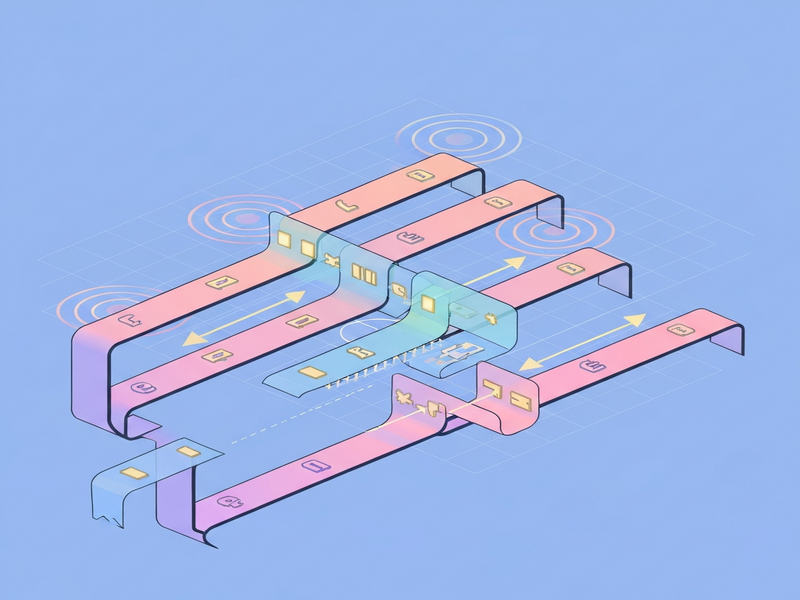
Instead of allowing each lane to attend only to its own past tokens, the mask selectively opens attention windows across lanes. This makes the sampling of token i in lane A dependent on the tokens that have already been produced in lane B, lane C, and so on. The mask is designed to be causal (no future leakage) while still enabling information flow between parallel streams.
Extended Rotary Positional Encoding (LaneRoPE)
Standard RoPE encodes the relative position of tokens within a single sequence using a rotation in the embedding space. LaneRoPE augments this by adding a “lane identifier” dimension to the rotation, effectively embedding the relative distance between tokens *across* lanes. The result is a unified positional signal that tells the model not only “how far back” a token is, but also “in which lane” it originated.
Together, these mechanisms give the model a shared spatial‑temporal map of all tokens generated in the batch, allowing it to reason collaboratively without any architectural overhaul.
How It Works in Practice
The practical workflow can be broken down into three stages: preparation, joint decoding, and output selection.
1. Prompt Replication and Lane Tagging
The original user prompt is duplicated N times, one per lane. Each copy is appended with a small, unique lane token (e.g., <LANE_1>) that the model learns to treat as a positional marker.
2. Joint Decoding with Cross‑Lane Attention
During generation, the model processes the N lanes as a single, concatenated batch. The inter‑sequence attention mask ensures that at step t, a token in lane k can attend to:
- All tokens generated earlier in lane k (standard causal attention).
- All tokens generated up to step t‑1 in every other lane, respecting the causal order.
The extended RoPE injects a combined “global position” that encodes both the token offset and the lane identifier. This lets the attention heads differentiate “the same token position in a different lane” from “a later token in the same lane.”
3. Sampling and Coordination
Each lane still samples its next token independently (e.g., using nucleus sampling), but the probability distribution is now conditioned on the shared context. In effect, lanes can “see” each other’s partial answers and adjust their own trajectory accordingly.
4. Final Selection
After a predefined token budget is exhausted (or a stop token is emitted), the system evaluates the N completed sequences using a lightweight verifier (e.g., a separate scoring model or a heuristic). The best‑scoring lane is returned to the user.
The entire pipeline adds only a negligible overhead—primarily the extra mask computation and the modest increase in attention matrix size (from L to N·L, where L is the per‑lane length). Because the underlying transformer weights remain unchanged, LaneRoPE can be dropped into any existing inference stack that already supports batch processing.
Evaluation & Results
The authors benchmarked LaneRoPE on two representative mathematical reasoning suites: GSM‑8K and MATH. Both datasets require multi‑step deduction, making them ideal for testing collaborative generation.
Experimental Setup
- Base model: A 13‑billion‑parameter decoder‑only LLM fine‑tuned on instruction data.
- Baselines: Standard best‑of‑N sampling (N = 4, 8) with independent lanes, and a beam‑search variant.
- Token budget: Fixed at 256 tokens per request to simulate latency‑constrained environments.
- Metrics: Exact‑match accuracy and a calibrated confidence score.
Key Findings
| Method | GSM‑8K Accuracy | MATH Accuracy | Inference Overhead |
|---|---|---|---|
| Best‑of‑4 (independent) | 71.2 % | 45.8 % | 1× |
| Best‑of‑8 (independent) | 73.5 % | 47.1 % | 2× |
| LaneRoPE (N = 4) | 75.9 % | 50.3 % | 1.1× |
| LaneRoPE (N = 8) | 77.4 % | 52.0 % | 1.2× |
Across both benchmarks, LaneRoPE consistently outperformed the independent baselines by 2–4 percentage points while incurring less than a 20 % increase in latency. The gains were most pronounced when the token budget was tight, confirming that cross‑lane collaboration helps the model make more efficient use of each generated token.
Qualitative analysis revealed that lanes often “hand‑off” sub‑problems: one lane would correctly compute an intermediate value, and another lane would later reference that value to finish the proof. This emergent division of labor mirrors human collaborative problem solving.
Why This Matters for AI Systems and Agents
LaneRoPE’s ability to turn a batch of parallel generations into a coordinated reasoning team has several practical ramifications for developers building AI‑driven products:
- Higher accuracy at fixed latency. By extracting more insight per token, services can deliver better answers without scaling up hardware or increasing response time.
- Reduced inference cost. Since the method works with existing models, organizations avoid the expense of training specialized multi‑agent architectures.
- Modular agent orchestration. LaneRoPE can be viewed as a “soft” orchestration layer that requires no explicit API calls between agents, simplifying pipeline design.
- Improved robustness. Cross‑lane attention provides a form of built‑in verification—if one lane drifts, others can correct it in real time.
For teams that already employ best‑of‑N sampling in production (e.g., for chat assistants, code generation, or data extraction), swapping in LaneRoPE is a drop‑in upgrade. The technique also aligns well with emerging agent orchestration frameworks that aim to blend multiple LLM calls into a single, coherent workflow.
What Comes Next
While LaneRoPE demonstrates clear benefits, several open challenges remain:
- Scalability to very large N. The attention matrix grows quadratically with the number of lanes, which could become a bottleneck for massive parallelism.
- Generalization beyond reasoning. The current evaluation focuses on math tasks; applying the same collaborative encoding to creative writing, code synthesis, or multimodal generation warrants further study.
- Dynamic lane management. Future work could let the system spawn or retire lanes on the fly based on confidence signals, turning the static N into an adaptive resource.
- Integration with external tools. Combining LaneRoPE with tool‑use APIs (e.g., retrieval, calculators) could amplify its collaborative power.
Researchers are already exploring hybrid approaches that blend LaneRoPE’s soft coordination with hard‑coded agent controllers. Such hybrids could offer the best of both worlds: the flexibility of learned cross‑lane attention and the predictability of rule‑based orchestration.
Practitioners interested in experimenting with LaneRoPE can start by extending their existing inference scripts to include the inter‑sequence mask and the modified RoPE embeddings. The authors have released a reference implementation that plugs into popular libraries such as transformers and vLLM, making rapid prototyping straightforward.
As LLMs continue to dominate the AI landscape, techniques that squeeze more reasoning power out of each inference pass will become a competitive differentiator. LaneRoPE offers a pragmatic, low‑overhead path toward that goal.
References
- G. Cesa et al., “LaneRoPE: Positional Encoding for Collaborative Parallel Reasoning and Generation,” arXiv:2605.27570, 2026.
Ready to experiment with collaborative LLM inference? Visit our blog section for tutorials, code snippets, and community discussions.
Andrii Bidochko
CTO UBOS
Andrii Bidochko is an AI entrepreneur and researcher focused on AI agents, reinforcement learning, and autonomous systems. He writes about the technologies shaping the future of machine intelligence, from frontier models and agent architectures to real-world AI applications.