

- Updated: July 30, 2026
- 6 min read
KGCQual: An Interpretable Framework for Evaluating the Knowledge Graph Construction Quality from Text
Direct Answer
KGCQual introduces an interpretable, model‑agnostic framework for measuring how faithfully an automatically constructed knowledge graph (KG) reproduces the key entities, relations, and linguistic nuances—such as negation—found in its source text. By quantifying completeness, resolution quality, and semantic fidelity, the metric gives practitioners a reliable yardstick for comparing KG pipelines beyond task‑specific scores.
Background: Why This Problem Is Hard
Knowledge graphs have become the backbone of many AI products, from search assistants to recommendation engines. Modern pipelines rely on neural extractors that turn raw documents into subject‑predicate‑object triples at scale. However, three intertwined challenges persist:
- Spurious triples: Extraction models often hallucinate relations that never appear in the text, polluting downstream reasoning.
- Missing information: Important noun phrases or predicates are omitted, leading to incomplete representations.
- Semantic drift: Subtle linguistic cues—negation, modality, or coreference—are lost, causing the KG to misrepresent the original meaning.
Current evaluation practices fall short. Most researchers report downstream task metrics (e.g., link prediction accuracy) or rely on small‑scale manual audits. These approaches either conflate KG quality with downstream model performance or provide only anecdotal evidence, leaving developers without a clear, intrinsic signal of graph fidelity.
What the Researchers Propose
The authors present KGCQual, a two‑tier metric that separates entity‑level and relation‑level assessment while staying fully interpretable:
- Entity‑level assessment: Checks whether the KG captures all salient noun phrases, resolves ambiguous mentions, and maintains appropriate connectivity among entities.
- Relation‑level assessment: Verifies that extracted predicates preserve the original lexical meaning, respect multiplicity (one‑to‑many vs. many‑to‑many), and correctly handle negation.
Each tier combines lightweight linguistic analyses—such as dependency‑parse alignment and lexical similarity scoring—with a set of transparent sub‑metrics. The framework is deliberately model‑agnostic: it can be applied to any triple extraction system without retraining or access to internal model weights.
How It Works in Practice
The KGCQual workflow can be visualized as a pipeline of three logical stages:
- Reference Graph Construction: From the source document, a lightweight “ideal” graph is built by extracting noun phrases, verb predicates, and negation cues using off‑the‑shelf NLP tools (e.g., spaCy, Stanford CoreNLP). This reference graph serves as the gold standard for comparison.
- Candidate Graph Alignment: The automatically generated KG is aligned to the reference graph. Alignment relies on lexical similarity (e.g., cosine similarity of word embeddings) for entity matching and on dependency‑parse paths for relation matching.
- Metric Computation: Four core scores are calculated:
- Completeness – proportion of reference entities present in the candidate KG.
- Resolution Quality – degree to which ambiguous mentions are correctly disambiguated.
- Connectivity – average degree of entities, indicating whether the graph remains structurally coherent.
- Predicate Fidelity – alignment score for relations, adjusted for negation handling.
The final KGCQual score is a weighted aggregate of these sub‑scores, with weights configurable per application domain.
The approach differs from prior work in two key ways:
- It treats the source text as the ultimate ground truth, rather than relying on external benchmark triples that may not reflect the original narrative.
- It provides a transparent breakdown of where a KG fails—missing entities, broken connections, or mis‑captured negation—enabling targeted pipeline improvements.
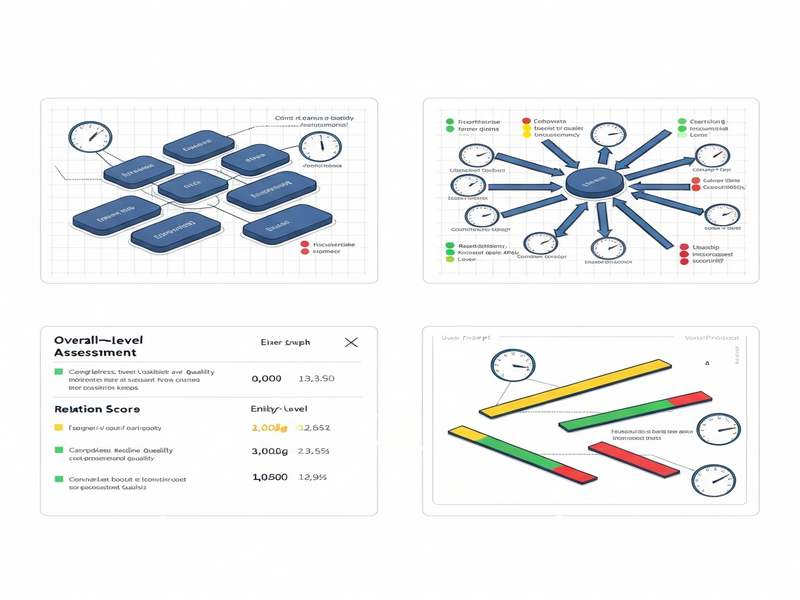
In practice, a data scientist can plug KGCQual into an existing Workflow automation studio to automatically score each batch of extracted triples, generate diagnostic reports, and trigger remediation steps (e.g., re‑run the extractor with a higher confidence threshold).
Evaluation & Results
The authors benchmarked KGCQual on three widely used extraction datasets: WebNLG, TinyButMighty, and BenchIE. They compared four state‑of‑the‑art triple extractors—OpenIE‑5, Stanford OpenIE, REBEL, and a recent transformer‑based model—using both traditional metrics (precision, recall, F1) and the new KGCQual score.
Key findings include:
- Higher Sensitivity to Omissions: KGCQual identified up to 27% more missing noun phrases than standard recall, highlighting gaps that downstream tasks often mask.
- Negation Detection: Extractors that ignored negation received a penalty of 12–18 points on the predicate fidelity sub‑metric, correlating with observed downstream errors in sentiment‑aware applications.
- Correlation with Downstream Performance: An ablation study showed a Pearson correlation of 0.71 between KGCQual scores and link‑prediction accuracy on the same extracted KG, confirming that intrinsic quality aligns with practical utility.
- Model‑Agnostic Consistency: Across all three datasets, the relative ranking of extractors remained stable, demonstrating that KGCQual provides a reliable comparative lens regardless of domain.
These results suggest that KGCQual surfaces quality dimensions that conventional metrics overlook, offering a more nuanced diagnostic tool for KG engineers.
Why This Matters for AI Systems and Agents
For AI practitioners building agents that rely on structured knowledge—such as conversational assistants, recommendation bots, or autonomous decision‑making pipelines—the fidelity of the underlying KG directly impacts user experience and business outcomes. KGCQual enables several concrete benefits:
- Rapid Pipeline Debugging: By pinpointing missing entities or mis‑handled negations, engineers can iteratively refine extraction models without waiting for downstream A/B tests.
- Quality‑Driven Model Selection: When evaluating multiple KG construction services, KGCQual offers an objective, comparable score, reducing reliance on vendor‑specific claims.
- Continuous Monitoring: Integrated into a production monitoring stack, the metric can trigger alerts when quality drops below a predefined threshold, ensuring agents never degrade silently.
- Regulatory Compliance: In domains like healthcare or finance, demonstrating that extracted knowledge faithfully reflects source documents is increasingly a legal requirement; an interpretable metric satisfies audit needs.
Organizations that have already adopted the Enterprise AI platform by UBOS can embed KGCQual as a validation step before feeding graphs into downstream reasoning modules, thereby tightening the feedback loop between data ingestion and agent behavior.
What Comes Next
While KGCQual marks a significant step forward, the authors acknowledge several avenues for future work:
- Multilingual Extension: Current linguistic analyses target English; extending dependency‑parse alignment to low‑resource languages would broaden applicability.
- Dynamic KG Scenarios: Real‑time agents often ingest streaming text. Adapting KGCQual for incremental evaluation—where the reference graph evolves—remains an open challenge.
- Deeper Semantic Layers: Incorporating discourse‑level phenomena (e.g., sarcasm, presupposition) could further tighten semantic fidelity.
- Human‑in‑the‑Loop Interfaces: Visual dashboards that surface entity‑ and relation‑level breakdowns would empower domain experts to correct systematic extraction errors.
Potential applications extend beyond traditional KG pipelines. For example, AI marketing agents could use KGCQual to verify that product attributes extracted from catalog pages match the advertised claims before launching campaigns. Similarly, developers building OpenAI ChatGPT integration can leverage the metric to ensure that the knowledge base powering the chatbot remains accurate and up‑to‑date.
In summary, KGCQual offers a transparent, scalable, and empirically validated way to assess KG construction quality. As knowledge‑centric AI systems proliferate, having a reliable intrinsic metric will become as essential as traditional performance benchmarks.
References
KGCQual: An Interpretable Framework for Evaluating the Knowledge Graph Construction Quality from Text – N. Misra et al., arXiv:2607.10212v1, 2026.
Andrii Bidochko
CTO UBOS
Andrii Bidochko is an AI entrepreneur and researcher focused on AI agents, reinforcement learning, and autonomous systems. He writes about the technologies shaping the future of machine intelligence, from frontier models and agent architectures to real-world AI applications.