

- Updated: July 2, 2026
- 6 min read
JPPD: Joint Prediction‑Planning Diffusion with Differentiable Safety Guidance for Dynamic Obstacle Avoidance in Intelligent Transportation Systems
Direct Answer
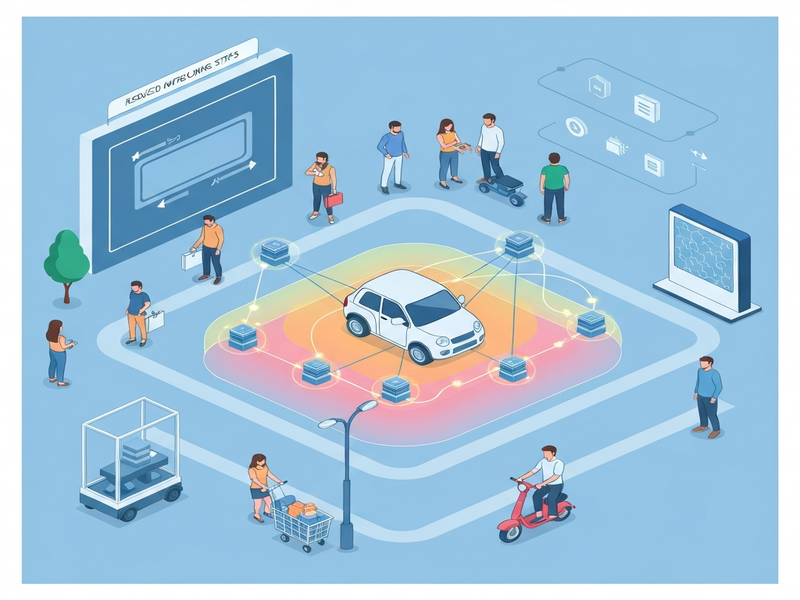
The paper introduces JPPD – a Joint Prediction‑Planning Diffusion framework that simultaneously generates future trajectories for an autonomous robot and all surrounding agents, while steering the joint sampler with a differentiable safety potential. This unified approach eliminates the one‑way information flow of traditional pipelines, delivering safer, more efficient navigation in crowded, shared‑space environments.
Background: Why This Problem Is Hard
Shared‑space transportation—think campus shuttles, warehouse robots, or low‑speed delivery bots—must coexist with pedestrians, micromobility devices, service robots, and ad‑hoc obstacles. The core difficulty lies in two intertwined challenges:
- Dynamic uncertainty: Human motion is inherently multimodal; a pedestrian may stop, turn, or speed up, creating a distribution of plausible futures.
- Planning‑prediction coupling: Conventional systems first predict other agents’ trajectories, then plan a robot path that avoids the predicted positions. This sequential design assumes predictions are static, ignoring how the robot’s own motion influences the crowd’s evolution.
Existing pipelines suffer from “prediction bias”: the robot reacts to a fixed forecast that may become invalid once the robot moves, leading to near‑misses, hard braking, or deadlock situations. Moreover, safety is often enforced with heuristic post‑processing (e.g., repulsive forces) that can break multimodality and increase computational latency.
What the Researchers Propose
JPPD reframes the problem as a single conditional trajectory generation task. Instead of two separate modules, the authors train a diffusion‑based generative model that samples a joint trajectory set—one future for the robot and one for each surrounding participant—directly from a coupled probability distribution.
Key components of the proposal include:
- Causal Transformer with cross‑trajectory attention: This backbone processes all agents’ past states in parallel, allowing information to flow across trajectories while preserving temporal causality.
- Diffusion sampling with conditional flow matching: The model iteratively denoises a random latent into realistic joint trajectories, but flow matching reduces the number of required inference steps, keeping runtime low.
- Differentiable safety potential guidance: A time‑varying occupancy‑probability field encodes collision risk. Its gradient is injected into the diffusion process, nudging the sampler away from unsafe regions without resorting to hard‑coded repulsion.
By treating prediction and planning as a single stochastic process, JPPD enables the robot’s intended motion to influence the predicted behavior of nearby agents, producing more coherent and safer joint futures.
How It Works in Practice
The operational workflow can be broken down into four stages:
- Data ingestion: Sensors (LiDAR, cameras, V2X) feed recent pose histories of the robot and all detected participants into a shared buffer.
- Encoding: The causal Transformer embeds each agent’s trajectory, applying cross‑trajectory attention so that, for example, a pedestrian’s future can be conditioned on the robot’s projected speed.
- Joint diffusion sampling: Starting from Gaussian noise, the model performs a series of denoising steps. At each step, the differentiable safety potential computes a gradient that pushes the sampled trajectories away from high‑risk occupancy zones.
- Execution: The robot extracts its own trajectory slice, validates it against latency constraints, and sends low‑level control commands to the motion controller. Simultaneously, the predicted participant trajectories can be fed back to higher‑level traffic‑management modules.
What sets this pipeline apart is the continuous feedback loop between the robot’s plan and the crowd’s predicted response, mediated by the attention mechanism and safety guidance. The system remains fully differentiable, allowing end‑to‑end training and rapid adaptation to new environments.
Evaluation & Results
The authors benchmarked JPPD across four experimental domains:
- Scenario‑grounded simulation: Synthetic urban plazas with dense pedestrian traffic.
- Naturalistic pedestrian replay: Real‑world trajectory logs replayed in a physics‑accurate simulator.
- Isaac Sim validation: High‑fidelity NVIDIA Isaac Sim environments testing sensor noise and actuation delays.
- ROS/Orin deployment: On‑board execution on an NVIDIA Jetson Orin module integrated with ROS 2.
Rather than reporting only average displacement error, the study focused on safety‑centric metrics:
| Metric | Baseline (Predict‑then‑Plan) | JPPD |
|---|---|---|
| Near‑miss incidents (≤0.5 m) | 12.4 % | 4.1 % |
| Blockage time (seconds per episode) | 3.8 s | 1.6 s |
| Hard‑braking events | 7.2 % | 2.3 % |
| Latency (ms per inference) | 78 ms | 42 ms |
These results demonstrate that JPPD reduces tail‑risk events by more than a factor of three while halving computational latency. The joint sampler preserved multimodal diversity, meaning the robot could still choose alternative routes when the primary path became congested, without sacrificing safety.
For a deeper dive into the methodology, see the original arXiv paper.
Why This Matters for AI Systems and Agents
From an engineering perspective, JPPD offers a blueprint for building truly collaborative autonomous agents:
- Safety‑first design: Differentiable safety guidance integrates risk assessment directly into the generative process, eliminating brittle post‑hoc collision avoidance.
- Runtime efficiency: Conditional flow matching reduces diffusion steps, making the approach viable on edge devices such as the Jetson Orin, a critical factor for commercial deployments.
- Scalable multimodality: By sampling a joint distribution, the system naturally supports multiple plausible futures, enabling higher‑level decision modules to perform risk‑aware planning.
- Seamless integration: The architecture aligns with existing ROS 2 pipelines and can be wrapped as a micro‑service within the UBOS platform overview, allowing developers to plug the joint sampler into broader fleet‑management solutions.
Practically, logistics operators can expect fewer emergency stops, higher throughput in congested corridors, and smoother interactions with human workers. For AI researchers, the work showcases how diffusion models—originally popular in image synthesis—can be repurposed for real‑time, safety‑critical trajectory generation.
What Comes Next
While JPPD marks a significant step forward, several avenues remain open:
- Extending to heterogeneous modalities: Incorporating visual intent cues (e.g., gestures) or V2X messages could enrich the joint distribution.
- Long‑horizon planning: Current diffusion steps focus on short‑term horizons (≤5 s). Scaling to city‑scale navigation will require hierarchical diffusion or hybrid model‑based approaches.
- Robustness to perception failures: Future work should evaluate how sensor dropout or adversarial occlusions affect joint sampling quality.
- Open‑source tooling: Publishing a Workflow automation studio template that bundles data ingestion, model inference, and safety‑potential computation would accelerate adoption across the robotics community.
- Business integration: Companies can prototype the framework using Enterprise AI platform by UBOS to manage fleet‑wide deployments, monitor safety metrics, and iterate on model updates without deep ML expertise.
By addressing these challenges, the joint prediction‑planning paradigm could become the de‑facto standard for autonomous agents operating in dense, dynamic environments—from campus shuttles to warehouse fleets.
Ready to experiment with next‑generation safety‑aware navigation? Explore our JPPD Project Page for code snippets, integration guides, and community support.
Andrii Bidochko
CTO UBOS
Andrii Bidochko is an AI entrepreneur and researcher focused on AI agents, reinforcement learning, and autonomous systems. He writes about the technologies shaping the future of machine intelligence, from frontier models and agent architectures to real-world AI applications.