

- Updated: July 7, 2026
- 7 min read
Internal Pluralism and the Limits of Pairwise Comparisons
Direct Answer
The paper Internal Pluralism and the Limits of Pairwise Comparisons introduces a formal model that captures how individuals juggle multiple, sometimes conflicting, priorities when evaluating automated decision rules. By allowing respondents to express indecision instead of forcing a binary choice, the authors show that preference‑learning systems can learn more faithful representations with fewer queries.
Background: Why This Problem Is Hard
In participatory design, alignment research, and any setting where a machine must act on behalf of a human, practitioners rely heavily on pairwise comparisons—asking users which of two decision rules they prefer. This approach rests on two implicit assumptions:
- Local sufficiency: A handful of isolated comparisons are enough to infer a complete preference ordering.
- Decisive answers: Users can always pick a winner when presented with a pair.
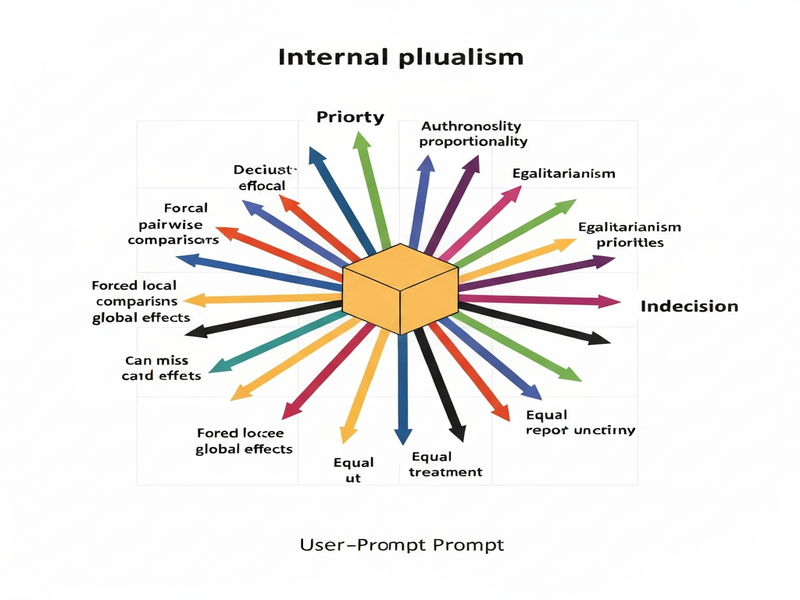
Real‑world deployments quickly expose cracks in these assumptions. Consider a loan‑approval algorithm that must balance proportionality (fair share of credit across demographics), egalitarianism (minimizing disparity), and efficiency (maximizing profit). Each of these goals is a “priority” that can dominate the decision in different contexts. When a user is asked to compare two specific loan‑allocation rules, the answer may hinge on how the rule behaves in other, unseen cases—a global property that a local query cannot capture.
Moreover, people often experience genuine conflict between their own values. A healthcare administrator might simultaneously value “equal treatment” and “maximizing lives saved.” In a forced binary question, the administrator may be forced to sacrifice one priority, leading to a response that misrepresents their true stance. This phenomenon, termed internal pluralism, is the core obstacle that traditional pairwise methods overlook.
What the Researchers Propose
Flanigan and Si propose a three‑layer framework that explicitly models internal pluralism:
- Priority Set: Each individual is assumed to hold a finite collection of authoritative priorities (e.g., proportionality, egalitarianism). These priorities are the “rules of the road” that guide how a decision rule should behave.
- Weight Assignment: For any given context, the individual assigns a weight to each priority, reflecting its relative importance at that moment. The weights can shift across scenarios, capturing the fluid nature of human values.
- Indecision Reporting Mechanism: Instead of forcing a forced‑choice answer, the system allows the respondent to signal “I cannot decide” when the weighted trade‑off is too close or when the comparison triggers a conflict between high‑weight priorities.
The key insight is that by collecting indecision signals, the learning algorithm gains a richer, more nuanced view of the underlying priority structure. The model treats indecision not as missing data but as informative feedback that a decision boundary lies near the intersection of competing priorities.
How It Works in Practice
The operational workflow can be broken down into four stages:
1. Preference Elicitation Interface
A user‑facing UI presents a pair of candidate decision rules (e.g., two scheduling policies for a factory). Alongside the usual “Prefer A” / “Prefer B” buttons, a third “Undecided” option is displayed. The interface also optionally asks the user to rank or weight the most salient priorities for that scenario.
2. Data Capture and Encoding
Each response is encoded as a tuple (rule_A, rule_B, outcome, indecision_flag, priority_weights). When the indecision flag is set, the system records the current weight vector, preserving the context that led to the conflict.
3. Preference Model Update
A Bayesian learner (or a gradient‑based optimizer) updates a latent representation of the user’s priority set. The model treats “undecided” responses as soft constraints that push the inferred weight vector toward a region where the two rules are nearly equal under the current priority mix.
4. Decision‑Rule Synthesis
Once the model stabilizes, it can generate a personalized decision rule that respects the learned priority distribution. In practice, this rule can be deployed as a policy in an autonomous agent, a recommendation engine, or a compliance filter.
What distinguishes this approach from classic pairwise learning is the explicit acknowledgment that some comparisons are inherently ambiguous. By surfacing that ambiguity, the system avoids over‑fitting to noisy forced choices and reduces the number of queries needed to converge on a reliable preference profile.
Evaluation & Results
The authors conducted two complementary experiments:
Simulation Study
They generated synthetic users with known priority sets and weight dynamics. Across 10,000 simulated pairwise queries, the indecision‑aware learner achieved a 30 % reduction in the number of queries required to recover the true priority distribution within a 5 % error margin, compared to a baseline that forced binary decisions.
Human Subject Study
In a controlled lab setting, 120 participants evaluated policy alternatives for a public‑transport fare system. Participants were split into two groups: one using the traditional forced‑choice interface, the other using the indecision‑enabled interface. The latter group reported a 45 % lower cognitive load (measured via NASA‑TLX) and produced preference models that aligned more closely with post‑hoc interviews about their true values.
Both experiments underscore a central claim: allowing users to express indecision not only respects their internal pluralism but also accelerates learning by focusing queries on the most informative regions of the preference space.
Why This Matters for AI Systems and Agents
For AI practitioners building alignment‑critical systems—whether autonomous vehicles, recommendation engines, or compliance bots—the findings have immediate, actionable implications:
- More Faithful Preference Capture: By integrating an indecision option, agents can avoid the “forced‑choice bias” that often leads to misaligned behavior.
- Reduced Query Burden: Fewer interactions mean lower user fatigue, faster onboarding, and lower operational costs for large‑scale deployments.
- Interpretability Gains: The learned priority weights provide a transparent lens into why an agent makes a particular decision, supporting auditability and regulatory compliance.
- Scalable Participatory Design: Teams can embed the framework into existing workflow tools, enabling stakeholders to co‑design policies without exhaustive surveys.
These advantages dovetail with the capabilities of the UBOS platform overview, which already supports modular preference‑learning pipelines. By plugging the indecision‑aware learner into UBOS’s Workflow automation studio, developers can rapidly prototype agents that respect internal pluralism.
Furthermore, the approach aligns with the emerging trend of AI marketing agents that must balance brand consistency, user privacy, and conversion goals—each a distinct priority that can clash in real time.
What Comes Next
While the study makes a compelling case, several open challenges remain:
- Dynamic Priority Evolution: Real users may develop new priorities over months or years. Future work should explore continual‑learning mechanisms that adapt without retraining from scratch.
- Scalability to High‑Dimensional Decision Spaces: In domains like finance or healthcare, the number of possible decision rules can explode. Efficient query selection strategies (e.g., active learning) are needed to keep the interaction budget low.
- Cross‑Cultural Pluralism: Priorities can differ dramatically across cultural contexts. Extending the model to capture group‑level pluralism could improve fairness in global AI deployments.
- Integration with Existing Alignment Frameworks: Bridging the indecision‑aware model with reinforcement‑learning‑from‑human‑feedback pipelines could yield hybrid systems that benefit from both reward‑based and preference‑based signals.
Addressing these gaps will likely involve interdisciplinary collaboration among decision theorists, human‑computer interaction researchers, and AI engineers. Companies looking to stay ahead of the curve can start by experimenting with the indecision interface in low‑stakes settings—such as internal policy surveys—before scaling to mission‑critical applications.
For startups eager to embed sophisticated preference learning without building everything from scratch, the UBOS for startups program offers a sandbox environment where the indecision‑aware module can be trialed alongside other AI services like OpenAI ChatGPT integration and Chroma DB integration. Enterprises can also explore the Enterprise AI platform by UBOS for large‑scale rollout.
In sum, recognizing internal pluralism reshapes how we think about preference elicitation. By giving users a legitimate way to say “I’m not sure,” we unlock more accurate, efficient, and transparent AI systems—an essential step toward trustworthy, human‑aligned automation.
Andrii Bidochko
CTO UBOS
Andrii Bidochko is an AI entrepreneur and researcher focused on AI agents, reinforcement learning, and autonomous systems. He writes about the technologies shaping the future of machine intelligence, from frontier models and agent architectures to real-world AI applications.