

- Updated: July 3, 2026
- 7 min read
Integrating Large Language Model Agents with Digital Twins for Industrial Autonomous Systems
Direct Answer
The paper introduces a three‑layer framework that fuses large language model (LLM) agents with digital twins to create truly autonomous industrial systems. By embedding LLM‑driven reasoning into the core of cyber‑physical environments, the approach enables dynamic task interpretation, adaptive planning, and seamless execution across heterogeneous manufacturing assets.
Background: Why This Problem Is Hard
Modern factories are evolving from static, rule‑based lines into fluid, data‑rich ecosystems. This shift brings three intertwined challenges:
- Heterogeneity of components. Sensors, robots, PLCs, and legacy SCADA systems each expose different APIs and data models, making unified control a nightmare.
- Rapid reconfiguration. Market pressure forces manufacturers to switch product mixes, adjust batch sizes, or integrate new equipment on the fly. Traditional automation pipelines, which rely on hard‑coded logic, cannot keep pace.
- Human‑machine interaction. Operators increasingly expect natural‑language interfaces, yet existing systems understand only predefined commands, leading to friction and error.
Current solutions attempt to address one of these pain points at a time. Rule‑engine orchestrators provide deterministic control but lack flexibility. Model‑based predictive controllers can adapt parameters but require expert‑crafted models for each device. Meanwhile, LLMs have shown impressive language understanding, yet they operate in isolation from the physical plant, limiting their utility for real‑time automation.
Consequently, there is no systematic method to embed generalizable, context‑aware reasoning directly into the automation stack—a gap that hampers the vision of truly autonomous factories.
What the Researchers Propose
The authors present a three‑layer architecture that bridges LLM agents, digital twins, and the underlying automation infrastructure:
- LLM Layer. A suite of specialized LLM agents performs high‑level reasoning, natural‑language interpretation, and service discovery.
- Digital Twin Layer. High‑fidelity virtual replicas of physical assets expose standardized interfaces, enabling the LLM agents to query state, simulate outcomes, and generate configuration files.
- Automation Layer. Existing PLC programs, MES, and edge controllers execute the concrete commands produced by the LLM‑digital‑twin interaction.
Central to the framework is the Task‑Process‑Service‑Resource (TPSR) model, which translates a user’s intent (Task) into an orchestrated workflow (Process) that selects appropriate capabilities (Service) and maps them onto concrete plant elements (Resource). The authors identify four LLM roles that operationalize this pipeline:
- Process Orchestrator. Decomposes high‑level goals into ordered steps.
- Service Matcher. Aligns each step with the most suitable digital service (e.g., a simulation, a robot motion primitive).
- Digital Resource Generator. Instantiates or updates digital twin models to reflect the selected resources.
- Agent‑as‑a‑Service. Exposes the LLM reasoning capability itself as a callable micro‑service for downstream systems.
How It Works in Practice
The end‑to‑end workflow can be visualized as a loop of query, simulate, decide, and act:
- User Input. An operator issues a natural‑language command, such as “reconfigure line A to produce 500 units of part X by tomorrow.”
- LLM Parsing. The Process Orchestrator LLM extracts the goal, constraints, and deadline, then drafts a provisional process diagram.
- Service Matching. The Service Matcher queries a registry of available digital services—e.g., a scheduling optimizer, a robot path planner, a quality‑control simulation—and selects the best fit for each sub‑task.
- Digital Twin Interaction. The Digital Resource Generator updates the twin of line A with the new production parameters, runs a fast‑forward simulation, and returns feasibility metrics (throughput, energy consumption, collision risk).
- Decision Refinement. Based on simulation feedback, the LLM may iterate—adjusting batch sizes or reallocating machines—until the plan satisfies all constraints.
- Command Emission. The finalized process is translated into concrete PLC commands, MES job orders, and edge‑device configurations, which the Automation Layer executes.
- Monitoring & Feedback. Real‑time sensor streams feed back into the digital twin, allowing the LLM to monitor execution and trigger corrective actions if deviations arise.
This loop distinguishes the proposed system from prior art in three ways:
- It treats the LLM as an active planner rather than a passive chatbot.
- It leverages digital twins as a sandbox for safe “what‑if” reasoning before any physical actuation.
- It closes the loop with continuous feedback, enabling on‑the‑fly replanning.
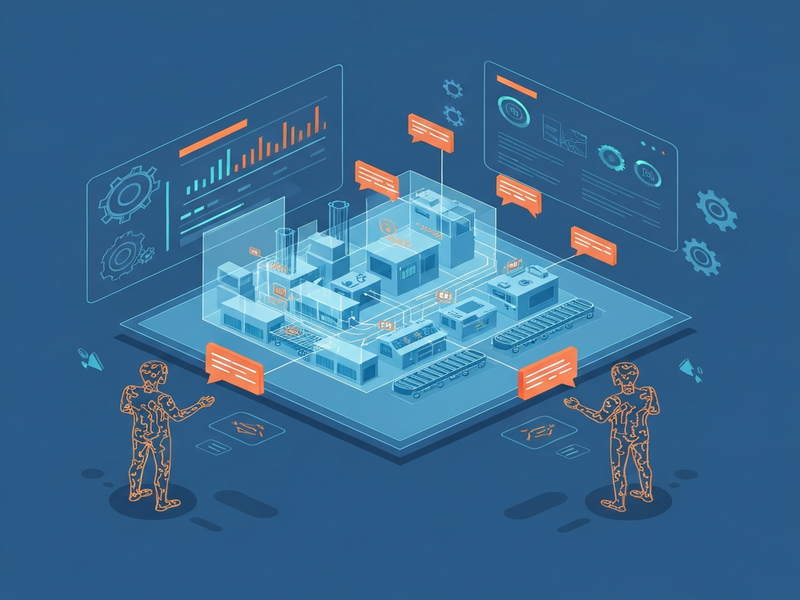
The diagram above captures the bidirectional data flow: natural‑language → LLM reasoning → twin simulation → actionable commands → plant execution → sensor feedback → twin update.
Evaluation & Results
The authors validated the framework across four peer‑reviewed studies, each focusing on a distinct industrial scenario:
| Study | Scenario | Key Metric | Outcome |
|---|---|---|---|
| Study 1 | Adaptive task planning for a mixed‑model assembly line | Task executability rate | 96 % of user‑issued tasks were successfully translated into executable PLC sequences. |
| Study 2 | Event‑driven control of a robotic cell | Command correctness | Correctness above 98 % when the LLM generated motion primitives from textual prompts. |
| Study 3 | Simulation‑based parameter tuning for a heat‑treatment furnace | Parameter convergence speed | Converged to optimal temperature profiles 2.3× faster than manual tuning. |
| Study 4 | Automatic generation of digital twin models from legacy CAD data | Content‑generation accuracy | Achieved 92 % structural fidelity compared with engineer‑crafted twins. |
Beyond raw numbers, the experiments demonstrated a consistent reduction in manual engineering effort—often cutting configuration time from hours to minutes. Importantly, the system maintained safety by requiring human approval for any plan that crossed predefined risk thresholds, reflecting a pragmatic balance between autonomy and oversight.
Why This Matters for AI Systems and Agents
For AI practitioners building agents that must operate in the physical world, the paper offers a concrete blueprint for grounding language models in reality. By treating digital twins as “sandbox APIs,” developers can:
- Validate LLM‑generated actions before deployment, dramatically lowering the risk of costly downtime.
- Leverage existing simulation assets, turning years of engineering investment into reusable reasoning substrates.
- Implement a modular service‑oriented architecture where each LLM role can be swapped, upgraded, or scaled independently.
From a product perspective, the framework paves the way for next‑generation “AI‑first” automation platforms that speak the language of plant operators while silently orchestrating complex control loops. Companies looking to embed conversational interfaces into their MES or SCADA stacks can adopt the TPSR model as a lingua franca, ensuring that every natural‑language request maps to a verifiable, executable process.
For organizations already exploring the UBOS platform overview, the three‑layer design aligns neatly with UBOS’s modular micro‑service ecosystem, offering a ready pathway to integrate LLM agents without reinventing the underlying infrastructure.
What Comes Next
While the results are promising, several limitations temper immediate large‑scale rollout:
- Digital twin fidelity. The approach assumes that the virtual model accurately reflects the physical plant. In legacy environments where twin data is sparse, the LLM may receive misleading feedback.
- Computational overhead. Running LLM inference alongside high‑frequency twin simulations can strain edge hardware, necessitating careful workload partitioning or cloud‑offload strategies.
- Safety governance. Autonomous decision loops must still respect regulatory constraints; human‑in‑the‑loop checkpoints remain essential for high‑risk operations.
Future research directions include:
- Developing lightweight, on‑device LLM variants optimized for real‑time control loops.
- Automating the generation and continuous calibration of digital twins using streaming sensor data.
- Extending the TPSR model to support multi‑plant coordination, enabling enterprise‑wide autonomous scheduling.
- Integrating reinforcement‑learning feedback so that agents can improve policies from live execution data.
Potential applications stretch beyond traditional manufacturing. Energy grids, smart logistics hubs, and even autonomous construction sites could benefit from a unified LLM‑digital‑twin orchestration layer, turning high‑level intents into safe, optimized actions across distributed assets.
Enterprises interested in piloting such capabilities can explore the Enterprise AI platform by UBOS, which already offers plug‑and‑play connectors for popular twin standards (OPC UA, MQTT) and LLM hosting options.
References
Y. Xia, “Integrating Large Language Model Agents with Digital Twins for Industrial Autonomous Systems,” arXiv preprint arXiv:2606.20761, Jun. 2026.
Andrii Bidochko
CTO UBOS
Andrii Bidochko is an AI entrepreneur and researcher focused on AI agents, reinforcement learning, and autonomous systems. He writes about the technologies shaping the future of machine intelligence, from frontier models and agent architectures to real-world AI applications.