

- Updated: July 11, 2026
- 6 min read
Infinity-Parser2 Technical Report
Direct Answer
Infinity-Parser2 is a next‑generation multimodal model that unifies document OCR, layout analysis, table extraction, formula parsing, chart interpretation, chemical structure reading, and visual question answering into a single, end‑to‑end system. By pairing a controllable data‑synthesis pipeline with a multi‑task reinforcement‑learning (RL) reward, it overcomes the chronic shortage of high‑quality annotated parsing data and delivers state‑of‑the‑art accuracy across a broad spectrum of document types.
Background: Why This Problem Is Hard
Enterprises and researchers alike face three intertwined bottlenecks when building document‑understanding solutions:
- Data scarcity. High‑fidelity annotations—bounding boxes, reading order, and semantic markup—are expensive to produce, especially for complex elements like LaTeX formulas or chemical SMILES strings.
- Fragmented tooling. Existing OCR engines excel at raw text extraction but stumble on structured elements (tables, charts, equations). Teams typically stitch together multiple specialized models, leading to brittle pipelines.
- Generalization gaps. Models trained on narrow corpora fail when confronted with multilingual layouts, unconventional fonts, or mixed‑media documents (e.g., a PDF that mixes scanned images with embedded vectors).
Traditional approaches try to patch these gaps by scaling up data collection or by fine‑tuning separate models for each sub‑task. Both strategies hit diminishing returns: manual labeling does not scale, and isolated fine‑tuning cannot capture the cross‑modal reasoning needed to understand a document holistically.
What the Researchers Propose
The authors introduce a three‑pronged framework that treats document parsing as a single reinforcement‑learning problem:
- Scalable synthesis engine. A controllable rendering system generates synthetic documents with precise ground‑truth annotations. An iterative refinement loop improves realism by feeding generated samples back into a discriminator that judges visual fidelity.
- Multi‑task reward architecture. Eight parsing objectives—layout, table, math, chart, chemical, VQA, and general multimodal understanding—are combined into a verifiable reward signal. The model learns to maximize this joint reward, aligning perception, structure, and reasoning.
- Dual model variants. Infinity-Parser2‑Flash prioritizes low‑latency inference (≈3.7× faster than its predecessor), while Infinity-Parser2‑Pro focuses on precision, achieving new benchmarks on OCR and parsing suites.
By treating all parsing subtasks as cooperative goals rather than isolated losses, the system learns shared representations that transfer across document domains.
How It Works in Practice
The end‑to‑end pipeline can be visualized as a loop of four interacting modules:
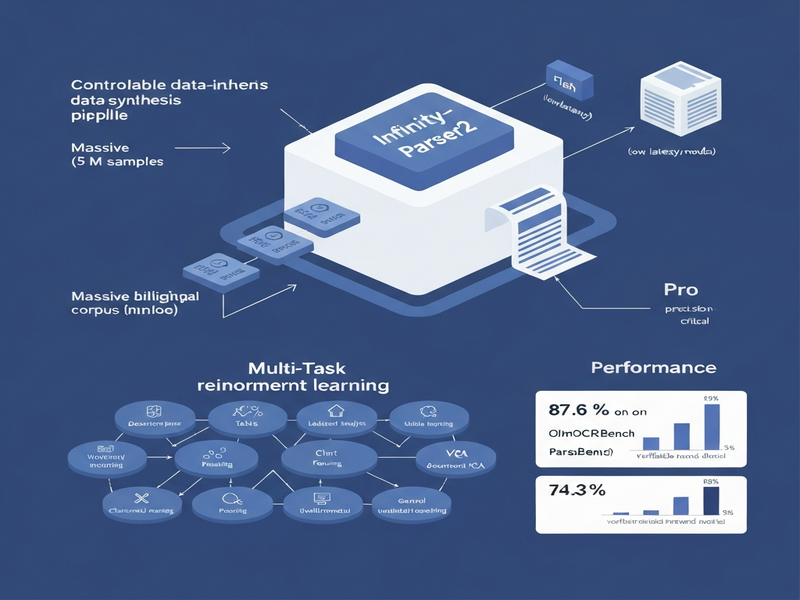
1. Data Synthesis & Rendering
A parameterizable engine assembles document templates (reports, invoices, scientific papers) in both Chinese and English. It injects random variations—font families, noise, distortions, and layout permutations—while simultaneously emitting structured annotations (bounding boxes, Markdown/HTML/LaTeX/SMILES markup, reading order).
2. Iterative Refinement Loop
The synthetic output is evaluated by a lightweight discriminator that flags visual artifacts. Those artifacts guide a second‑stage renderer to adjust lighting, compression, or background textures, gradually closing the realism gap between synthetic and real‑world scans.
3. Joint Reinforcement Learning
The core multimodal transformer receives an image and produces a unified output stream: tokenized text, layout tokens, and structured objects. After each forward pass, a reward calculator checks eight criteria (e.g., IoU for bounding boxes, exact‑match for LaTeX strings). The cumulative reward drives policy gradients that update the model weights.
4. Inference Variants
At deployment, users select either the Flash or Pro variant. Flash trades a modest drop in parsing precision for a 3.68× speed boost, making it suitable for high‑throughput pipelines. Pro retains the full reward‑optimized weights, delivering the highest accuracy for compliance‑critical workloads.
This architecture differs from prior work in two key ways:
- It eliminates the need for separate task‑specific heads; a single decoder emits all required formats.
- The reward is verifiable—each component of the output can be programmatically checked against the ground truth, ensuring transparent optimization.
Evaluation & Results
The authors benchmarked Infinity-Parser2 on three public suites and their own Infinity‑Doc2‑5M test split:
- olmOCR‑Bench. Pro achieved 87.6% accuracy, surpassing DeepSeek‑OCR‑2 (84.1%) and PaddleOCR‑VL‑1.5 (82.7%).
- ParseBench. The model recorded 74.3% F1, outpacing MinerU2.5 (68.9%) and other multimodal baselines.
- Cross‑modal generalization. On unseen chart types and chemical formulas, the joint reward enabled >80% correct extraction without any task‑specific fine‑tuning.
Beyond raw numbers, the experiments demonstrate that a single model can replace a cascade of specialized OCR, table, and formula parsers while delivering higher overall consistency. The synthetic Infinity‑Doc2‑5M corpus—5 million bilingual samples—proved sufficient to close the data gap that has historically limited multimodal parsing research.
Why This Matters for AI Systems and Agents
For developers building AI agents that need to ingest and act on real‑world documents, Infinity-Parser2 offers a turnkey solution:
- Unified perception. Agents no longer need to orchestrate separate OCR, table, and VQA services; a single API call returns a structured representation ready for downstream reasoning.
- Reduced latency. The Flash variant enables near‑real‑time processing, crucial for chat‑based assistants that must answer user queries on the fly.
- Improved reliability. By training on a reward that explicitly checks output correctness, the model exhibits fewer hallucinations—a common pain point for LLM‑driven agents.
- Seamless integration. The model can be wrapped inside the Workflow automation studio, allowing enterprises to chain document parsing with downstream actions such as data entry, compliance checks, or knowledge‑base updates.
In practice, a financial services chatbot could upload a scanned contract, receive a JSON payload describing clauses, tables, and signatures, and then trigger automated compliance workflows—all without stitching together multiple third‑party APIs.
What Comes Next
While Infinity-Parser2 sets a new benchmark, several avenues remain open for exploration:
- Domain adaptation. Fine‑tuning on industry‑specific corpora (e.g., medical records) could further boost accuracy for niche applications.
- Interactive correction. Incorporating human‑in‑the‑loop feedback during inference would allow agents to ask clarifying questions when the reward signal is ambiguous.
- Extended multimodality. Adding audio or video overlays (e.g., narrated presentations) could turn the model into a full‑document media interpreter.
- Open‑source ecosystem. The released Infinity-Parser2 Technical Report includes the Infinity‑Doc2‑5M dataset, inviting the community to build complementary tools such as Enterprise AI platform by UBOS for large‑scale deployment.
Developers interested in rapid prototyping can start by leveraging the UBOS templates for quick start, which now include pre‑configured connectors for the Flash variant. For organizations that need a production‑grade, high‑precision pipeline, the Pro model can be integrated via the UBOS platform overview, ensuring compliance, monitoring, and scaling capabilities out of the box.
Conclusion
Infinity-Parser2 demonstrates that a carefully engineered data‑synthesis engine combined with a multi‑task reinforcement‑learning reward can finally deliver a truly universal document parser. By collapsing eight historically separate tasks into a single, jointly optimized model, it reduces engineering overhead, improves consistency, and pushes the performance frontier on both OCR and structured extraction benchmarks. As enterprises continue to digitize legacy paperwork and AI agents become more document‑aware, the ability to parse complex, multilingual, and multimodal content reliably will be a decisive competitive advantage.
Andrii Bidochko
CTO UBOS
Andrii Bidochko is an AI entrepreneur and researcher focused on AI agents, reinforcement learning, and autonomous systems. He writes about the technologies shaping the future of machine intelligence, from frontier models and agent architectures to real-world AI applications.