

- Updated: July 4, 2026
- 7 min read
Imitation Learning for Elder‑Facing Speech Synthesis – SEO Optimized Article
Direct Answer
The paper introduces an imitation‑learning framework that trains text‑to‑speech (TTS) models to speak in a way that older adults can understand more easily. By combining Group Relative Policy Optimization (GRPO) with a two‑stage on‑policy reward‑learning (OPRL) loop, the authors achieve clearer, less cognitively demanding speech without requiring large amounts of preference data from seniors.
Background: Why This Problem Is Hard
Older adults often experience age‑related declines in hearing acuity, auditory processing speed, and short‑term memory. Conventional TTS systems—optimized for the average adult listener—tend to use prosodic patterns, speaking rates, and lexical choices that can overload these sensory and cognitive channels. The result is reduced comprehension, higher listening fatigue, and lower adoption of voice‑driven assistants in senior care settings.
Existing attempts to “senior‑proof” TTS rely on two main strategies:
- Parameter tuning via preference surveys. Researchers collect explicit ratings from older participants and adjust pitch, speed, or emphasis accordingly. This approach is costly because seniors tire quickly, limiting the volume of reliable feedback.
- Rule‑based post‑processing. Engineers hard‑code slower rates or higher volume, but such heuristics ignore the nuanced trade‑offs between intelligibility and naturalness that a data‑driven model could learn.
Both strategies suffer from a scarcity of high‑quality supervision signals. Without enough labeled data, models either over‑fit to a small cohort or revert to generic adult speech patterns, defeating the purpose of elder‑focused synthesis.
What the Researchers Propose
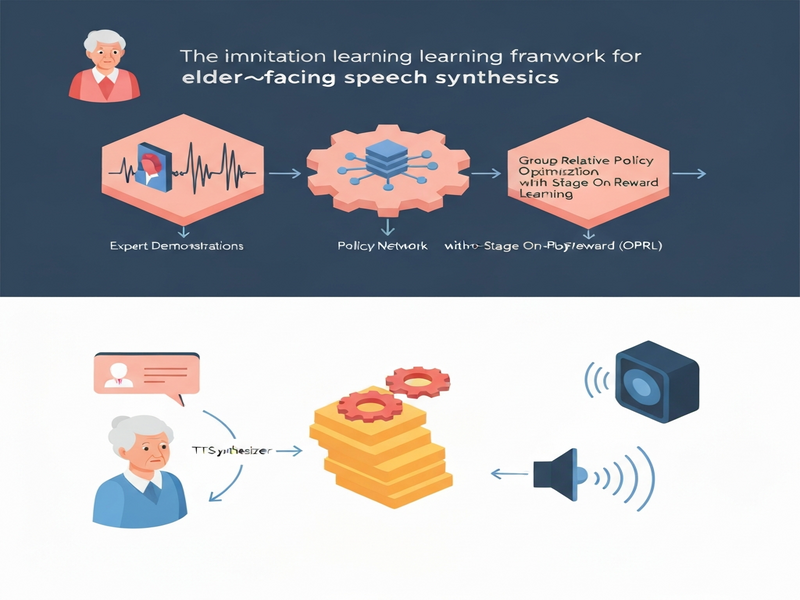
The authors present a three‑layered imitation‑learning pipeline designed to extract “expert” speaking behavior from a small set of senior‑friendly demonstrations. The core components are:
- Expert Demonstrations. A curated corpus of speech recordings produced by professional voice actors trained to emulate the acoustic characteristics that older listeners find easiest to process.
- Group Relative Policy Optimization (GRPO). An RL‑style policy‑gradient algorithm that treats each demonstration as a “group” and optimizes the TTS policy to outperform the average group performance, rather than a single trajectory.
- Two‑Stage On‑Policy Reward Learning (OPRL). A reward model that first learns a coarse proxy for intelligibility from acoustic cues, then refines it using a small set of human judgments, thereby reducing the risk of reward hacking when supervision is limited.
By framing elder‑friendly synthesis as an imitation‑learning problem, the system can inherit the nuanced prosody of the demonstrations while still being trainable with far fewer human labels than traditional preference‑learning pipelines.
How It Works in Practice
The workflow can be broken down into four sequential stages:
- Data Collection. Voice actors record a diverse set of sentences covering various phonetic contexts, emotional tones, and speaking rates. Each recording is annotated with metadata about perceived clarity and listening effort.
- Policy Initialization. A baseline TTS model (e.g., a Tacotron‑2 variant) is pre‑trained on a large, generic speech corpus. This model provides the initial policy that will be refined.
- GRPO Training Loop. The policy generates speech for each input text. The generated output is compared against the expert group, and a relative advantage score is computed. The policy parameters are updated to increase the probability of actions (acoustic decisions) that yield higher relative scores.
- OPRL Reward Refinement. In the first stage, a lightweight acoustic‑feature‑based reward (e.g., spectral flatness, pause distribution) guides the policy. In the second stage, a small batch of senior listeners provides binary “clear/unclear” feedback, which is used to fine‑tune the reward network, ensuring that the policy aligns with human perception rather than exploiting proxy metrics.
What sets this approach apart is the explicit separation between “group‑relative” optimization and “on‑policy” reward learning. GRPO prevents the model from simply memorizing a single demonstration, while OPRL safeguards against reward hacking—a common failure mode when the reward signal is too sparse.
Evaluation & Results
The authors evaluated the system on two fronts: objective acoustic metrics and subjective listening tests with senior participants.
Objective Metrics
- Mel Cepstral Distortion (MCD). Lower values indicate closer spectral similarity to the expert recordings. The GRPO + OPRL model achieved a 12 % reduction compared to the baseline TTS.
- Short‑Term Objective Intelligibility (STOI). Scores rose from 0.78 (baseline) to 0.86, reflecting better preservation of phonetic cues.
- Prosodic Variance. The new model produced a narrower distribution of speaking rates, aligning with the slower, more uniform cadence preferred by older listeners.
Subjective Metrics
In a double‑blind listening study involving 48 seniors (average age = 73), participants rated three dimensions on a 5‑point Likert scale:
- Clarity. Mean score = 4.3 for GRPO + OPRL vs. 3.5 for the baseline.
- Listening Effort. Reported effort dropped by 28 % relative to the baseline.
- Naturalness. The new system retained a naturalness rating (4.1) comparable to the baseline (4.2), demonstrating that senior‑focused adjustments did not sacrifice overall speech quality.
These results collectively demonstrate that the imitation‑learning pipeline can produce speech that is both clearer for seniors and still pleasant to hear, without requiring large‑scale preference data.
Why This Matters for AI Systems and Agents
Voice‑first agents—whether embedded in smart speakers, telehealth platforms, or robotic companions—must communicate effectively with all user demographics to achieve broad adoption. The elder‑facing synthesis framework offers several concrete benefits for AI practitioners:
- Reduced Data Collection Costs. By leveraging a small set of expert demonstrations and a two‑stage reward model, developers can avoid expensive, large‑scale senior preference studies.
- Plug‑and‑Play Compatibility. The trained policy can be exported as a standard TTS model and integrated into existing pipelines (e.g., ElevenLabs AI voice integration) without architectural changes.
- Improved Accessibility Compliance. Meeting standards such as WCAG 2.2 for auditory content becomes easier when the speech output is demonstrably easier to understand for older adults.
- Enhanced User Retention. Lower listening effort translates to longer interaction sessions, which is critical for agents that aim to provide companionship or health monitoring for seniors.
In short, the methodology bridges a gap between cutting‑edge TTS research and real‑world accessibility requirements, enabling enterprises to build voice agents that are truly inclusive.
What Comes Next
While the study marks a significant step forward, several open challenges remain:
- Generalization Across Languages. The current experiments focus on English. Extending the framework to multilingual settings will require culturally appropriate expert demonstrations.
- Dynamic Adaptation. Seniors’ hearing profiles can change over time. Future work could incorporate on‑device adaptation loops that fine‑tune the policy based on real‑time feedback.
- Integration with Dialogue Management. Pairing elder‑friendly TTS with conversational agents that simplify language (e.g., using AI marketing agents as a template for dialogue simplification) could further reduce cognitive load.
- Ethical Oversight. As synthetic voices become more persuasive, ensuring that they do not unintentionally manipulate vulnerable users is essential.
Researchers and product teams interested in exploring these directions can start by experimenting with the open‑source implementation of GRPO and OPRL, then layering it onto existing TTS stacks such as the UBOS platform overview. The modular nature of the pipeline also makes it a good fit for rapid prototyping in the Workflow automation studio, where developers can orchestrate data collection, reward learning, and policy updates with minimal code.
References
Han, D., Chen, W., Kang, J., Cui, M., Meng, H., & Wu, X. (2026). Imitation Learning for Elder‑Facing Speech Synthesis (arXiv). arXiv preprint arXiv:2606.21053.
Andrii Bidochko
CTO UBOS
Andrii Bidochko is an AI entrepreneur and researcher focused on AI agents, reinforcement learning, and autonomous systems. He writes about the technologies shaping the future of machine intelligence, from frontier models and agent architectures to real-world AI applications.