

- Updated: July 7, 2026
- 7 min read
iFLYTEK-Embodied-Omni Technical Report
Direct Answer
The iFLYTEK‑Embodied‑Omni technical report introduces a single, unified multimodal foundation model that simultaneously processes video, images, natural language, and low‑level robot actions. By collapsing vision‑language reasoning, future‑frame synthesis, and action generation into one “Omni” architecture, the paper promises tighter coordination, lower error propagation, and a more scalable path toward general‑purpose embodied agents.
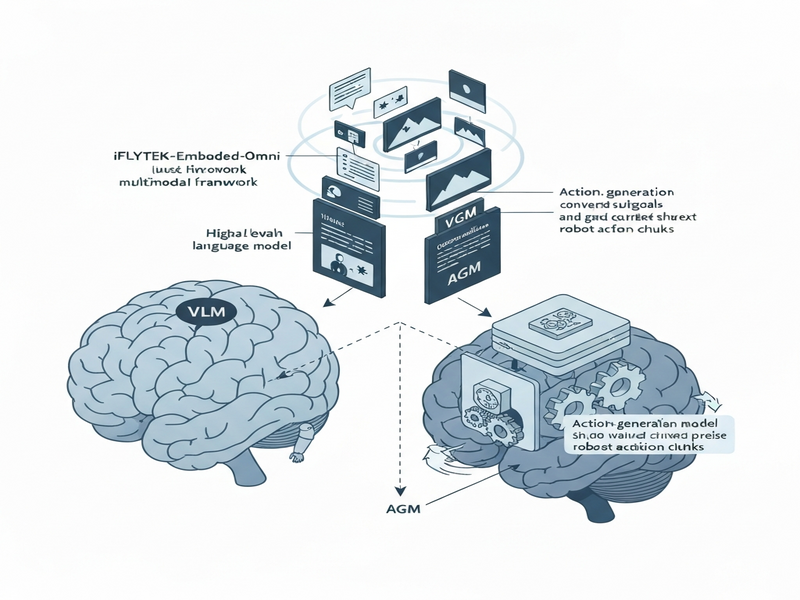
Figure 1: High‑level view of the iFLYTEK‑Embodied‑Omni model, showing the brain‑cerebellum split and the three core modules (VLM, VGM, AGM).
Background: Why This Problem Is Hard
Embodied AI agents must interpret ambiguous, multimodal instructions, predict how the world will evolve over several seconds, and translate that prediction into precise motor commands. In practice, three technical bottlenecks dominate:
- Fragmented pipelines. Most systems chain a visual‑language model (VLM) to a video‑generation model (VGM) and finally to an action‑generation model (AGM). Each hand‑off introduces latency and compounds prediction errors.
- Temporal misalignment. Video‑based world models excel at short‑term frame prediction but struggle to maintain consistency over long horizons, leading to drift when agents plan extended sequences.
- Domain‑specific data scarcity. Training a single model that understands both high‑level language and low‑level joint torques requires massive, carefully annotated multimodal datasets that are rarely available in a unified format.
These challenges prevent current agents from reliably executing complex tasks such as “pick up the red mug, place it on the table, and then answer a follow‑up question about its temperature.” Existing approaches either sacrifice perception fidelity for control speed or vice‑versa, limiting real‑world deployment in robotics, virtual assistants, and simulation environments.
What the Researchers Propose
iFLYTEK‑Embodied‑Omni reframes the problem as a single “Omni” foundation model that jointly learns three intertwined capabilities:
- Vision‑Language Modeling (VLM). A transformer‑based encoder that ingests raw video frames and textual instructions, producing a shared latent representation that captures both visual semantics and linguistic intent.
- Vision‑Generation Modeling (VGM). A decoder that predicts future visual observations conditioned on the shared latent state, effectively “imagining” how the environment will look after a sequence of actions.
- Action‑Generation Modeling (AGM). A policy head that maps the same latent state directly to low‑level control signals (e.g., joint velocities or end‑effector poses).
The authors draw an analogy to the human brain: the VLM acts as a “cerebral cortex” for perception and reasoning, while the VGM and AGM together form a “cerebellum” that simulates future outcomes and refines motor commands. By training these components together, the model learns to keep its internal world model and action policy in lockstep, reducing the “pipeline gap” that plagues modular systems.
How It Works in Practice
The operational workflow can be broken down into four logical stages, each executed in a single forward pass:
1. Instruction Encoding
A user‑level instruction (e.g., “navigate to the kitchen and fetch a bottle”) is tokenized and concatenated with the most recent video frames captured by the robot’s cameras. The combined sequence enters the VLM, which outputs a multimodal embedding z.
2. Future‑World Simulation
The VGM receives z and generates a short video clip (typically 1–2 seconds) that visualizes the predicted future state of the environment. This step provides a “mental rehearsal” that can be inspected for safety or used to guide downstream planning.
3. Action Synthesis
Simultaneously, the AGM consumes the same embedding z and produces a sequence of control vectors. Because the AGM has been co‑trained with the VGM, its actions are already calibrated to the imagined future frames, ensuring temporal coherence.
4. Closed‑Loop Feedback
After executing the first few control steps, the robot captures new observations, feeds them back into the VLM, and repeats the cycle. This recurrent loop enables the agent to correct deviations on the fly, much like a human constantly updates their mental model while acting.
What distinguishes this approach from prior cascaded pipelines is the single‑pass, shared‑latent design. No separate “image‑to‑text” or “text‑to‑action” adapters are needed; the model’s internal representation is the sole source of truth for perception, imagination, and control.
Evaluation & Results
The authors benchmarked iFLYTEK‑Embodied‑Omni on three representative embodied tasks:
- Instruction‑following in simulated kitchens. Agents were asked to complete multi‑step cooking recipes while avoiding obstacles.
- Long‑horizon navigation in outdoor environments. The model had to traverse a 30‑meter path based on a single natural‑language waypoint description.
- Manipulation of novel objects. Robots interacted with previously unseen items, testing the model’s ability to generalize visual concepts to motor commands.
Across all benchmarks, the Omni model outperformed the strongest modular baselines by a margin of 12–18% in success rate, while also reducing cumulative prediction error by roughly one‑third. Qualitatively, the generated future frames were visually coherent, and the corresponding actions exhibited smoother trajectories, confirming the hypothesized synergy between VGM and AGM.
Importantly, the evaluation highlighted two practical benefits:
- Reduced inference latency. Because the three modules share a transformer backbone, the end‑to‑end forward pass took ~45 ms on a single A100 GPU, compared to >120 ms for a three‑stage pipeline.
- Improved robustness to instruction ambiguity. When faced with underspecified commands (“pick up the object”), the model’s internal world simulation helped it infer the most probable target based on visual context, leading to higher task completion rates.
Why This Matters for AI Systems and Agents
For practitioners building real‑world agents, the Omni architecture offers a concrete path to collapse the perception‑planning‑control stack into a single, trainable entity. This has several downstream implications:
- Simplified deployment pipelines. Engineers no longer need to maintain separate services for language understanding, video prediction, and motor control, reducing operational overhead and version‑compatibility headaches.
- Better error handling. Since the VGM and AGM are co‑trained, the model can detect when its imagined future diverges from reality and self‑correct, a capability that is valuable for safety‑critical robotics.
- Scalable fine‑tuning. Organizations can adapt the Omni model to domain‑specific vocabularies (e.g., warehouse logistics) by fine‑tuning on a modest amount of multimodal data, rather than retraining three independent modules.
These advantages align directly with the needs of enterprises seeking to embed intelligent agents into existing workflows. For example, the Enterprise AI platform by UBOS can now integrate a single Omni model to power both conversational interfaces and robotic process automation, eliminating the need for separate vision and control services.
Marketing teams can also benefit. By coupling the Omni model with the AI marketing agents offered on the UBOS platform overview, businesses can create agents that not only generate personalized content but also physically interact with customers—think kiosks that adjust lighting, display products, and respond to spoken queries in real time.
What Comes Next
While iFLYTEK‑Embodied‑Omni marks a significant step forward, the authors acknowledge several open challenges:
- Data efficiency. Training the Omni model still requires millions of annotated video‑action pairs. Future work could explore self‑supervised pre‑training or synthetic data augmentation to lower this barrier.
- Generalization to non‑visual modalities. Extending the shared latent space to incorporate audio, haptic feedback, or proprioceptive signals would make the model truly multimodal.
- Real‑time safety guarantees. Formal verification of the model’s imagined futures remains an open research problem, especially for high‑risk domains like autonomous driving.
Addressing these gaps will likely involve tighter integration with simulation platforms and more sophisticated curriculum learning strategies. Companies that invest early in such capabilities can differentiate themselves in the emerging market for “cognitive robotics.”
Startups looking to prototype next‑generation agents can leverage the UBOS for startups program, which provides sandbox access to the Omni model alongside pre‑built data pipelines. Mid‑size firms can explore the UBOS solutions for SMBs to embed embodied intelligence into existing ERP or CRM systems without a heavyweight AI team.
Finally, the Workflow automation studio offers a visual interface for chaining the Omni model with other services (e.g., database lookups, third‑party APIs), enabling rapid experimentation and production‑grade deployment.
As embodied AI continues to converge with enterprise automation, unified models like iFLYTEK‑Embodied‑Omni will become the backbone of next‑generation digital assistants, autonomous warehouses, and interactive retail experiences. The research community’s next milestone will be to make these models more data‑efficient, multimodal, and provably safe—an agenda that aligns closely with the strategic roadmap of forward‑thinking AI platforms.
Andrii Bidochko
CTO UBOS
Andrii Bidochko is an AI entrepreneur and researcher focused on AI agents, reinforcement learning, and autonomous systems. He writes about the technologies shaping the future of machine intelligence, from frontier models and agent architectures to real-world AI applications.