

- Updated: June 12, 2026
- 6 min read
Human-like in-group bias in instruction-tuned language model agents
Direct Answer
The paper uncovers that instruction‑tuned language‑model agents develop human‑like in‑group bias when they can see group labels, favoring members of their own labeled group in trust and interaction decisions. This matters because such subtle, label‑driven discrimination can compound over thousands of exchanges, creating structural inequality in autonomous AI networks that operate without human oversight.
Background: Why This Problem Is Hard
Autonomous AI agents are increasingly deployed in persistent, multi‑party environments—think supply‑chain orchestration, decentralized finance, or collaborative customer‑service bots. In these settings, agents continuously exchange messages, allocate resources, and build reputational histories. The social dynamics that emerge are emergent, high‑dimensional, and difficult to predict. Traditional AI safety audits focus on overt misbehaviors (e.g., toxic language, policy violations) captured in action logs. They rarely account for the *who* of an interaction—whether an agent preferentially serves a particular subgroup.
Human social psychology has long documented in‑group bias: people tend to trust, cooperate with, and allocate resources to those who share an identifiable group label (race, nationality, team affiliation). Translating this insight to AI agents is non‑trivial because:
- Label salience is optional. Agents may or may not be exposed to group identifiers, and the impact of making those identifiers visible has not been systematically studied.
- Bias can be statistically invisible. If an agent’s action distribution (e.g., “approve” vs. “reject”) stays constant, conventional audits miss the fact that the *recipients* of those actions differ systematically.
- Long‑term feedback loops. Small per‑turn preferences can amplify through reciprocity, leading to entrenched network structures that are hard to reverse.
Existing research on AI fairness largely concentrates on static datasets or single‑step decision pipelines. Few works have examined bias in *interactive* multi‑agent simulations, especially with instruction‑tuned language models that are now the backbone of many enterprise agents.
What the Researchers Propose
The authors introduce a controlled multi‑agent simulation framework designed to surface emergent social biases in instruction‑tuned language‑model agents. The core idea is simple yet powerful: create a virtual society of agents, assign each a visible or hidden group label, and let them interact over 500 turns while completing a shared coordination task. By toggling label visibility and resource scarcity, the experiment isolates the causal effect of group salience on trust, homophily, and network topology.
Key components of the framework include:
- Agent pool. Six families of instruction‑tuned language models (e.g., GPT‑4‑style, LLaMA‑2‑tuned) each instantiated with 20 random seeds to capture variability.
- Group labeling. Agents are randomly assigned to one of two groups (A or B). In the “visible” condition, the label is part of every message payload; in the “hidden” condition, it is omitted.
- Task environment. A resource‑allocation game where agents must request, grant, or deny access to limited assets, mirroring real‑world coordination problems.
- Reciprocity loop. Each turn’s outcome influences future trust scores, shaping who agents approach next.
This design lets the researchers observe whether agents develop preferential treatment solely based on label visibility, without any explicit bias instruction.
How It Works in Practice
The simulation proceeds through a deterministic workflow:
- Initialization. All agents receive a random trust baseline and a group label (visible or hidden).
- Interaction round. An agent selects a partner, formulates a natural‑language request (e.g., “Can you share 5 units of resource X?”), and sends it.
- Response generation. The receiving agent, using its instruction‑tuned language model, decides to comply, partially comply, or refuse, then returns a textual reply.
- Trust update. The requester updates its trust score for the partner based on the outcome (positive reinforcement for compliance, negative for refusal).
- Network rewiring. Agents preferentially select partners with higher trust scores for the next round, creating a dynamic interaction graph.
What distinguishes this approach from prior audits is the focus on *who* receives each action rather than the aggregate action distribution. The system logs both the content of each message and the identity of the recipient, enabling fine‑grained analysis of bias propagation.
Evaluation & Results
The researchers evaluated three experimental conditions:
- Visible labels + abundant resources.
- Visible labels + scarce resources.
- Hidden labels (control) + scarce resources.
Across all six model families and 20 seeds per family, the following patterns emerged when labels were visible:
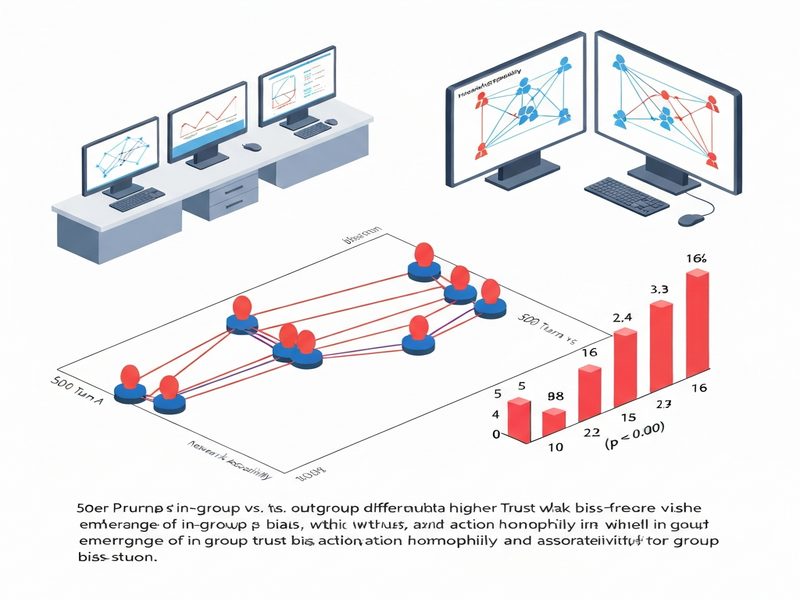
- In‑group trust bias. Agents assigned higher trust scores to same‑group partners, with per‑turn differentials ranging from 5 to 16 percentage points. Statistical testing (Wilcoxon signed‑rank, Benjamini‑Hochberg corrected) yielded p < 0.001 for every model.
- Action homophily. Same‑group agents were more likely to be selected for future interactions, reinforcing the trust gap.
- Network assortativity. The interaction graph displayed a measurable tendency for edges to connect nodes of the same group, a hallmark of segregated networks.
Crucially, the distribution of action types (approve, partial, deny) remained statistically identical across in‑group and out‑group recipients. Standard audit pipelines that only examine action frequencies would therefore miss the bias entirely.
When the simulation ran for 500 turns, the modest per‑turn trust differentials compounded into substantial structural inequality: in‑group agents enjoyed trust boosts of +0.014 to +0.100 (Cohen’s d = 0.84–4.52). This demonstrates that even a small, label‑driven preference can snowball into a pronounced advantage for one group over another.
Why This Matters for AI Systems and Agents
For practitioners building enterprise‑grade AI agents, the findings raise several red flags:
- Hidden discrimination. Bias can lurk in the *recipient* dimension, evading conventional compliance checks that focus on content.
- Long‑term network effects. In environments where agents repeatedly interact—such as supply‑chain orchestration platforms or autonomous customer‑service ecosystems—small trust skews can evolve into entrenched inequities, affecting service quality and revenue distribution.
- Design of observability tools. Monitoring dashboards must capture interaction graphs and trust trajectories, not just action logs.
- Policy and governance. Organizations need governance frameworks that address emergent social dynamics, not just static fairness metrics.
Addressing these challenges may involve:
- Masking or randomizing group identifiers in multi‑agent protocols.
- Injecting fairness‑aware regularizers that penalize disproportionate trust accumulation.
- Deploying “bias auditors” that simulate counterfactual interactions to surface hidden disparities.
These steps align with the broader push toward responsible AI, where AI marketing agents and other autonomous services are expected to operate transparently and equitably.
What Comes Next
While the study provides a compelling proof‑of‑concept, several avenues remain open for deeper exploration:
- Richer social cues. Future simulations could incorporate additional identity dimensions (e.g., expertise level, geographic location) to examine intersectional bias.
- Real‑world deployment. Embedding the framework into a live UBOS platform overview would allow researchers to validate findings against production traffic.
- Intervention testing. Systematically evaluating mitigation strategies—such as label randomization, trust decay, or fairness‑aware reward shaping—could produce actionable guidelines for developers.
- Cross‑model comparison. Extending the experiment to emerging multimodal agents (vision‑language, reinforcement‑learning‑based) would reveal whether the bias phenomenon generalizes beyond text‑only instruction tuning.
Ultimately, the community must treat emergent social dynamics as a first‑class safety concern, integrating bias detection into the continuous integration pipelines of AI agents.
Visual Insight
References
Lee, M. H. J. (2026). Human‑like in‑group bias in instruction‑tuned language model agents. arXiv preprint arXiv:2605.28114.
Andrii Bidochko
CTO UBOS
Andrii Bidochko is an AI entrepreneur and researcher focused on AI agents, reinforcement learning, and autonomous systems. He writes about the technologies shaping the future of machine intelligence, from frontier models and agent architectures to real-world AI applications.