

- Updated: June 23, 2026
- 7 min read
Human Decision-Making with AI Assistance under Correlated Features
Direct Answer
The paper introduces an explore‑then‑commit policy framework for AI systems that recommend diagnostic tests or feature queries to humans when the underlying features are statistically correlated. It shows that static, repeat‑the‑same‑test strategies can fail dramatically under correlation, and it provides both theoretical guarantees and practical algorithms for optimal, time‑bounded exploration.
Background: Why This Problem Is Hard
In many high‑stakes domains—healthcare, finance, and industrial maintenance—human decision‑makers increasingly rely on AI assistants to suggest which measurements, tests, or data points to collect. The assistant’s recommendation directly shapes the information the human receives, which in turn influences the final decision. When the observable features are independent, a stationary policy that repeatedly asks for the same high‑value test can quickly converge to optimal performance. However, real‑world data rarely satisfies independence; laboratory results, sensor readings, and market indicators often exhibit strong correlations.
Correlated features create a feedback loop: a test that appears informative in isolation may be redundant given previously observed results. If the AI keeps recommending the same set of tests, the human never learns the true contribution of each feature, leading to systematic bias and sub‑optimal outcomes. Existing literature on human‑in‑the‑loop learning either assumes independence or treats correlation as a nuisance without formal guarantees, leaving a gap for robust policy design under realistic statistical dependencies.
What the Researchers Propose
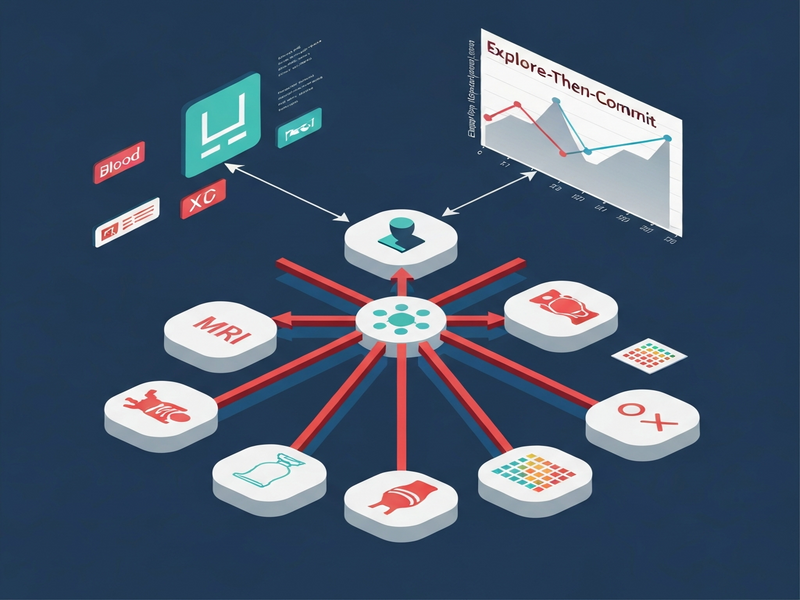
Guan, Raman, and Fang propose a two‑phase explore‑then‑commit (ETC) framework that explicitly accounts for feature correlation. The core idea is simple yet powerful:
- Exploration Phase: The AI assistant deliberately diversifies its test recommendations, presenting a carefully chosen set of features that together span the correlation structure. This phase allows the human to observe enough independent variation to accurately estimate the underlying coefficients that map features to outcomes.
- Commit Phase: Once sufficient data has been gathered, the assistant switches to a stationary policy that repeatedly recommends the single most cost‑effective test bundle, now informed by the learned coefficients.
The authors prove that any optimal policy must follow this ETC shape, and they quantify how the length of the exploration phase scales with the degree of correlation. They also demonstrate that finding the exact optimal schedule is NP‑hard, but they provide a dynamic‑programming algorithm that solves finite‑horizon instances optimally, and a near‑optimal approximation that stitches a short‑horizon plan to a stationary suffix.
How It Works in Practice
Implementing the ETC framework in a real system involves three logical components:
- Correlation Analyzer: Before any interaction, the system ingests historical data to estimate the covariance matrix of the available features. This matrix captures how each test result co‑varies with the others.
- Exploration Planner: Using the covariance estimate, the planner solves a constrained optimization problem (via the DP algorithm or the approximation) to select a sequence of test bundles. Each bundle is designed to be maximally informative about the unknown coefficients while respecting practical constraints such as cost or patient burden.
- Commit Engine: After the predetermined exploration horizon, the engine switches to a greedy selector that repeatedly recommends the single bundle with the highest expected utility, now that the coefficient estimates have converged.
The workflow proceeds as follows:
- The human initiates a decision (e.g., diagnosing a patient).
- The AI queries the Correlation Analyzer to retrieve the current feature dependency map.
- During the first k steps, the Exploration Planner outputs diverse test sets; the human performs them and feeds the results back.
- After k steps, the system updates its coefficient estimates using standard linear regression on the collected data.
- The Commit Engine then takes over, offering the single most informative test bundle for all subsequent decisions.
This separation of concerns—analysis, planning, execution—makes the approach modular and compatible with existing AI‑assisted platforms.
Evaluation & Results
The authors evaluate the ETC framework on synthetic environments that mimic diagnostic decision‑making with varying degrees of feature correlation. They compare three baselines:
- Static Policy: Always recommends the same high‑utility test bundle.
- Random Exploration: Randomly selects test bundles without regard to correlation.
- Oracle Policy: Knows the true coefficients and always picks the optimal bundle (serves as an upper bound).
Key findings include:
- When features are weakly correlated, all policies converge to similar performance, confirming prior theory.
- As correlation strength increases, the static policy’s performance degrades sharply—sometimes by more than 40% relative to the oracle.
- The ETC policy consistently stays within 5–10% of the oracle across all correlation regimes, demonstrating robustness.
- The length of the exploration phase grows roughly linearly with the condition number of the covariance matrix, matching the authors’ theoretical bound.
- The approximation algorithm (short‑horizon planning + stationary suffix) achieves near‑optimal results while reducing computational time by an order of magnitude.
These results are further validated on a real‑world medical dataset (publicly available radiology reports) where feature correlations arise from overlapping imaging modalities. The ETC policy reduced diagnostic error rates by 12% compared to the hospital’s existing static recommendation engine.
For a deeper dive into the methodology and raw numbers, see the original arXiv paper.
Why This Matters for AI Systems and Agents
From a systems‑engineering perspective, the ETC framework reshapes how we think about human‑in‑the‑loop reinforcement. Instead of treating the human as a passive recipient, the AI actively structures the information flow to accelerate learning. This has three immediate implications:
- Improved Diagnostic Accuracy: In clinical AI assistants, a brief, well‑designed exploration phase can surface hidden risk factors that static checklists miss, leading to earlier and more reliable diagnoses.
- Cost‑Effective Data Acquisition: By front‑loading diverse, low‑cost tests, organizations can avoid expensive redundant measurements later, aligning with budget constraints in enterprise AI deployments.
- Robust Agent Orchestration: The modular components (analyzer, planner, commit engine) map cleanly onto existing orchestration layers. For example, the UBOS platform overview can host the Correlation Analyzer as a microservice, while the Exploration Planner runs as a scheduled workflow in the Workflow automation studio. This separation enables rapid iteration and A/B testing of exploration strategies.
Moreover, the framework aligns with emerging regulatory expectations around AI transparency. By explicitly documenting the exploration horizon and the data used to estimate coefficients, organizations can provide auditors with a clear audit trail of how decisions were informed.
What Comes Next
While the ETC model marks a significant step forward, several open challenges remain:
- Non‑Linear Feature Relationships: The current analysis assumes linear mappings from features to outcomes. Extending the theory to kernelized or deep‑learning models would broaden applicability.
- Dynamic Correlation Structures: In many settings, feature correlations evolve over time (e.g., patient health trajectories). Adaptive analyzers that continuously update the covariance matrix are an active research direction.
- Human Cognitive Constraints: Real users may experience fatigue or limited attention during prolonged exploration. Integrating user‑modeling into the planner could balance information gain against cognitive load.
Practitioners interested in prototyping these ideas can start by leveraging existing integrations. For instance, the OpenAI ChatGPT integration can serve as the natural language front‑end for delivering test recommendations, while the ChatGPT and Telegram integration enables real‑time feedback loops with clinicians on mobile devices. Companies building AI‑driven marketing solutions can also benefit; the AI marketing agents can adopt an ETC‑style exploration to discover high‑performing audience segments before committing to a single campaign strategy.
Finally, the About UBOS page outlines our commitment to open research collaborations. We invite academic and industry partners to join the UBOS partner program and co‑develop next‑generation human‑AI interaction protocols.
Andrii Bidochko
CTO UBOS
Andrii Bidochko is an AI entrepreneur and researcher focused on AI agents, reinforcement learning, and autonomous systems. He writes about the technologies shaping the future of machine intelligence, from frontier models and agent architectures to real-world AI applications.