

- Updated: June 16, 2026
- 6 min read
Human-AI Collaboration for Estimating Scientific Replicability
Direct Answer
The paper introduces a hybrid prediction‑market framework where algorithmic agents trade alongside human participants to forecast the replicability of published scientific findings. By blending data‑driven models with real‑time expert intuition, the approach consistently matches or exceeds the accuracy of purely human or purely artificial markets, offering a scalable path to more reliable reproducibility assessments.
Background: Why This Problem Is Hard
Scientific replicability sits at the core of empirical progress, yet the global research ecosystem struggles to verify results efficiently. Traditional replication studies are costly, time‑consuming, and often limited to high‑profile papers, leaving a vast majority of findings unchecked. Consequently, the literature accumulates false positives, eroding trust and diverting resources.
Two dominant assessment strategies have emerged. First, expert panels apply domain knowledge to judge credibility, but human judgment is vulnerable to cognitive biases, limited exposure to the full breadth of literature, and inconsistent standards across fields. Second, machine‑learning models ingest metadata—titles, abstracts, citation networks—to predict reproducibility, yet they frequently miss nuanced contextual cues such as experimental design subtleties or methodological rigor that seasoned researchers spot. Both approaches, in isolation, fall short of delivering the breadth and depth needed for systematic reproducibility monitoring.
What the Researchers Propose
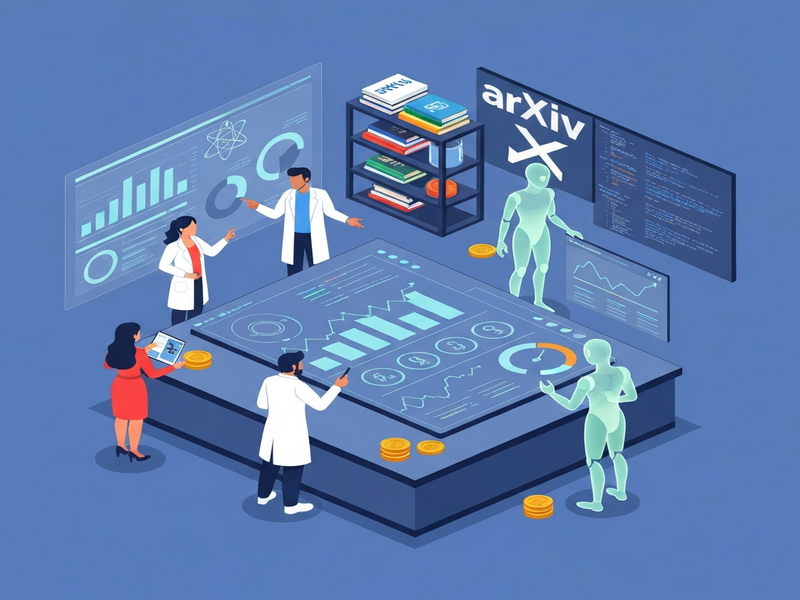
The authors propose a hybrid prediction market that unites algorithmic agents with human traders in a shared trading environment. In this market, each participant—whether a neural model or a domain expert—places bets on the probability that a specific study will replicate successfully. The market price, dynamically adjusted by supply and demand, aggregates these diverse signals into a single, calibrated forecast.
Key components of the framework include:
- Algorithmic agents: Trained on a curated dataset of hundreds of past replication outcomes, these agents learn statistical patterns linking paper attributes to replicability.
- Human participants: Researchers or graduate students from the relevant discipline contribute real‑time intuition, leveraging their subject‑matter expertise.
- Market engine: A continuous double‑auction mechanism that matches buy and sell orders, updates prices, and records transaction histories for later analysis.
- Feedback loop: After a controlled replication study concludes, the actual outcome is fed back to both agents and humans, enabling model retraining and participant learning.
How It Works in Practice
At the start of a forecasting round, a set of target papers—selected from recent publications across multiple disciplines—is posted to the market platform. Each paper is accompanied by its abstract, citation metadata, and any available methodological details. Algorithmic agents automatically generate initial price signals based on learned patterns, while human traders review the same information and place their own bids or asks reflecting confidence levels.
The market engine continuously matches opposing orders. If many participants believe a study is likely to replicate, the price rises toward 1 (high probability); if skepticism dominates, the price drifts toward 0. Crucially, the price itself becomes a communication channel: agents can observe human‑driven price movements and adjust their internal predictions, while humans can see aggregated algorithmic confidence and refine their judgments.
Once the market closes—typically after a predefined trading window—the final price is recorded as the hybrid forecast. The actual replication outcome, obtained from a controlled experimental follow‑up, is then disclosed. Researchers compare the forecast against the ground truth, and the discrepancy informs both model updates (for agents) and educational feedback (for human participants).
Evaluation & Results
To validate the hybrid market, the authors conducted three live experiments spanning psychology, biomedical research, and computer science. Each experiment recruited 30–50 participants with varying levels of expertise and ran parallel prediction markets for 100 papers per discipline. The performance of three configurations was measured:
- Human‑only market: Trades executed solely by participants.
- AI‑only market: Trades executed solely by algorithmic agents.
- Hybrid market: Combined human and AI trading.
Across all domains, the hybrid market achieved the lowest Brier scores—a proper scoring rule that penalizes inaccurate probability forecasts—indicating superior calibration. In psychology, the hybrid’s average Brier score was 0.12 versus 0.18 for human‑only and 0.16 for AI‑only. Similar gaps appeared in biomedical and computer‑science settings. Moreover, the hybrid approach demonstrated greater robustness: performance remained stable even when the participant pool was reduced or when agents were trained on a limited subset of prior replication data.
Statistical analysis confirmed that the improvements were significant (p < 0.01) and not merely artifacts of sample size. The authors also observed that human participants adjusted their trading behavior over time, gradually aligning with algorithmic signals that proved reliable, suggesting a learning effect facilitated by the market’s feedback loop.
Why This Matters for AI Systems and Agents
For AI practitioners building decision‑support tools, the hybrid prediction‑market model offers a concrete blueprint for integrating human expertise without sacrificing scalability. By treating human intuition as a tradable asset, developers can quantify and continuously refine the contribution of domain experts, turning qualitative judgments into measurable signals that improve model performance.
Agent designers can adopt the market engine as an orchestration layer, allowing multiple specialized models—e.g., citation‑network analyzers, methodological checkers, and language‑model summarizers—to compete and collaborate in real time. This competitive‑cooperative dynamic mirrors successful approaches in finance and crowdsourcing, where diverse predictors collectively outperform any single source.
From an operational standpoint, the framework aligns with emerging UBOS platform overview, which emphasizes modular AI pipelines and real‑time data exchange. Embedding a hybrid market within such a platform could enable enterprises to assess the reliability of internal research reports, patent filings, or market analyses before committing resources.
Furthermore, the approach illustrates a pathway toward trustworthy AI: by exposing model predictions to human scrutiny and allowing humans to influence market outcomes, the system creates a transparent audit trail. This transparency is essential for compliance regimes that demand explainability in high‑stakes decision making.
What Comes Next
While the results are promising, several limitations warrant further investigation. The current agents rely heavily on historical replication outcomes, which may bias them toward well‑studied domains and underrepresent emerging fields. Expanding the training corpus to include pre‑registration data, open‑lab notebooks, and negative results could improve generalization.
Future research should also explore richer interaction modalities. For instance, integrating ChatGPT and Telegram integration would let participants discuss papers in a conversational thread while the market updates in the background, potentially surfacing collective reasoning patterns.
Another avenue is to couple the hybrid market with a Enterprise AI platform by UBOS that automates the ingestion of new publications, triggers market creation, and visualizes forecast trajectories for stakeholders. Such end‑to‑end automation could transform reproducibility monitoring from an occasional academic exercise into a continuous service for research institutions and funding agencies.
Finally, the authors acknowledge the need for ethical safeguards. Trading mechanisms must prevent manipulation, ensure participant anonymity, and provide equitable credit for human contributions. Designing incentive structures that reward accurate forecasting without encouraging speculative betting will be crucial for long‑term adoption.
For readers interested in diving deeper, the full methodological details and data are available in the original arXiv paper. Exploring this work can inspire new hybrid systems that blend AI speed with human insight across domains ranging from drug discovery to policy analysis.
Andrii Bidochko
CTO UBOS
Andrii Bidochko is an AI entrepreneur and researcher focused on AI agents, reinforcement learning, and autonomous systems. He writes about the technologies shaping the future of machine intelligence, from frontier models and agent architectures to real-world AI applications.